Ch. 3 - Derivatives
Briggs - Calculus: Early Transcendentals 3rd Edition
Briggs3rd EditionCalculus: Early TranscendentalsISBN: 9780136847243Non è quello che usi tu?Cambia libro di testo
Capitolo 3, Problema 3.1.63c

Another way to approximate derivatives is to use the centered difference quotient: f' (a) ≈ f(a+h) - f(a- h) / 2h. Again, consider f(x) = √x.
c. Explain why it is not necessary to use negative values of h in the table of part (b).

Guida verificata passo dopo passo
1
Step 1: Understand the centered difference quotient formula: The centered difference quotient is given by \( f'(a) \approx \frac{f(a+h) - f(a-h)}{2h} \). This formula is used to approximate the derivative of a function at a point \( a \).
Step 2: Recognize the role of \( h \): In the formula, \( h \) is a small positive number that represents a small change in \( x \). The choice of \( h \) affects the accuracy of the approximation.
Step 3: Consider symmetry in the formula: The centered difference quotient uses both \( f(a+h) \) and \( f(a-h) \), which means it inherently considers both positive and negative changes around \( a \).
Step 4: Analyze the effect of negative \( h \): Using a negative \( h \) would simply reverse the roles of \( f(a+h) \) and \( f(a-h) \), but since the formula already accounts for both directions, negative values of \( h \) are redundant.
Step 5: Conclude on the necessity of negative \( h \): Since the centered difference quotient already incorporates both forward and backward differences through its symmetric structure, using negative values of \( h \) does not provide additional information or improve the approximation.

Risposta video verificata per un problema simile:

Questa soluzione video è stata consigliata dai nostri tutor come utile per risolvere questo problema.
Durata del video:
5m

Concetti chiave

Ecco i concetti essenziali che devi comprendere per rispondere correttamente alla domanda.

Centered Difference Quotient

The centered difference quotient is a method for approximating the derivative of a function at a point by averaging the slopes of secant lines on either side of that point. It is defined as f'(a) ≈ (f(a+h) - f(a-h)) / (2h), where h is a small positive value. This approach provides a more accurate estimate of the derivative compared to the forward or backward difference quotients, especially when h is small.
Video consigliato:
06:43
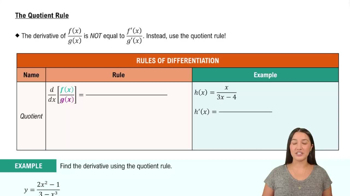
The Quotient Rule

Symmetry in Function Values

When using the centered difference quotient, the function values f(a+h) and f(a-h) are symmetrically located around the point a. This symmetry means that the contributions of positive and negative h values effectively cancel out any asymmetries in the function's behavior at a, allowing for a more accurate approximation of the derivative without needing to consider negative h values.
Video consigliato:
Percorso guidato
06:37
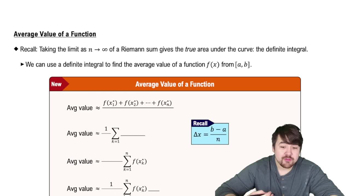
Average Value of a Function

Behavior of the Function Near a Point

The behavior of the function f(x) near the point a is crucial for understanding why negative values of h are unnecessary. If the function is continuous and differentiable at a, the values of f(a+h) and f(a-h) will converge to the same limit as h approaches zero. Thus, using only positive h values suffices to capture the local behavior of the function around a, ensuring a reliable approximation of the derivative.
Video consigliato:
04:50
Critical Points
Pratica correlata
Domanda del libro di testo

Derivatives of inverse functions from a table Use the following tables to determine the indicated derivatives or state that the derivative cannot be determined. <IMAGE>

c. (f^-1)'(1)

167
views

Domanda del libro di testo

{Use of Tech} Spring runoff The flow of a small stream is monitored for 90 days between May 1 and August 1. The total water that flows past a gauging station is given by v(t) = <matrix 2x2> where V is measured in cubic feet and t is measured in days, with t=0 corresponding to May 1.

c. Describe the flow of the stream over the 3-month period. Specifically, when is the flow rate a maximum?

218
views
Domanda del libro di testo

Highway travel A state patrol station is located on a straight north-south freeway. A patrol car leaves the station at 9:00 A.M. heading north with position function s = f(t) that gives its location in miles t hours after 9:00 A.M. (see figure). Assume s is positive when the car is north of the patrol station. <IMAGE>

c. Find the average velocity of the car over the interval [1.75, 2.25]. Estimate the velocity of the car at 11:00 A.M. and determine the direction in which the patrol car is moving.

239
views
Domanda del libro di testo

Computing the derivative of f(x) = e^-x

c. Use parts (a) and (b) to find the derivative of f(x) = e^-x.

255
views
Domanda del libro di testo

Suppose a stone is thrown vertically upward from the edge of a cliff on Earth with an initial velocity of 19.6 m/s from a height of 24.5 m above the ground. The height (in meters) of the stone above the ground t seconds after it is thrown is s(t) = -4.9t²+19.6t+24.5.

c. What is the height of the stone at the highest point?

183
views
Domanda del libro di testo

Vibrations of a spring Suppose an object of mass m is attached to the end of a spring hanging from the ceiling. The mass is at its equilibrium position y=0y=0 when the mass hangs at rest. Suppose you push the mass to a position y0y_0 units above its equilibrium position and release it. As the mass oscillates up and down (neglecting any friction in the system), the position y of the mass after t seconds is y=y0cos(tkm)y=y_0\(\cos\)\(\left\)(t\(\sqrt{\frac{k}{m}\)}\(\right\)), where k>0k>0 is a constant measuring the stiffness of the spring (the larger the value of kk, the stiffer the spring) and yy is positive in the upward direction.

Use equation (4) to answer the following questions.

c. How would the velocity be affected if the experiment were repeated with a spring having four times the stiffness (kk is increased by a factor of 44)?

394
views