Ch. 3 - Derivatives
Briggs - Calculus: Early Transcendentals 3rd Edition
Briggs3rd EditionCalculus: Early TranscendentalsISBN: 9780136847243Non è quello che usi tu?Cambia libro di testo
Capitolo 3, Problema 3.6.60c

{Use of Tech} Spring runoff The flow of a small stream is monitored for 90 days between May 1 and August 1. The total water that flows past a gauging station is given by v(t) = <matrix 2x2> where V is measured in cubic feet and t is measured in days, with t=0 corresponding to May 1.
c. Describe the flow of the stream over the 3-month period. Specifically, when is the flow rate a maximum?

Guida verificata passo dopo passo
1
To describe the flow of the stream over the 3-month period, we need to analyze the function v(t) that represents the total volume of water that flows past the gauging station. The flow rate of the stream is given by the derivative of v(t), denoted as v'(t).
Calculate the derivative v'(t) to find the flow rate function. This involves differentiating the given function v(t) with respect to time t.
Once you have v'(t), identify the critical points by setting v'(t) = 0 and solving for t. These critical points are potential candidates for maximum or minimum flow rates.
To determine whether each critical point is a maximum or minimum, use the second derivative test. Calculate the second derivative v''(t) and evaluate it at each critical point. If v''(t) is negative at a critical point, the flow rate is at a maximum there.
Finally, evaluate the flow rate at the endpoints of the interval (t = 0 and t = 90) and compare these values with the flow rates at the critical points to determine when the flow rate is at its maximum over the entire 90-day period.

Risposta video verificata per un problema simile:

Questa soluzione video è stata consigliata dai nostri tutor come utile per risolvere questo problema.
Durata del video:
9m

Concetti chiave

Ecco i concetti essenziali che devi comprendere per rispondere correttamente alla domanda.

Flow Rate

Flow rate refers to the volume of fluid that passes through a given surface per unit of time. In this context, it is essential to understand how the flow rate of the stream varies over the specified period. The flow rate can be represented mathematically as the derivative of the volume function, indicating how quickly water is flowing at any given time.
Video consigliato:
Percorso guidato
04:16
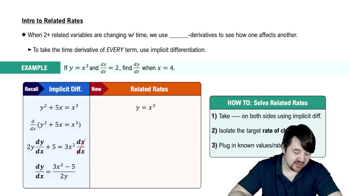
Intro To Related Rates

Integration

Integration is a fundamental concept in calculus that allows us to calculate the total accumulation of quantities, such as the total volume of water flowing over time. In this scenario, integrating the flow rate function over the 90-day period will provide the total volume of water that has flowed past the gauging station, which is crucial for understanding the stream's behavior.
Video consigliato:
Percorso guidato
05:04
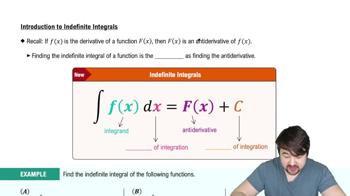
Introduction to Indefinite Integrals

Critical Points

Critical points are values of the independent variable where the derivative of a function is zero or undefined, indicating potential maximum or minimum values. To determine when the flow rate is at its maximum, one must find the critical points of the flow rate function and evaluate them to identify the maximum flow rate during the monitoring period.
Video consigliato:
04:50
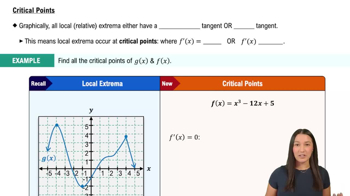
Critical Points
Pratica correlata
Domanda del libro di testo

Derivatives of inverse functions from a table Use the following tables to determine the indicated derivatives or state that the derivative cannot be determined. <IMAGE>

c. (f^-1)'(1)

167
views

Domanda del libro di testo

Another way to approximate derivatives is to use the centered difference quotient: f' (a) ≈ f(a+h) - f(a- h) / 2h. Again, consider f(x) = √x.

c. Explain why it is not necessary to use negative values of h in the table of part (b).

361
views
Domanda del libro di testo

Highway travel A state patrol station is located on a straight north-south freeway. A patrol car leaves the station at 9:00 A.M. heading north with position function s = f(t) that gives its location in miles t hours after 9:00 A.M. (see figure). Assume s is positive when the car is north of the patrol station. <IMAGE>

c. Find the average velocity of the car over the interval [1.75, 2.25]. Estimate the velocity of the car at 11:00 A.M. and determine the direction in which the patrol car is moving.

239
views
Domanda del libro di testo

City urbanization City planners model the size of their city using the function A(t) = - 1/50t² + 2t +20, for 0 ≤ t ≤ 50, where A is measured in square miles and t is the number of years after 2010.

c. Suppose the population density of the city remains constant from year to year at 1000 people mi². Determine the growth rate of the population in 2030.

297
views
Domanda del libro di testo

Computing the derivative of f(x) = e^-x

c. Use parts (a) and (b) to find the derivative of f(x) = e^-x.

255
views
Domanda del libro di testo

Suppose a stone is thrown vertically upward from the edge of a cliff on Earth with an initial velocity of 19.6 m/s from a height of 24.5 m above the ground. The height (in meters) of the stone above the ground t seconds after it is thrown is s(t) = -4.9t²+19.6t+24.5.

c. What is the height of the stone at the highest point?

183
views