Ch. 3 - Derivatives
Briggs - Calculus: Early Transcendentals 3rd Edition
Briggs3rd EditionCalculus: Early TranscendentalsISBN: 9780136847243Non è quello che usi tu?Cambia libro di testo
Capitolo 3, Problema 3.6.38a

Comparing velocities Two stones are thrown vertically upward, each with an initial velocity of 48 ft/s at time t=0. One stone is thrown from the edge of a bridge that is 32 feet above the ground, and the other stone is thrown from ground level. The height above the ground of the stone thrown from the bridge after t seconds is f(t) = − 16t²+48t+32. and the height of the stone thrown from the ground after t seconds is g(t) = −16t²+48t.
a. Show that the stones reach their high points at the same time.

Guida verificata passo dopo passo
1
Identify the height functions for both stones: f(t) = -16t² + 48t + 32 for the stone thrown from the bridge, and g(t) = -16t² + 48t for the stone thrown from the ground.
To find the time at which each stone reaches its highest point, we need to determine the vertex of the parabolic functions f(t) and g(t). The vertex form of a parabola given by ax² + bx + c is at t = -b/(2a).
For both functions, f(t) and g(t), the coefficient a is -16 and the coefficient b is 48. Substitute these values into the vertex formula: t = -48/(2 * -16).
Calculate the expression t = -48/(2 * -16) to find the time at which both stones reach their maximum height.
Since both functions have the same coefficients for t² and t, the time at which they reach their maximum height is the same for both stones.

Risposta video verificata per un problema simile:

Questa soluzione video è stata consigliata dai nostri tutor come utile per risolvere questo problema.
Durata del video:
3m

Concetti chiave

Ecco i concetti essenziali che devi comprendere per rispondere correttamente alla domanda.

Quadratic Functions

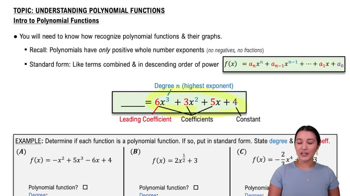
The height functions f(t) and g(t) are quadratic equations, which are polynomial functions of degree two. They can be expressed in the standard form f(t) = at² + bt + c, where 'a', 'b', and 'c' are constants. The graph of a quadratic function is a parabola, and its vertex represents the maximum or minimum point, which is crucial for determining the high point of the stones.
Video consigliato:
6:04
Introduction to Polynomial Functions

Vertex of a Parabola

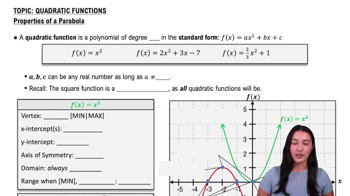
The vertex of a parabola given by a quadratic function occurs at the time t = -b/(2a), where 'a' and 'b' are the coefficients from the standard form of the quadratic equation. This point represents the maximum height for the upward-thrown stones. By calculating the vertex for both height functions, we can determine if they reach their high points simultaneously.
Video consigliato:
7:42
Properties of Parabolas

Initial Velocity and Gravity

In this scenario, both stones are thrown with an initial velocity of 48 ft/s, and the effect of gravity is modeled by the term -16t², which represents the downward acceleration due to gravity (in feet per second squared). Understanding how initial velocity and gravitational acceleration affect the motion of the stones is essential for analyzing their trajectories and determining when they reach their maximum heights.
Video consigliato:
Percorso guidato
05:59
Initial Value Problems Example 2
Pratica correlata
Domanda del libro di testo

Surface area of a cone The lateral surface area of a cone of radius r and height h (the surface area excluding the base) is A = πr√r²+h².

a. Find dr/dh for a cone with a lateral surface area of A=1500π.

367
views

Domanda del libro di testo

62–65. {Use of Tech} Graphing f and f'

a. Graph f with a graphing utility.

f(x) = (x−1) sin^−1 x on [−1,1]

221
views
Domanda del libro di testo

Volume of a torus The volume of a torus (doughnut or bagel) with an inner radius of a and an outer radius of b is V=π²(b+a)(b−a)²/4.

a. Find db/da for a torus with a volume of 64π².

368
views
Domanda del libro di testo

A woman attached to a bungee cord jumps from a bridge that is 30 m above a river. Her height in meters above the river t seconds after the jump is y(t) = 15(1+e-t cos t), for t ≥ 0.

Determine her velocity at t = 1 and t = 3. 

278
views
Domanda del libro di testo

Vertical tangent lines If a function f is continuous at a and lim x→a| f′(x)|=∞, then the curve y=f(x) has a vertical tangent line at a, and the equation of the tangent line is x=a. If a is an endpoint of a domain, then the appropriate one-sided derivative (Exercises 71–72) is used. Use this information to answer the following questions.

73. {Use of Tech} Graph the following functions and determine the location of the vertical tangent lines.

a. f(x) = (x-2)^1/3

353
views
Domanda del libro di testo

13-26 Implicit differentiation Carry out the following steps.

a. Use implicit differentiation to find dy/dx.

tan xy = x+y; (0,0)

222
views