Ch. 3 - Derivatives
Briggs - Calculus: Early Transcendentals 3rd Edition
Briggs3rd EditionCalculus: Early TranscendentalsISBN: 9780136847243Non è quello che usi tu?Cambia libro di testo
Capitolo 3, Problema 3.10.86c

Tangents and inverses Suppose L(x)=ax+b (with a≠0) is the equation of the line tangent to the graph of a one-to-one function f at (x0,y0). Also, suppose M(x)=cx+d is the equation of the line tangent to the graph of f^−1 at (y0,x0).


c. Prove that L^−1(x)=M(x).

Guida verificata passo dopo passo
1
Start by understanding the relationship between a function and its inverse. If L(x) is tangent to f at (x0, y0), then the slope of L(x), which is 'a', is equal to the derivative of f at x0, i.e., f'(x0) = a.
For the inverse function f^−1, the derivative at a point (y0, x0) is the reciprocal of the derivative of f at x0. Therefore, the slope of M(x), which is 'c', is equal to 1/a, i.e., c = 1/a.
The line L(x) = ax + b is tangent to f at (x0, y0), so it passes through the point (x0, y0). Therefore, y0 = ax0 + b, which can be rearranged to find b: b = y0 - ax0.
Similarly, the line M(x) = cx + d is tangent to f^−1 at (y0, x0), so it passes through the point (y0, x0). Therefore, x0 = cy0 + d, which can be rearranged to find d: d = x0 - cy0.
To prove L^−1(x) = M(x), find the inverse of L(x). The inverse L^−1(x) is found by swapping x and y in the equation y = ax + b and solving for y. This gives L^−1(x) = (x - b)/a. Substitute b = y0 - ax0 into this equation to show that L^−1(x) = M(x) = (1/a)x + (x0 - (1/a)y0).

Risposta video verificata per un problema simile:

Questa soluzione video è stata consigliata dai nostri tutor come utile per risolvere questo problema.
Durata del video:
3m

Concetti chiave

Ecco i concetti essenziali che devi comprendere per rispondere correttamente alla domanda.

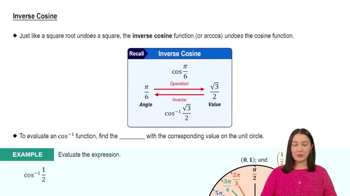
Inverse Functions

An inverse function essentially reverses the effect of the original function. If f(x) takes an input x and produces an output y, then the inverse function f^−1(y) takes y back to x. For a function to have an inverse, it must be one-to-one, meaning each output is produced by exactly one input.
Video consigliato:
4:49
Inverse Cosine

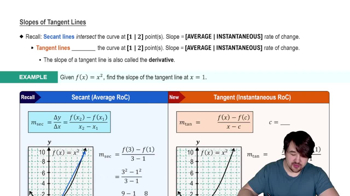
Tangent Lines

A tangent line to a function at a given point represents the instantaneous rate of change of the function at that point. The slope of the tangent line is given by the derivative of the function at that point. In the context of the problem, the tangent lines L(x) and M(x) represent the slopes of the original function f and its inverse f^−1, respectively.
Video consigliato:
Percorso guidato
05:13
Slopes of Tangent Lines

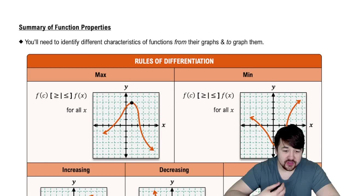
Properties of Derivatives

The derivative of a function at a point provides information about the function's behavior near that point, including its slope. For inverse functions, a key property is that the slopes of the tangent lines at corresponding points are reciprocals of each other. This relationship is crucial for proving that the inverse of the tangent line L(x) equals the tangent line M(x).
Video consigliato:
Percorso guidato
06:21
Properties of Functions
Pratica correlata
Domanda del libro di testo

21–30. Derivatives

b. Evaluate f'(a) for the given values of a.

f(x) = 4x²+1; a= 2,4

367
views

Domanda del libro di testo

Surface area of a cone The lateral surface area of a cone of radius r and height h (the surface area excluding the base) is A = πr√r²+h².

b. Evaluate this derivative when r=30 and h=40.

292
views
Domanda del libro di testo

Deriving trigonometric identities

c. Differentiate both sides of the identity sin 2t = 2 sin t cost to prove that cos 2t = cos²t−sin²t.

478
views
Domanda del libro di testo

Volume of a torus The volume of a torus (doughnut or bagel) with an inner radius of a and an outer radius of b is V=π²(b+a)(b−a)²/4.

b. Evaluate this derivative when a=6 and b=10.

307
views
Domanda del libro di testo

62–65. {Use of Tech} Graphing f and f'

c. Verify that the zeros of f' correspond to points at which f has a horizontal tangent line.

f(x) = (x−1) sin^−1 x on [−1,1]

243
views
Domanda del libro di testo

97–100. Logistic growth Scientists often use the logistic growth function P(t) = P₀K / P₀+(K−P₀)e^−r₀t to model population growth, where P₀ is the initial population at time t=0, K is the carrying capacity, and r₀ is the base growth rate. The carrying capacity is a theoretical upper bound on the total population that the surrounding environment can support. The figure shows the sigmoid (S-shaped) curve associated with a typical logistic model. <IMAGE>


{Use of Tech} Gone fishing When a reservoir is created by a new dam, 50 fish are introduced into the reservoir, which has an estimated carrying capacity of 8000 fish. A logistic model of the fish population is P(t) = 400,000 / 50+7950e^−0.5t, where t is measured in years.


c. How fast (in fish per year) is the population growing at t=0? At t=5?

200
views