Ch. 3 - Derivatives
Briggs - Calculus: Early Transcendentals 3rd Edition
Briggs3rd EditionCalculus: Early TranscendentalsISBN: 9780136847243Non è quello che usi tu?Cambia libro di testo
Capitolo 3, Problema 3.2.73c

Vertical tangent lines If a function f is continuous at a and lim x→a| f′(x)|=∞, then the curve y=f(x) has a vertical tangent line at a, and the equation of the tangent line is x=a. If a is an endpoint of a domain, then the appropriate one-sided derivative (Exercises 71–72) is used. Use this information to answer the following questions.
73. {Use of Tech} Graph the following functions and determine the location of the vertical tangent lines.
c. f(x) = √|x-4|

Guida verificata passo dopo passo
1
Step 1: Understand the problem. We need to find the location of vertical tangent lines for the function f(x) = \(\sqrt{|x-4|}\). A vertical tangent line occurs where the derivative of the function approaches infinity.
Step 2: Analyze the function. The function f(x) = \(\sqrt{|x-4|}\) is continuous everywhere in its domain, which is all real numbers. However, the expression inside the square root, |x-4|, changes behavior at x = 4.
Step 3: Find the derivative of the function. To find where the vertical tangent line occurs, we need to compute the derivative f'(x). Start by rewriting the function as f(x) = (|x-4|)^{1/2}. Use the chain rule and the derivative of the absolute value function to find f'(x).
Step 4: Evaluate the behavior of the derivative at x = 4. Since the absolute value function has a corner at x = 4, check the limit of the derivative as x approaches 4 from both sides. Specifically, calculate \(\lim\)_{x \(\to\) 4^-} f'(x) and \(\lim\)_{x \(\to\) 4^+} f'(x).
Step 5: Determine the location of the vertical tangent line. If either of the one-sided limits from Step 4 approaches infinity, then there is a vertical tangent line at x = 4. The equation of this vertical tangent line is x = 4.

Risposta video verificata per un problema simile:

Questa soluzione video è stata consigliata dai nostri tutor come utile per risolvere questo problema.
Durata del video:
6m

Concetti chiave

Ecco i concetti essenziali che devi comprendere per rispondere correttamente alla domanda.

Vertical Tangent Lines

A vertical tangent line occurs at a point on a curve where the slope of the tangent approaches infinity. This typically indicates that the derivative of the function is undefined or infinite at that point. In the context of calculus, if the limit of the absolute value of the derivative approaches infinity as x approaches a certain value, the function has a vertical tangent line at that point.
Video consigliato:
Percorso guidato
05:13
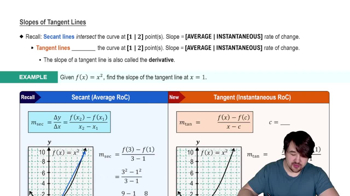
Slopes of Tangent Lines

Continuity of Functions

A function is continuous at a point if there are no breaks, jumps, or holes in the graph at that point. For a function to have a vertical tangent line, it must first be continuous at the point of interest. This means that the function's value at that point is well-defined, and the behavior of the function around that point can be analyzed using limits.
Video consigliato:
05:34
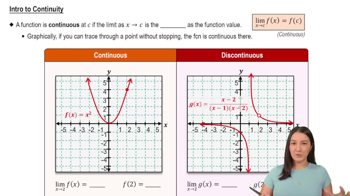
Intro to Continuity

One-Sided Derivatives

One-sided derivatives are used to analyze the behavior of a function at endpoints or points where the function may not be differentiable in the traditional sense. The left-hand derivative considers the slope of the tangent as you approach the point from the left, while the right-hand derivative does so from the right. In cases where a function is defined only on one side of a point, one-sided derivatives provide crucial information about the function's behavior at that point.
Video consigliato:
05:50
One-Sided Limits
Pratica correlata
Domanda del libro di testo

62–65. {Use of Tech} Graphing f and f'

c. Verify that the zeros of f' correspond to points at which f has a horizontal tangent line.

f(x)=e^−x tan^−1 x on [0,∞)

145
views

Domanda del libro di testo

Deriving trigonometric identities

c. Differentiate both sides of the identity sin 2t = 2 sin t cost to prove that cos 2t = cos²t−sin²t.

478
views
Domanda del libro di testo

City urbanization City planners model the size of their city using the function A(t) = - 1/50t² + 2t +20, for 0 ≤ t ≤ 50, where A is measured in square miles and t is the number of years after 2010.

c. Suppose the population density of the city remains constant from year to year at 1000 people mi². Determine the growth rate of the population in 2030.

297
views
Domanda del libro di testo

Computing the derivative of f(x) = e^-x

c. Use parts (a) and (b) to find the derivative of f(x) = e^-x.

255
views
Domanda del libro di testo

62–65. {Use of Tech} Graphing f and f'

c. Verify that the zeros of f' correspond to points at which f has a horizontal tangent line.

f(x) = (x−1) sin^−1 x on [−1,1]

243
views
Domanda del libro di testo

97–100. Logistic growth Scientists often use the logistic growth function P(t) = P₀K / P₀+(K−P₀)e^−r₀t to model population growth, where P₀ is the initial population at time t=0, K is the carrying capacity, and r₀ is the base growth rate. The carrying capacity is a theoretical upper bound on the total population that the surrounding environment can support. The figure shows the sigmoid (S-shaped) curve associated with a typical logistic model. <IMAGE>


{Use of Tech} Gone fishing When a reservoir is created by a new dam, 50 fish are introduced into the reservoir, which has an estimated carrying capacity of 8000 fish. A logistic model of the fish population is P(t) = 400,000 / 50+7950e^−0.5t, where t is measured in years.


c. How fast (in fish per year) is the population growing at t=0? At t=5?

200
views