Ch. 3 - Derivatives
Briggs - Calculus: Early Transcendentals 3rd Edition
Briggs3rd EditionCalculus: Early TranscendentalsISBN: 9780136847243Non è quello che usi tu?Cambia libro di testo
Capitolo 3, Problema 3.5.54

Verifying derivative formulas Verify the following derivative formulas using the Quotient Rule.
d/dx (csc x) = -csc x cot x

Guida verificata passo dopo passo
1
Start by recalling the definition of the cosecant function: \( \csc x = \frac{1}{\sin x} \). We need to find the derivative of this function with respect to \( x \).
Apply the Quotient Rule for derivatives, which states that if you have a function \( \frac{u}{v} \), its derivative is \( \frac{v \cdot u' - u \cdot v'}{v^2} \). Here, \( u = 1 \) and \( v = \sin x \).
Calculate the derivatives: \( u' = 0 \) since the derivative of a constant is zero, and \( v' = \cos x \) since the derivative of \( \sin x \) is \( \cos x \).
Substitute these into the Quotient Rule formula: \( \frac{\sin x \cdot 0 - 1 \cdot \cos x}{(\sin x)^2} = \frac{-\cos x}{\sin^2 x} \).
Recognize that \( \frac{-\cos x}{\sin^2 x} \) can be rewritten using trigonometric identities as \( -\csc x \cdot \cot x \), thus verifying the derivative formula \( \frac{d}{dx}(\csc x) = -\csc x \cot x \).

Risposta video verificata per un problema simile:

Questa soluzione video è stata consigliata dai nostri tutor come utile per risolvere questo problema.
Durata del video:
3m

Concetti chiave

Ecco i concetti essenziali che devi comprendere per rispondere correttamente alla domanda.

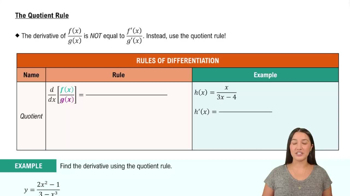
Quotient Rule

The Quotient Rule is a fundamental technique in calculus used to differentiate functions that are expressed as the ratio of two other functions. It states that if you have a function f(x) = g(x)/h(x), the derivative f'(x) can be calculated using the formula f'(x) = (g'(x)h(x) - g(x)h'(x)) / (h(x))^2. This rule is essential for verifying derivatives of functions like csc(x), which can be expressed as a quotient.
Video consigliato:
06:43
The Quotient Rule

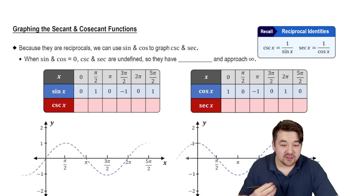
Cosecant Function

The cosecant function, denoted as csc(x), is the reciprocal of the sine function, defined as csc(x) = 1/sin(x). Understanding the properties and behavior of the cosecant function is crucial for differentiating it, as it influences the application of the Quotient Rule. Additionally, knowing the relationship between csc(x) and sin(x) helps in simplifying the derivative calculations.
Video consigliato:
Percorso guidato
6:22
Graphs of Secant and Cosecant Functions

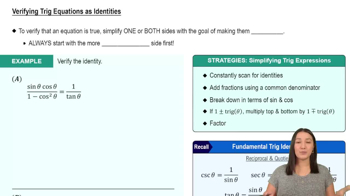
Trigonometric Identities

Trigonometric identities are equations involving trigonometric functions that hold true for all values of the variables involved. Key identities, such as sin^2(x) + cos^2(x) = 1, are often used in calculus to simplify expressions and derivatives. Familiarity with these identities is important when verifying derivative formulas, as they can help in transforming and simplifying the resulting expressions from the differentiation process.
Video consigliato:
7:17
Verifying Trig Equations as Identities
Pratica correlata
Domanda del libro di testo

Using identities Use the identity sin 2x=2 sin x cos x sin 2 to find d/dx (sin 2x). Then use the identity cos 2x = cos² x−sin² x to express the derivative of sin 2x in terms of cos 2x.

421
views

Domanda del libro di testo

Orthogonal trajectories Two curves are orthogonal to each other if their tangent lines are perpendicular at each point of intersection (recall that two lines are perpendicular to each other if their slopes are negative reciprocals). A family of curves forms orthogonal trajectories with another family of curves if each curve in one family is orthogonal to each curve in the other family. For example, the parabolas y = cx² form orthogonal trajectories with the family of ellipses x²+2y² = k, where c and k are constants (see figure).

Find dy/dx for each equation of the following pairs. Use the derivatives to explain why the families of curves form orthogonal trajectories. <IMAGE>


y = cx²; x²+2y² = k, where c and k are constants

473
views
Domanda del libro di testo

27–76. Calculate the derivative of the following functions.

y=(x2+2x+7)8y=\(\left\)(x^2+2x+7\(\right\))^8

326
views
Domanda del libro di testo

9–61. Evaluate and simplify y'.


y = (2x−3)x^3/2

305
views
Domanda del libro di testo

Evaluate the derivative of the following functions.

f(x) = sin-1 2x

286
views
Domanda del libro di testo

Calculate the derivative of the following functions. In some cases, it is useful to use the properties of logarithms to simplify the functions before computing f'(x).

f(x) = In(3x + 1)⁴

252
views