Ch. 4 - Applications of the Derivative
Briggs - Calculus: Early Transcendentals 3rd Edition
Briggs3rd EditionCalculus: Early TranscendentalsISBN: 9780136847243Non è quello che usi tu?Cambia libro di testo
Capitolo 4, Problema 4.4.14g

if ƒ(x) = 1 / (3x⁴ + 5) , it can be shown that ƒ'(x) = 12x³ / (3x⁴ + 5)² and ƒ"(x) = 180x² (x² + 1) (x + 1) (x - 1) / (3x⁴ + 5)³ . Use these functions to complete the following steps.


g. Use your work in parts (a) through (f) to sketch a graph of ƒ .

Guida verificata passo dopo passo
1
Step 1: Identify the critical points of the function ƒ(x) by setting the first derivative ƒ'(x) equal to zero and solving for x. This will help determine where the function has local maxima, minima, or points of inflection.
Step 2: Analyze the sign of ƒ'(x) around the critical points to determine the intervals where the function is increasing or decreasing. This will help in understanding the behavior of the function on different intervals.
Step 3: Use the second derivative ƒ"(x) to determine the concavity of the function. Set ƒ"(x) equal to zero to find potential inflection points, and analyze the sign of ƒ"(x) around these points to determine where the function is concave up or concave down.
Step 4: Consider the asymptotic behavior of the function. Since ƒ(x) is a rational function, examine the behavior as x approaches positive and negative infinity, as well as any vertical asymptotes that may occur when the denominator is zero.
Step 5: Combine the information from the critical points, intervals of increase/decrease, concavity, and asymptotic behavior to sketch the graph of ƒ(x). Ensure that the graph reflects all the analyzed characteristics, such as local extrema, inflection points, and asymptotes.

Risposta video verificata per un problema simile:

Questa soluzione video è stata consigliata dai nostri tutor come utile per risolvere questo problema.
Durata del video:
8m

Concetti chiave

Ecco i concetti essenziali che devi comprendere per rispondere correttamente alla domanda.

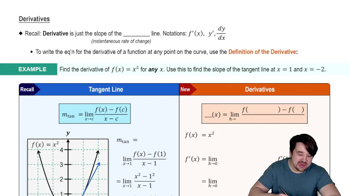
Derivative

The derivative of a function measures how the function's output changes as its input changes. It represents the slope of the tangent line to the graph of the function at any given point. In this case, the first derivative ƒ'(x) indicates the rate of change of the function ƒ(x) = 1 / (3x⁴ + 5), which is crucial for understanding the function's behavior, including increasing and decreasing intervals.
Video consigliato:

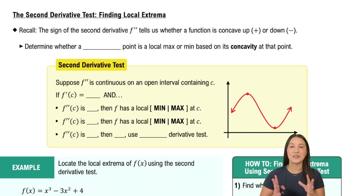
Second Derivative

The second derivative of a function, denoted as ƒ''(x), provides information about the curvature of the graph of the function. It indicates whether the function is concave up or concave down at a given point. In this context, analyzing the second derivative helps identify points of inflection, where the graph changes its concavity, which is essential for sketching an accurate graph of ƒ.
Video consigliato:
06:02
The Second Derivative Test: Finding Local Extrema

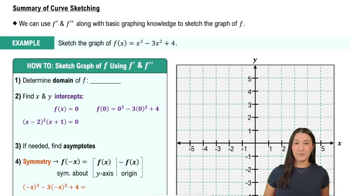
Graph Sketching

Graph sketching involves using information from the function and its derivatives to create a visual representation of the function's behavior. This includes identifying critical points, intervals of increase and decrease, concavity, and asymptotic behavior. By applying the first and second derivatives of ƒ(x), one can effectively outline the shape of the graph, including local maxima, minima, and points of inflection.
Video consigliato:
11:41
Summary of Curve Sketching
Pratica correlata
Domanda del libro di testo

107–110. {Use of Tech} Motion with gravity Consider the following descriptions of the vertical motion of an object subject only to the acceleration due to gravity. Begin with the acceleration equation a(t) = v' (t) = -g , where g = 9.8 m/s² .

d. Find the time when the object strikes the ground.

A payload is released at an elevation of 400 m from a hot-air balloon that is rising at a rate of 10 m/s.

56
views
Domanda del libro di testo

Interpreting the derivative The graph of f' on the interval [-3,2] is shown in the figure. <IMAGE>


f. Sketch one possible graph of f.

275
views
Domanda del libro di testo

For each function ƒ and interval [a, b], a graph of ƒ is given along with the secant line that passes though the graph of ƒ at x = a and x = b.


a. Use the graph to make a conjecture about the value(s) of c satisfying the equation (ƒ(b) - ƒ(a)) / (b-a) = ƒ' (c) .


b. Verify your answer to part (a) by solving the equation (ƒ(b) - ƒ(a)) / (b-a) = ƒ' (c) for c.


ƒ(x) = x⁵/16 ; [-2, 2] <IMAGE>

168
views
Domanda del libro di testo

Use the graphs of ƒ' and ƒ" to complete the following steps. <IMAGE>

Plot a possible graph of f.

238
views
Domanda del libro di testo

{Use of Tech} A damped oscillator The displacement of an object as it bounces vertically up and down on a spring is given by y(t) = 2.5e⁻ᵗ cos 2t, where the initial displacement is y(0) = 2.5 and y = 0 corresponds to the rest position (see figure). <IMAGE>


d. Find the time and the displacement when the object reaches its high point for the second time.

210
views
Domanda del libro di testo

Let ƒ(x) = (x - 3) (x + 3)²


g. Use your work in parts (a) through (f) to sketch a graph of ƒ.

253
views