
Ch. 4 - Applications of the Derivative
Briggs - Calculus: Early Transcendentals 3rd Edition
Briggs3rd EditionCalculus: Early TranscendentalsISBN: 9780136847243Non è quello che usi tu?Cambia libro di testo
Capitolo 4, Problema 4.8.37d

{Use of Tech} A damped oscillator The displacement of an object as it bounces vertically up and down on a spring is given by y(t) = 2.5e⁻ᵗ cos 2t, where the initial displacement is y(0) = 2.5 and y = 0 corresponds to the rest position (see figure). <IMAGE>


d. Find the time and the displacement when the object reaches its high point for the second time.

Guida verificata passo dopo passo
1
Identify the function for displacement: y(t) = 2.5e^(-t) * cos(2t). This function represents a damped harmonic oscillator, where the exponential term 2.5e^(-t) accounts for the damping effect, and cos(2t) represents the oscillatory motion.
To find the high points, we need to determine when the derivative of y(t) with respect to t is zero. This involves finding y'(t) and setting it equal to zero. Use the product rule for differentiation: if u(t) = 2.5e^(-t) and v(t) = cos(2t), then y(t) = u(t)v(t) and y'(t) = u'(t)v(t) + u(t)v'(t).
Calculate the derivatives: u'(t) = -2.5e^(-t) (derivative of 2.5e^(-t)) and v'(t) = -2sin(2t) (derivative of cos(2t)). Substitute these into the product rule formula to find y'(t).
Set y'(t) = 0 to find the critical points. This will give you an equation involving trigonometric and exponential terms. Solve this equation to find the values of t where the displacement reaches a high point.
Determine the second high point by identifying the second positive value of t from the solutions obtained. Substitute this value back into the original displacement function y(t) to find the corresponding displacement at this time.

Risposta video verificata per un problema simile:

Questa soluzione video è stata consigliata dai nostri tutor come utile per risolvere questo problema.
Durata del video:
5m

Concetti chiave

Ecco i concetti essenziali che devi comprendere per rispondere correttamente alla domanda.

Damped Oscillator

A damped oscillator is a system in which the amplitude of oscillation decreases over time due to a resistive force, such as friction or air resistance. In the given equation, the term 'e⁻ᵗ' represents the damping effect, causing the oscillation to gradually lose energy and amplitude as time progresses.
Video consigliato:
03:07
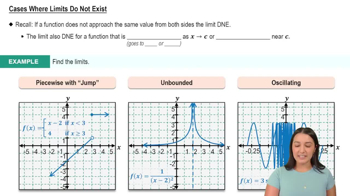
Cases Where Limits Do Not Exist

Cosine Function in Oscillations

The cosine function is fundamental in describing periodic motion, such as oscillations. In the equation y(t) = 2.5e⁻ᵗ cos 2t, the 'cos 2t' component indicates that the object oscillates with a frequency determined by the coefficient of 't', which affects how quickly the object moves up and down.
Video consigliato:
Percorso guidato
5:53
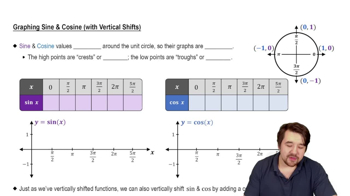
Graph of Sine and Cosine Function

Finding Extrema in Functions

To find the high points (maxima) of the oscillation, one must analyze the function y(t) for critical points. This involves taking the derivative of y(t), setting it to zero, and solving for t to determine when the displacement reaches its maximum value, which corresponds to the high points of the oscillation.
Video consigliato:
05:58
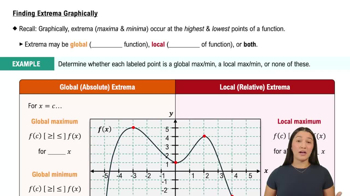
Finding Extrema Graphically