Ch. 5 - Integration
Briggs - Calculus: Early Transcendentals 3rd Edition
Briggs3rd EditionCalculus: Early TranscendentalsISBN: 9780136847243Non è quello che usi tu?Cambia libro di testo
Capitolo 5, Problema 5.3.85

Derivatives of integrals Simplify the following expressions.


d/d𝓍 ∫₀ˣ (√1 + t²) dt (Hint: ∫ˣ₋ₓ (√1 + t²) dt = ∫⁰₋ₓ (√1 + t²) dt + ∫ˣ₋ₓ (√1 + t²) dt ) .

Guida verificata passo dopo passo
1
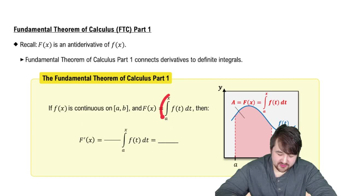
Step 1: Recognize that the problem involves the Fundamental Theorem of Calculus, which states that if F(x) = ∫ₐˣ f(t) dt, then dF/dx = f(x). This theorem will be key in solving the derivative of the integral.
Step 2: Analyze the given integral ∫₀ˣ (√1 + t²) dt. According to the Fundamental Theorem of Calculus, the derivative of this integral with respect to x is simply the integrand evaluated at the upper limit of integration, which is √(1 + x²).
Step 3: Consider the hint provided: ∫ˣ₋ₓ (√1 + t²) dt = ∫⁰₋ₓ (√1 + t²) dt + ∫ˣ₋ₓ (√1 + t²) dt. This suggests breaking the integral into parts, but for the derivative d/d𝓍 ∫₀ˣ (√1 + t²) dt, the hint is not directly necessary since the Fundamental Theorem of Calculus simplifies the process.
Step 4: Apply the Fundamental Theorem of Calculus directly to the integral ∫₀ˣ (√1 + t²) dt. The derivative with respect to x is simply √(1 + x²), as the lower limit of integration (0) does not contribute to the derivative.
Step 5: Conclude that the derivative of the given integral is √(1 + x²). The hint provided is more relevant for breaking down integrals with different limits, but in this case, the direct application of the theorem suffices.

Risposta video verificata per un problema simile:

Questa soluzione video è stata consigliata dai nostri tutor come utile per risolvere questo problema.
Durata del video:
1m

Concetti chiave

Ecco i concetti essenziali che devi comprendere per rispondere correttamente alla domanda.

Fundamental Theorem of Calculus

The Fundamental Theorem of Calculus links differentiation and integration, stating that if F is an antiderivative of f on an interval [a, b], then the integral of f from a to b can be computed as F(b) - F(a). This theorem also implies that the derivative of an integral function is the integrand evaluated at the upper limit of integration.
Video consigliato:
Percorso guidato
06:11
Fundamental Theorem of Calculus Part 1

Differentiation under the Integral Sign

Differentiation under the integral sign allows us to differentiate an integral with respect to a parameter. This technique is useful when the limits of integration or the integrand itself depend on a variable, enabling the evaluation of complex integrals by treating them as functions of that variable.
Video consigliato:
Percorso guidato
05:53
Finding Differentials

Integration by Parts

Integration by parts is a technique used to integrate products of functions. It is based on the product rule for differentiation and is expressed as ∫u dv = uv - ∫v du. This method can simplify the integration of more complex expressions, particularly when one function is easily integrable and the other is easily differentiable.
Video consigliato:
Percorso guidato
06:18
Integration by Parts for Definite Integrals
Pratica correlata
Domanda del libro di testo

Use a substitution of the form u = a𝓍 + b to evaluate the following indefinite integrals

∫(e³ˣ ⁺¹ d𝓍

61
views

Domanda del libro di testo

Area Find (i) the net area and (ii) the area of the following regions. Graph the function and indicate the region in question.


The region bounded by y = 6 cos 𝓍 and the 𝓍-axis between 𝓍 = ―π/2 and 𝓍 = π

103
views
Domanda del libro di testo

Average distance on a triangle Consider the right triangle with vertices (0,0) ,(0,b) , and (a,0) , where a > 0 and b > 0. Show that the average vertical distance from points on the 𝓍-axis to the hypotenuse is b/2 , for all a > 0 .

49
views
Domanda del libro di testo

Approximating displacement The velocity of an object is given by the following functions on a specified interval. Approximate the displacement of the object on this interval by subdividing the interval into n subintervals. Use the left endpoint of each subinterval to compute the height of the rectangles.

v = 2t + 1(m/s), for 0 ≤ t ≤ 8 ; n = 2

84
views
Domanda del libro di testo

Definite integrals from graphs The figure shows the areas of regions bounded by the graph of ƒ and the 𝓍-axis. Evaluate the following integrals.


∫₀ᶜ |ƒ(𝓍)| d𝓍

143
views
Domanda del libro di testo

Suppose the interval [1, 3] is partitioned into n = 4 subintervals. What is the subinterval length ∆𝓍? List the grid points x₀ , x₁ , x₂ , x₃ and x₄. Which points are used for the left, right, and midpoint Riemann sums?

85
views