Ch. 5 - Integration
Briggs - Calculus: Early Transcendentals 3rd Edition
Briggs3rd EditionCalculus: Early TranscendentalsISBN: 9780136847243Non è quello che usi tu?Cambia libro di testo
Capitolo 5, Problema 5.R.43

Evaluating integrals Evaluate the following integrals.


∫₀¹ √𝓍 (√𝓍 + 1) d𝓍

Guida verificata passo dopo passo
1
Step 1: Begin by expanding the integrand. The given integral is ∫₀¹ √𝓍 (√𝓍 + 1) d𝓍. Distribute √𝓍 across the terms inside the parentheses to rewrite the integrand as ∫₀¹ (𝓍 + √𝓍) d𝓍.
Step 2: Split the integral into two separate integrals for easier computation: ∫₀¹ (𝓍 + √𝓍) d𝓍 = ∫₀¹ 𝓍 d𝓍 + ∫₀¹ √𝓍 d𝓍.
Step 3: Evaluate the first integral, ∫₀¹ 𝓍 d𝓍. Use the power rule for integration, which states ∫𝓍ⁿ d𝓍 = (𝓍ⁿ⁺¹)/(n+1) + C, where n ≠ -1. Here, n = 1, so ∫₀¹ 𝓍 d𝓍 = [𝓍²/2]₀¹.
Step 4: Evaluate the second integral, ∫₀¹ √𝓍 d𝓍. Rewrite √𝓍 as 𝓍^(1/2) and apply the power rule for integration. For n = 1/2, ∫𝓍^(1/2) d𝓍 = (𝓍^(3/2))/(3/2) + C. Simplify to (2/3)𝓍^(3/2). Evaluate this expression from 0 to 1: [(2/3)𝓍^(3/2)]₀¹.
Step 5: Combine the results of the two integrals. Add the evaluated results of ∫₀¹ 𝓍 d𝓍 and ∫₀¹ √𝓍 d𝓍 to obtain the final value of the integral ∫₀¹ √𝓍 (√𝓍 + 1) d𝓍.

Risposta video verificata per un problema simile:

Questa soluzione video è stata consigliata dai nostri tutor come utile per risolvere questo problema.
Durata del video:
3m

Concetti chiave

Ecco i concetti essenziali che devi comprendere per rispondere correttamente alla domanda.

Definite Integrals

A definite integral represents the signed area under a curve between two specified limits. In this case, the integral ∫₀¹ √𝓍 (√𝓍 + 1) d𝓍 is evaluated from 0 to 1, which means we are calculating the area under the curve of the function √𝓍 (√𝓍 + 1) from x = 0 to x = 1.
Video consigliato:
Percorso guidato
05:43
Definition of the Definite Integral

Integration Techniques

To evaluate integrals, various techniques can be employed, such as substitution, integration by parts, or recognizing patterns. For the given integral, simplifying the integrand √𝓍 (√𝓍 + 1) may involve expanding the expression or using substitution to make the integration process more manageable.
Video consigliato:
Percorso guidato
06:18
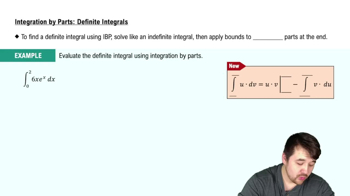
Integration by Parts for Definite Integrals

Fundamental Theorem of Calculus

The Fundamental Theorem of Calculus links differentiation and integration, stating that if F is an antiderivative of f on an interval [a, b], then ∫ₐᵇ f(x) dx = F(b) - F(a). This theorem is essential for evaluating definite integrals, as it allows us to find the area under the curve by calculating the difference of the antiderivative at the upper and lower limits.
Video consigliato:
Percorso guidato
06:11
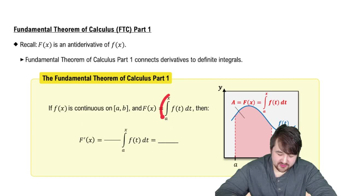
Fundamental Theorem of Calculus Part 1
Pratica correlata
Domanda del libro di testo

Integration by Riemann sums Consider the integral ∫₁⁴ (3𝓍― 2) d𝓍.


(b) Use summation notation to express the right Riemann sum in terms of a positive integer n .

100
views

Domanda del libro di testo

Evaluating integrals Evaluate the following integrals.


∫₀¹ 𝓍 • 2ˣ²⁺¹ d𝓍

88
views
Domanda del libro di testo

Use geometry and properties of integrals to evaluate the following definite integrals.                                                                                          


 ∫₀⁴ √(8𝓍―𝓍²) d𝓍 . (Hint: Complete the square .)

98
views
Domanda del libro di testo

Function defined by an integral Let H (𝓍) = ∫₀ˣ √(4 ― t²) dt, for ― 2 ≤ 𝓍 ≤ 2.

(e) Find the value of s such that H (𝓍) = sH(―𝓍)

83
views
Domanda del libro di testo

Evaluating integrals Evaluate the following integrals.


∫₀⁵ |2𝓍―8|d𝓍

49
views
Domanda del libro di testo

Evaluating integrals Evaluate the following integrals.                                                                                                                                         


 ∫ d𝓍/[(tan⁻¹ 𝓍) (1 + 𝓍²)]

63
views