

Ch. 5 - Integration
Briggs - Calculus: Early Transcendentals 3rd Edition
Briggs3rd EditionCalculus: Early TranscendentalsISBN: 9780136847243Non è quello che usi tu?Cambia libro di testo
Capitolo 5, Problema 5.3.10

Explain why ∫ₐᵇ ƒ ′(𝓍) d𝓍 = ƒ(b) ― ƒ(a)

Guida verificata passo dopo passo
1
Step 1: Recall the Fundamental Theorem of Calculus, Part 1, which states that if a function ƒ is continuous on [a, b] and differentiable on (a, b), then the integral of its derivative ƒ′(𝓍) over [a, b] is equal to the net change in ƒ(𝓍) over that interval.
Step 2: Write the mathematical expression for the Fundamental Theorem of Calculus: ∫ₐᵇ ƒ′(𝓍) d𝓍 = ƒ(b) ― ƒ(a). This equation shows that the definite integral of the derivative of ƒ(𝓍) from a to b gives the difference between the values of ƒ(𝓍) at the endpoints b and a.
Step 3: Conceptually, the derivative ƒ′(𝓍) represents the rate of change of the function ƒ(𝓍). Integrating ƒ′(𝓍) over the interval [a, b] accumulates all the infinitesimal changes in ƒ(𝓍) over that interval, resulting in the total change in ƒ(𝓍) from a to b.
Step 4: To understand this geometrically, think of the integral ∫ₐᵇ ƒ′(𝓍) d𝓍 as calculating the area under the curve of ƒ′(𝓍) over [a, b]. This area corresponds to the net change in the original function ƒ(𝓍) over the interval.
Step 5: Finally, note that this relationship holds because differentiation and integration are inverse operations. The integral essentially 'undoes' the differentiation, leaving you with the original function evaluated at the endpoints: ƒ(b) ― ƒ(a).

Risposta video verificata per un problema simile:

Questa soluzione video è stata consigliata dai nostri tutor come utile per risolvere questo problema.
Durata del video:
1m

Concetti chiave

Ecco i concetti essenziali che devi comprendere per rispondere correttamente alla domanda.

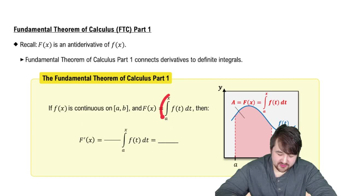
Fundamental Theorem of Calculus

The Fundamental Theorem of Calculus connects differentiation and integration, stating that if a function is continuous on [a, b] and F is an antiderivative of f on that interval, then the integral of f from a to b equals F(b) - F(a). This theorem provides a powerful tool for evaluating definite integrals and establishes the relationship between the two main branches of calculus.
Video consigliato:
Percorso guidato
06:11
Fundamental Theorem of Calculus Part 1

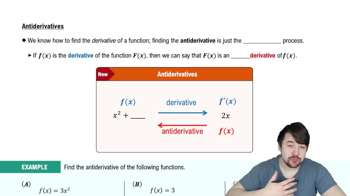
Antiderivative

An antiderivative of a function f is another function F such that F' = f. In the context of the integral ∫ₐᵇ ƒ ′(𝓍) d𝓍, the function F is the antiderivative of f', meaning that F is the original function f before differentiation. This concept is crucial for understanding how integration reverses the process of differentiation.
Video consigliato:
Percorso guidato
05:50
Antiderivatives

Definite Integral

A definite integral, represented as ∫ₐᵇ f(x) dx, calculates the net area under the curve of the function f(x) from x = a to x = b. It provides a numerical value that represents the accumulation of quantities, such as area, over an interval. The result of a definite integral is a specific number, which in the case of ∫ₐᵇ ƒ ′(𝓍) d𝓍, corresponds to the difference in the values of the antiderivative at the endpoints b and a.
Video consigliato:
Percorso guidato
05:43
Definition of the Definite Integral
Pratica correlata
Domanda del libro di testo

Max/min of area functions Suppose ƒ is continuous on [0 ,∞) and A(𝓍) is the net area of the region bounded by the graph of ƒ and the t-axis on [0, x]. Show that the local maxima and minima of A occur at the zeros of ƒ. Verify this fact with the function ƒ(𝓍) = 𝓍² - 10𝓍.

46
views
Domanda del libro di testo

Indefinite integrals Use a change of variables or Table 5.6 to evaluate the following indefinite integrals. Check your work by differentiating.                                                                                  


 ∫ [ 1/(10𝓍―3) d𝓍

57
views
Domanda del libro di testo

Suppose an object moves along a line at 15 m/s, for 0 ≤ t < 2 and at 25 m/s, for 2 ≤ t ≤ 5, where t is measured in seconds. Sketch the graph of the velocity function and find the displacement of the object for 0 ≤ t ≤ 5.

47
views
Domanda del libro di testo

Average velocity The velocity in m/s of an object moving along a line over the time interval [0,6] is v (t) = t² + 3t. Find the average velocity of the object over this time interval.

161
views
Domanda del libro di testo

Definite integrals from graphs The figure shows the areas of regions bounded by the graph of ƒ and the 𝓍-axis. Evaluate the following integrals.


∫ₐᶜ ƒ(𝓍) d𝓍

102
views
Domanda del libro di testo

A midpoint Riemann sum Approximate the area of the region bounded by the graph of ƒ(𝓍) = 100 ― x² and the x-axis on [0, 10] with n = 5 subintervals. Use the midpoint of each subinterval to determine the height of each rectangle (see figure).

111
views