
Ch. 5 - Integration
Briggs - Calculus: Early Transcendentals 3rd Edition
Briggs3rd EditionCalculus: Early TranscendentalsISBN: 9780136847243Non è quello che usi tu?Cambia libro di testo
Capitolo 5, Problema 5.1.1

Suppose an object moves along a line at 15 m/s, for 0 ≤ t < 2 and at 25 m/s, for 2 ≤ t ≤ 5, where t is measured in seconds. Sketch the graph of the velocity function and find the displacement of the object for 0 ≤ t ≤ 5.

Guida verificata passo dopo passo
1
Step 1: Understand the problem. The velocity function is piecewise defined: v(t) = 15 m/s for 0 ≤ t < 2, and v(t) = 25 m/s for 2 ≤ t ≤ 5. Displacement is calculated as the integral of the velocity function over the given time interval.
Step 2: Sketch the graph of the velocity function. For 0 ≤ t < 2, draw a horizontal line at v(t) = 15 m/s. For 2 ≤ t ≤ 5, draw another horizontal line at v(t) = 25 m/s. Ensure the graph is piecewise continuous and clearly shows the change in velocity at t = 2.
Step 3: Set up the integral to calculate displacement. Displacement is the area under the velocity-time graph. Break the integral into two parts: ∫[0,2] v(t) dt and ∫[2,5] v(t) dt. Substitute the respective velocity values into each integral.
Step 4: Compute the first integral ∫[0,2] v(t) dt. Since v(t) = 15 m/s is constant over this interval, the integral simplifies to 15 × (2 - 0). This represents the displacement for the first segment of motion.
Step 5: Compute the second integral ∫[2,5] v(t) dt. Since v(t) = 25 m/s is constant over this interval, the integral simplifies to 25 × (5 - 2). Add the results of both integrals to find the total displacement over the interval 0 ≤ t ≤ 5.

Risposta video verificata per un problema simile:

Questa soluzione video è stata consigliata dai nostri tutor come utile per risolvere questo problema.
Durata del video:
5m

Concetti chiave

Ecco i concetti essenziali che devi comprendere per rispondere correttamente alla domanda.

Velocity Function

The velocity function describes the speed and direction of an object's motion over time. In this case, the object has two distinct velocity segments: 15 m/s for the first two seconds and 25 m/s for the next three seconds. Understanding how to represent these segments graphically is crucial for visualizing the object's motion.
Video consigliato:
Percorso guidato
10:17
Using The Velocity Function

Displacement

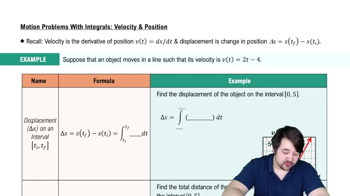
Displacement is the total change in position of an object over a given time interval, calculated as the integral of the velocity function. It accounts for the direction of motion and can be found by summing the areas under the velocity graph for each segment. In this scenario, calculating displacement involves integrating the velocity over the specified time intervals.
Video consigliato:
Percorso guidato
10:17
Using The Velocity Function

Graphing Piecewise Functions

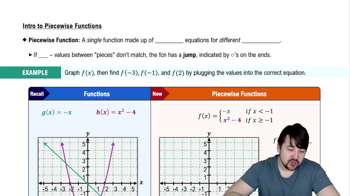
Graphing piecewise functions involves plotting different expressions for different intervals of the independent variable. For this problem, the velocity function is piecewise defined, requiring separate graphs for the intervals 0 ≤ t < 2 and 2 ≤ t ≤ 5. Understanding how to accurately represent these segments is essential for visualizing the overall motion of the object.
Video consigliato:
Percorso guidato
05:36
Piecewise Functions
Pratica correlata
Domanda del libro di testo

Max/min of area functions Suppose ƒ is continuous on [0 ,∞) and A(𝓍) is the net area of the region bounded by the graph of ƒ and the t-axis on [0, x]. Show that the local maxima and minima of A occur at the zeros of ƒ. Verify this fact with the function ƒ(𝓍) = 𝓍² - 10𝓍.

46
views
Domanda del libro di testo

Indefinite integrals Use a change of variables or Table 5.6 to evaluate the following indefinite integrals. Check your work by differentiating.                                                                                  


 ∫ 2𝓍(𝓍² ― 1)⁹⁹ d𝓍

86
views
Domanda del libro di testo

Indefinite integrals Use a change of variables or Table 5.6 to evaluate the following indefinite integrals. Check your work by differentiating.                                                                                  


 ∫ [ 1/(10𝓍―3) d𝓍

57
views
Domanda del libro di testo

Explain why ∫ₐᵇ ƒ ′(𝓍) d𝓍 = ƒ(b) ― ƒ(a)

85
views
Domanda del libro di testo

Average velocity The velocity in m/s of an object moving along a line over the time interval [0,6] is v (t) = t² + 3t. Find the average velocity of the object over this time interval.

161
views
Domanda del libro di testo

Definite integrals from graphs The figure shows the areas of regions bounded by the graph of ƒ and the 𝓍-axis. Evaluate the following integrals.


∫ₐᶜ ƒ(𝓍) d𝓍

102
views