
Ch. 5 - Integration
Briggs - Calculus: Early Transcendentals 3rd Edition
Briggs3rd EditionCalculus: Early TranscendentalsISBN: 9780136847243Non è quello che usi tu?Cambia libro di testo
Capitolo 5, Problema 5.R.1b

Explain why or why not Determine whether the following statements are true and give an explanation or counterexample. Assume ƒ and ƒ' are continuous functions for all real numbers.
(b) Given an area function A(𝓍) = ∫ₐˣ ƒ(t) dt and an antiderivative F of ƒ, it follows that A'(𝓍) = F(𝓍) .

Guida verificata passo dopo passo
1
Step 1: Begin by understanding the problem. The area function A(𝓍) = ∫ₐˣ ƒ(t) dt represents the accumulated area under the curve of ƒ(t) from a fixed point 'a' to a variable point '𝓍'. The goal is to determine whether A'(𝓍) = F(𝓍), where F is an antiderivative of ƒ.
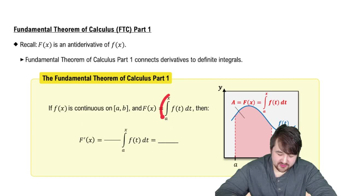
Step 2: Recall the Fundamental Theorem of Calculus, Part 1. It states that if ƒ is continuous on [a, 𝓍], then the derivative of the area function A(𝓍) with respect to 𝓍 is equal to the value of the integrand at 𝓍. Mathematically, A'(𝓍) = ƒ(𝓍).
Step 3: Understand the relationship between an antiderivative and the integrand. An antiderivative F of ƒ satisfies F'(𝓍) = ƒ(𝓍). This means that F is a function whose derivative is ƒ.
Step 4: Compare A'(𝓍) = ƒ(𝓍) (from the Fundamental Theorem of Calculus) with the statement A'(𝓍) = F(𝓍). Since F'(𝓍) = ƒ(𝓍), the statement A'(𝓍) = F(𝓍) is incorrect unless F(𝓍) = ƒ(𝓍), which is not generally true. A'(𝓍) equals ƒ(𝓍), not F(𝓍).
Step 5: Provide a counterexample to clarify. Consider ƒ(𝓍) = 𝓍². The area function A(𝓍) = ∫ₐˣ 𝓉² dt has a derivative A'(𝓍) = 𝓍². However, an antiderivative F(𝓍) of ƒ(𝓍) could be F(𝓍) = (1/3)𝓍³ + C, which is not equal to ƒ(𝓍). This demonstrates that the statement A'(𝓍) = F(𝓍) is false.

Risposta video verificata per un problema simile:

Questa soluzione video è stata consigliata dai nostri tutor come utile per risolvere questo problema.
Durata del video:
1m

Concetti chiave

Ecco i concetti essenziali che devi comprendere per rispondere correttamente alla domanda.

Fundamental Theorem of Calculus

The Fundamental Theorem of Calculus connects differentiation and integration, stating that if F is an antiderivative of a continuous function f on an interval [a, b], then the integral of f from a to x is given by A(x) = ∫ₐˣ f(t) dt = F(x) - F(a). This theorem implies that the derivative of the area function A(x) is equal to the original function f evaluated at x, i.e., A'(x) = f(x).
Video consigliato:
Percorso guidato
06:11
Fundamental Theorem of Calculus Part 1

Area Function

An area function A(x) represents the accumulated area under the curve of a function f from a fixed point a to a variable point x. Mathematically, it is defined as A(x) = ∫ₐˣ f(t) dt. This function is crucial in understanding how the total area changes as x varies, and its derivative A'(x) gives the instantaneous rate of change of this area, which corresponds to the value of the function f at that point.
Video consigliato:
05:06
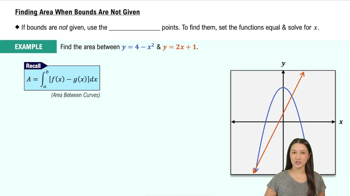
Finding Area When Bounds Are Not Given

Antiderivative

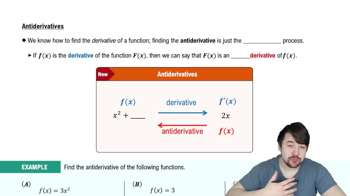
An antiderivative F of a function f is a function whose derivative is f, meaning F' = f. Antiderivatives are essential in calculus as they allow us to reverse the process of differentiation. In the context of the area function, if F is an antiderivative of f, then the area function A(x) can be expressed in terms of F, leading to the conclusion that A'(x) = F'(x) = f(x).
Video consigliato:
Percorso guidato
05:50
Antiderivatives
Pratica correlata
Domanda del libro di testo

Limit definition of the definite integral Use the limit definition of the definite integral with right Riemann sums and a regular partition to evaluate the following definite integrals. Use the Fundamental Theorem of Calculus to check your answer. 


∫₀² (𝓍²―4) d𝓍

155
views
Domanda del libro di testo

Use geometry and properties of integrals to evaluate the following definite integrals.

∫₄⁰ (2𝓍 + √(16―𝓍²)) d𝓍 . (Hint: Write the integral as sum of two integrals.)

114
views
Domanda del libro di testo

Area functions and the Fundamental Theorem Consider the function

ƒ(t) = { t      if  ―2 ≤ t < 0

t²/2    if    0 ≤ t ≤ 2

and its graph shown below. Let F(𝓍) = ∫₋₁ˣ ƒ(t) dt and G(𝓍) = ∫₋₂ˣ ƒ(t) dt.

(b) Use the Fundamental Theorem to find an expression for F '(𝓍) for ―2 ≤ 𝓍 < 0.

60
views
Domanda del libro di testo

Use geometry and properties of integrals to evaluate the following definite integrals.                                                                                          


 ∫₀⁴ √(8𝓍―𝓍²) d𝓍 . (Hint: Complete the square .)

98
views
Domanda del libro di testo

Integration by Riemann sums Consider the integral ∫₁⁴ (3𝓍― 2) d𝓍.


(c) Evaluate the definite integral by taking the limit as n →∞ of the Riemann sum in part (b).

77
views
Domanda del libro di testo

Evaluating integrals Evaluate the following integrals.                                                                                                                                         


 ∫ (cos 7ω) /(16 + sin² 7ω) dω 

71
views