


Ch. 5 - Integration
Briggs - Calculus: Early Transcendentals 3rd Edition
Briggs3rd EditionCalculus: Early TranscendentalsISBN: 9780136847243Non è quello che usi tu?Cambia libro di testo
Capitolo 5, Problema 5.R.9c

Integration by Riemann sums Consider the integral ∫₁⁴ (3𝓍― 2) d𝓍.


(c) Evaluate the definite integral by taking the limit as n →∞ of the Riemann sum in part (b).

Guida verificata passo dopo passo
1
Step 1: Recall the formula for the Riemann sum approximation of a definite integral. Divide the interval [1, 4] into n subintervals of equal width Δ𝓍 = (4 - 1)/n = 3/n.
Step 2: Identify the sample points within each subinterval. For simplicity, use the right endpoints of each subinterval: 𝓍ᵢ = 1 + iΔ𝓍, where i ranges from 1 to n.
Step 3: Write the Riemann sum for the function f(𝓍) = 3𝓍 - 2 over the interval [1, 4]. The sum is given by Sₙ = Σᵢ₌₁ⁿ f(𝓍ᵢ)Δ𝓍, where f(𝓍ᵢ) = 3𝓍ᵢ - 2 and Δ𝓍 = 3/n.
Step 4: Substitute 𝓍ᵢ = 1 + iΔ𝓍 and Δ𝓍 = 3/n into the Riemann sum. This gives Sₙ = Σᵢ₌₁ⁿ [(3(1 + i(3/n)) - 2)(3/n)]. Simplify the expression inside the summation.
Step 5: Take the limit as n → ∞ of the Riemann sum Sₙ. Use the properties of summation and limits to evaluate the sum, which will yield the value of the definite integral ∫₁⁴ (3𝓍 - 2) d𝓍.

Risposta video verificata per un problema simile:

Questa soluzione video è stata consigliata dai nostri tutor come utile per risolvere questo problema.
Durata del video:
5m

Concetti chiave

Ecco i concetti essenziali che devi comprendere per rispondere correttamente alla domanda.

Riemann Sums

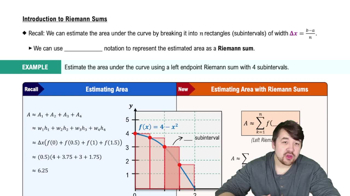
Riemann sums are a method for approximating the value of a definite integral by dividing the area under a curve into small rectangles. The sum of the areas of these rectangles provides an estimate of the integral. As the number of rectangles increases (n → ∞) and their width decreases, the Riemann sum approaches the exact value of the integral.
Video consigliato:
Percorso guidato
06:11
Introduction to Riemann Sums

Definite Integral

A definite integral represents the signed area under a curve between two specified limits, in this case, from 1 to 4. It is denoted as ∫ₐᵇ f(x) dx, where f(x) is the function being integrated. The value of a definite integral can be interpreted as the accumulation of quantities, such as area, over the interval [a, b].
Video consigliato:
Percorso guidato
05:43
Definition of the Definite Integral

Limit Process

The limit process in calculus involves evaluating the behavior of a function as it approaches a certain point or value. In the context of Riemann sums, taking the limit as n approaches infinity allows us to refine our approximation of the integral, leading to the exact value. This process is fundamental in defining the concept of integration in calculus.
Video consigliato:
05:50
One-Sided Limits
Pratica correlata
Domanda del libro di testo

Limit definition of the definite integral Use the limit definition of the definite integral with right Riemann sums and a regular partition to evaluate the following definite integrals. Use the Fundamental Theorem of Calculus to check your answer. 


∫₀² (𝓍²―4) d𝓍

155
views
Domanda del libro di testo

Use geometry and properties of integrals to evaluate the following definite integrals.

∫₄⁰ (2𝓍 + √(16―𝓍²)) d𝓍 . (Hint: Write the integral as sum of two integrals.)

114
views
Domanda del libro di testo

Area functions and the Fundamental Theorem Consider the function

ƒ(t) = { t      if  ―2 ≤ t < 0

t²/2    if    0 ≤ t ≤ 2

and its graph shown below. Let F(𝓍) = ∫₋₁ˣ ƒ(t) dt and G(𝓍) = ∫₋₂ˣ ƒ(t) dt.

(b) Use the Fundamental Theorem to find an expression for F '(𝓍) for ―2 ≤ 𝓍 < 0.

60
views
Domanda del libro di testo

Evaluating integrals Evaluate the following integrals.                                                                                                                                         


 ∫ y² /(y³ + 27) dy

70
views
Domanda del libro di testo

Explain why or why not Determine whether the following statements are true and give an explanation or counterexample. Assume ƒ and ƒ' are continuous functions for all real numbers.

(f) ∫ₐᵇ (2 ƒ(𝓍) ―3g (𝓍)) d𝓍 = 2 ∫ₐᵇ ƒ(𝓍) d𝓍 + 3 ∫₆ᵃ g(𝓍) d𝓍 .

37
views
Domanda del libro di testo

Explain why or why not Determine whether the following statements are true and give an explanation or counterexample. Assume ƒ and ƒ' are continuous functions for all real numbers.

(b) Given an area function A(𝓍) = ∫ₐˣ ƒ(t) dt and an antiderivative F of ƒ, it follows that A'(𝓍) = F(𝓍) .

46
views