Ch. 5 - Integration
Briggs - Calculus: Early Transcendentals 3rd Edition
Briggs3rd EditionCalculus: Early TranscendentalsISBN: 9780136847243Non è quello che usi tu?Cambia libro di testo
Capitolo 5, Problema 5.3.87b

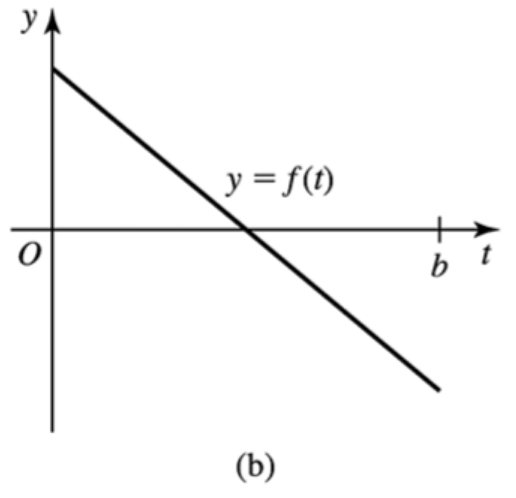
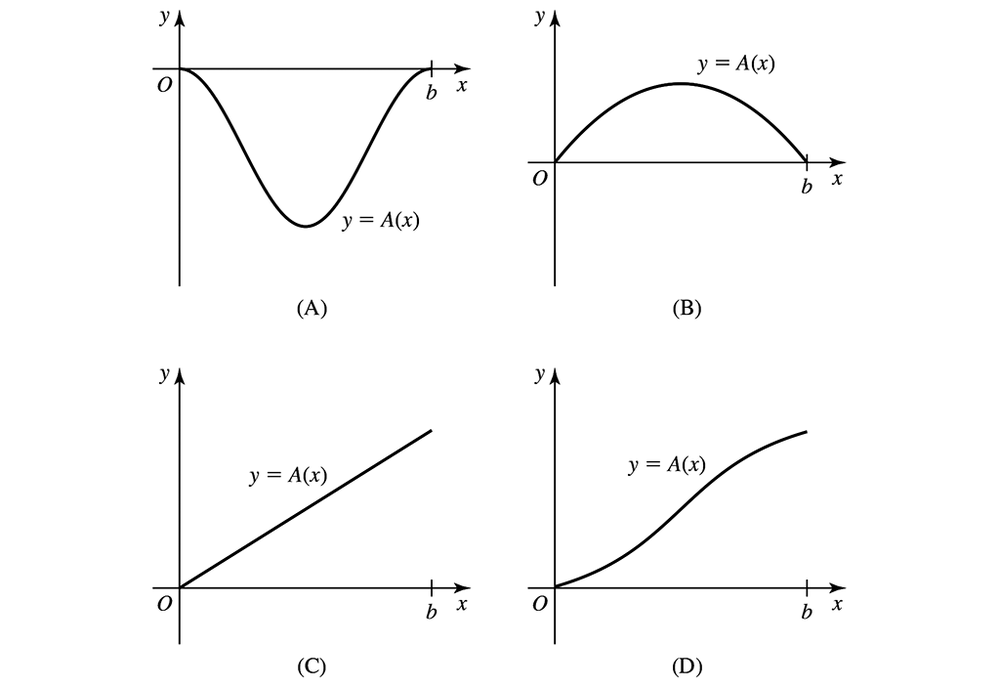
Matching functions with area functions Match the functions ƒ, whose graphs are given in a― d, with the area functions A (𝓍) = ∫₀ˣ ƒ(t) dt, whose graphs are given in A–D.


<IMAGE>


<IMAGE>

Guida verificata passo dopo passo
1
Step 1: Understand the relationship between the function ƒ(t) and the area function A(x). The area function A(x) = ∫₀ˣ ƒ(t) dt represents the accumulated area under the curve of ƒ(t) from t = 0 to t = x. The shape of A(x) depends on the behavior of ƒ(t).
Step 2: Analyze the graph of ƒ(t) in image (b). The function ƒ(t) is a linear function that starts positive at t = 0, decreases linearly, crosses the t-axis, and becomes negative. This indicates that the area accumulated initially increases, then decreases as the negative contributions dominate.
Step 3: Match the behavior of ƒ(t) to the corresponding area function A(x). Since ƒ(t) starts positive, A(x) initially increases. As ƒ(t) crosses the t-axis and becomes negative, A(x) starts decreasing. This matches the graph labeled (A), which shows an initial increase followed by a decrease.
Step 4: Verify the match by considering the slope of A(x). The slope of A(x) is given by ƒ(t). In graph (A), the slope of A(x) is positive initially (matching the positive ƒ(t)), becomes zero at the peak (where ƒ(t) = 0), and then becomes negative (matching the negative ƒ(t)).
Step 5: Conclude that the graph of ƒ(t) in image (b) corresponds to the area function A(x) in graph (A). This is based on the consistent relationship between the function and its integral.

Risposta video verificata per un problema simile:

Questa soluzione video è stata consigliata dai nostri tutor come utile per risolvere questo problema.
Durata del video:
2m

Concetti chiave

Ecco i concetti essenziali che devi comprendere per rispondere correttamente alla domanda.

Definite Integral

A definite integral represents the signed area under the curve of a function f(t) from a specified lower limit to an upper limit. It is denoted as A(x) = ∫₀ˣ f(t) dt, where A(x) gives the accumulated area from 0 to x. Understanding this concept is crucial for relating the function f(t) to its area function A(x).
Video consigliato:
Percorso guidato
05:43
Definition of the Definite Integral

Area Function

An area function A(x) is defined as the integral of a function f(t) from a lower limit to x. It provides a way to visualize how the area under the curve changes as x varies. The shape and behavior of the area function graph can reveal important characteristics about the original function f(t), such as its increasing or decreasing nature.
Video consigliato:
05:06
Finding Area When Bounds Are Not Given

Graphical Interpretation

Graphical interpretation involves analyzing the visual representation of functions and their integrals. For the functions f(t) and their corresponding area functions A(x), understanding how the graph of f(t) influences the graph of A(x) is essential. For instance, if f(t) is positive, A(x) will increase, while if f(t) is negative, A(x) will decrease, illustrating the relationship between the two.
Video consigliato:
05:02
Determining Differentiability Graphically
Pratica correlata