Ch. 5 - Integration
Briggs - Calculus: Early Transcendentals 3rd Edition
Briggs3rd EditionCalculus: Early TranscendentalsISBN: 9780136847243Non è quello che usi tu?Cambia libro di testo
Capitolo 5, Problema 5.3.98b

Working with area functions Consider the function ƒ and the points a, b, and c.
(b) Graph ƒ and A.
ƒ(𝓍) = 1/𝓍 ; a = 1 , b = 4 , c = 6

Guida verificata passo dopo passo
1
First, understand that the function given is \( f(x) = \frac{1}{x} \), which is a hyperbola defined for \( x > 0 \).
Next, identify the points \( a = 1 \), \( b = 4 \), and \( c = 6 \) on the x-axis. These will be important for defining the intervals over which we consider the area function.
The area function \( A(x) \) is typically defined as the integral of \( f(t) \) from a fixed point \( a \) to a variable upper limit \( x \), so write \( A(x) = \int_{a}^{x} \frac{1}{t} \, dt \).
To graph \( f(x) \), plot the curve \( y = \frac{1}{x} \) for \( x \geq 1 \), noting that it decreases and approaches zero as \( x \) increases.
To graph the area function \( A(x) \), recognize that it represents the accumulated area under \( f(t) \) from \( t = 1 \) to \( t = x \). This area corresponds to the integral \( \int_{1}^{x} \frac{1}{t} \, dt \), which is related to the natural logarithm function.

Risposta video verificata per un problema simile:

Questa soluzione video è stata consigliata dai nostri tutor come utile per risolvere questo problema.
Durata del video:
3m

Concetti chiave

Ecco i concetti essenziali che devi comprendere per rispondere correttamente alla domanda.

Area Functions and the Definite Integral

An area function A(x) represents the accumulated area under the curve of a function ƒ from a fixed point a to a variable point x. It is defined using the definite integral, A(x) = ∫ₐˣ ƒ(t) dt, which measures the net area between the graph of ƒ and the x-axis over [a, x]. Understanding this concept is essential for interpreting and graphing area functions.
Video consigliato:
Percorso guidato
05:43
Definition of the Definite Integral

Graphing the Function ƒ(x) = 1/x

The function ƒ(x) = 1/x is a hyperbola with two branches, defined for x ≠ 0. It is positive and decreasing on the interval (0, ∞), approaching zero as x increases. Recognizing its shape and behavior helps in visualizing the area under the curve between points a, b, and c, which is crucial for sketching both ƒ and the area function A.
Video consigliato:
03:39
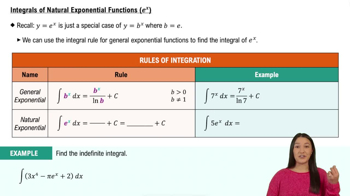
Integrals of Natural Exponential Functions (e^x)

Relationship Between a Function and Its Area Function

The Fundamental Theorem of Calculus links a function ƒ and its area function A by stating that A'(x) = ƒ(x). This means the slope of the area function at any point x equals the value of ƒ at x. Understanding this relationship aids in graphing A by using the shape of ƒ and interpreting how the accumulated area changes over the interval.
Video consigliato:
05:23
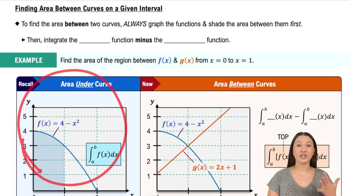
Finding Area Between Curves on a Given Interval
Pratica correlata
Domanda del libro di testo

Using properties of integrals Use the value of the first integral I to evaluate the two given integrals. 

I = ∫₀¹ (𝓍³ ― 2𝓍) d𝓍 = ―3/4

(b) ∫₁⁰ (2𝓍―𝓍³) d𝓍

85
views

Domanda del libro di testo

Area functions for linear functions Consider the following functions ƒ and real numbers a (see figure).

(b) Verify that A'(𝓍) = ƒ(𝓍).

ƒ(t) = 3t + 1 , a = 2

71
views
Domanda del libro di testo

Use Table 5.6 to evaluate the following indefinite integrals.                                                                                                               


 (b) ∫ sec 5𝓍 tan 5𝓍 d𝓍

103
views
Domanda del libro di testo

Matching functions with area functions Match the functions ƒ, whose graphs are given in a― d, with the area functions A (𝓍) = ∫₀ˣ ƒ(t) dt, whose graphs are given in A–D.


63
views
Domanda del libro di testo

Properties of integrals Suppose ∫₀³ƒ(𝓍) d𝓍 = 2 , ∫₃⁶ƒ(𝓍) d𝓍 = ―5 , and ∫₃⁶g(𝓍) d𝓍 = 1. Evaluate the following integrals.

(b) ∫₃⁶ (―3g(𝓍)) d𝓍

38
views
Domanda del libro di testo

Properties of integrals Consider two functions ƒ and g on [1,6] such that ∫₁⁶ƒ(𝓍) d𝓍 = 10 and ∫₁⁶g(𝓍) d𝓍 = 5, ∫₄⁶ƒ(𝓍) d𝓍 = 5 , and ∫₁⁴g(𝓍) d𝓍 = 2. Evaluate the following integrals.


(b) ∫₁⁶ (f(𝓍) ― g(𝓍)) d𝓍

63
views