Ch. 5 - Integration
Briggs - Calculus: Early Transcendentals 3rd Edition
Briggs3rd EditionCalculus: Early TranscendentalsISBN: 9780136847243Non è quello che usi tu?Cambia libro di testo
Capitolo 5, Problema 5.4.50

Symmetry of composite functions Prove that the integrand is either even or odd. Then give the value of the integral or show how it can be simplified. Assume f and g are even functions and p and q are odd functions.
∫ᵃ₋ₐ ƒ(p(𝓍)) d𝓍

Guida verificata passo dopo passo
1
Step 1: Recall the definitions of even and odd functions. An even function satisfies ƒ(𝓍) = ƒ(-𝓍), while an odd function satisfies ƒ(𝓍) = -ƒ(-𝓍). These properties will help us analyze the symmetry of the integrand.
Step 2: Analyze the composition ƒ(p(𝓍)). Since ƒ is an even function, ƒ(p(𝓍)) will depend on the behavior of p(𝓍). Because p is an odd function, p(-𝓍) = -p(𝓍). Substituting this into ƒ, we get ƒ(p(-𝓍)) = ƒ(-p(𝓍)).
Step 3: Use the property of ƒ being even. Since ƒ is even, ƒ(-p(𝓍)) = ƒ(p(𝓍)). Therefore, ƒ(p(𝓍)) satisfies ƒ(p(-𝓍)) = ƒ(p(𝓍)), which means the integrand ƒ(p(𝓍)) is an even function.
Step 4: Apply the symmetry property of definite integrals. For an even function integrated over a symmetric interval [-a, a], the integral simplifies to 2 times the integral from 0 to a. Specifically, ∫ᵃ₋ₐ ƒ(p(𝓍)) d𝓍 = 2∫₀ᵃ ƒ(p(𝓍)) d𝓍.
Step 5: Conclude the simplification. Since the integrand is even, the integral can be simplified as described in Step 4. If further evaluation is needed, substitute specific forms of ƒ and p into the integral and proceed with integration techniques.

Risposta video verificata per un problema simile:

Questa soluzione video è stata consigliata dai nostri tutor come utile per risolvere questo problema.
Durata del video:
2m

Concetti chiave

Ecco i concetti essenziali che devi comprendere per rispondere correttamente alla domanda.

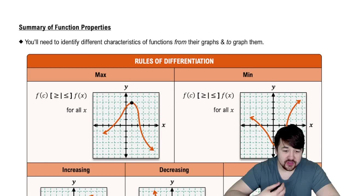
Even and Odd Functions

Even functions satisfy the property f(-x) = f(x) for all x, meaning their graphs are symmetric about the y-axis. Odd functions, on the other hand, satisfy f(-x) = -f(x), indicating symmetry about the origin. Understanding these properties is crucial for analyzing the symmetry of composite functions and their integrals.
Video consigliato:
Percorso guidato
06:21
Properties of Functions

Composite Functions

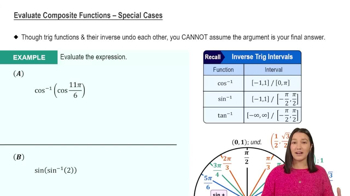
A composite function is formed when one function is applied to the result of another function, denoted as (f ∘ g)(x) = f(g(x)). When dealing with even and odd functions, the symmetry properties of the outer and inner functions can affect the overall symmetry of the composite function, which is essential for determining the nature of the integrand.
Video consigliato:
3:48
Evaluate Composite Functions - Special Cases

Integration of Symmetric Functions

When integrating even functions over symmetric intervals, the integral can be simplified to twice the integral from 0 to a, while the integral of odd functions over symmetric intervals equals zero. This property allows for easier computation of integrals involving even and odd functions, particularly in the context of the given problem.
Video consigliato:
05:11
Integrals of General Exponential Functions
Pratica correlata
Domanda del libro di testo

Let ƒ(𝓍) = c, where c is a positive constant. Explain why an area function of ƒ is an increasing function.

72
views

Domanda del libro di testo

Areas of regions Find the area of the region bounded by the graph of ƒ and the 𝓍-axis on the given interval.


ƒ(𝓍) = sin 𝓍 on [―π/4, 3π/4]

108
views
Domanda del libro di testo

Is x¹² an even or odd function? Is sin x² an even or odd function?

74
views
Domanda del libro di testo

Symmetry in integrals Use symmetry to evaluate the following integrals.

∫²₋₂ (x² + x³) dx

113
views
Domanda del libro di testo

Left and right Riemann sums Use the figures to calculate the left and right Riemann sums for f on the given interval and for the given value of n.

ƒ(𝓍) = x + 1 on [1,6] ; n = 5

533
views
Domanda del libro di testo

Use the given substitution to evaluate the following indefinite integrals. Check your answer by differentiating.                                                                                              


 ∫ 8𝓍 cos (4𝓍² + 3) d𝓍, u = 4𝓍² + 3

53
views