 Indietro
Bioenergetics and Enzyme Catalysis in Cell Biology
Guida di studio - Note intelligenti
 Appunti personalizzati basati sui tuoi materiali, ampliati con definizioni chiave, esempi e contesto.
Bioenergetics: The Flow of Energy in the Cell
Types of Biological Work
Cells perform various types of work to sustain life, each requiring energy transformation:
Synthetic Work: Formation and rearrangement of chemical bonds, such as biosynthesis of macromolecules.
Mechanical Work: Movement of cells or subcellular structures, e.g., muscle contraction or chromosome separation.
Concentration Work: Transport of molecules across membranes against concentration gradients.
Electrical Work: Movement of ions across membranes to generate electrochemical gradients.
Heat Work: Increase in temperature, often as a byproduct of metabolic reactions.
Bioluminescence: Production of light, as seen in certain organisms like fireflies.
Energy Transformation in Biological Systems
Energy flows through biological systems via photosynthesis and chemotrophic metabolism. Phototrophs convert solar energy into chemical energy, while chemotrophs utilize organic compounds for energy.
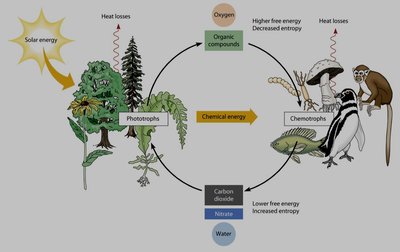
Laws of Thermodynamics in Biology
The behavior of energy in cells is governed by two fundamental laws:
First Law: Energy cannot be created or destroyed; it can only change forms.
Second Law: Entropy (disorder) of the universe is always increasing, meaning the capacity to do work decreases over time.
The relationship between energy, entropy, and temperature is described by the equation:
Where: = total energy = free energy (usable for work) = entropy (unusable energy) = temperature in Kelvin
Free Energy and Chemical Reactions
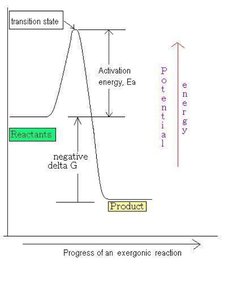
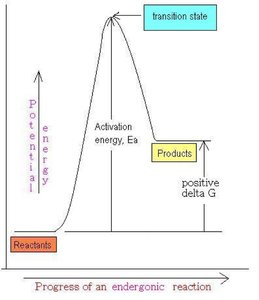
Free energy (Gibbs' energy) is the portion of a system's energy available to do work. Chemical reactions involve changes in free energy, which determines whether a reaction is spontaneous.
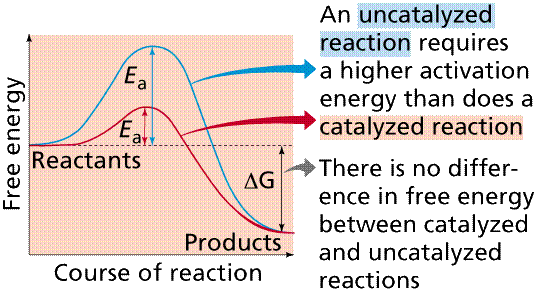
Activation Energy: The energy required to initiate a reaction by breaking chemical bonds.( can not be used for anything else , it's there to break
delta G - change in free energy free energy of the P- the Reactants= negative delta G ( gives energy)
Exergonic vs. Endergonic Reactions
Reactions of synthesis are classified based on their energy changes:
Exergonic Reactions: Release energy; spontaneous (). -
Endergonic Reactions: Consume energy; non-spontaneous (). (
Energy Change vs. Absolute Energy
Biologists focus on the change in energy during reactions rather than absolute energy values. For example, burning wood releases measurable energy, indicating the energy required to form wood.
Energy and Equilibrium
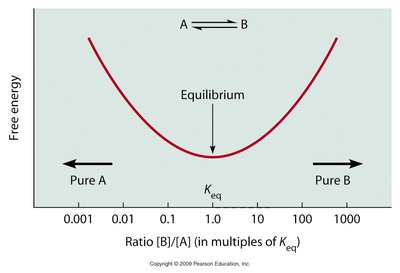
Biological systems maintain a metastable state, far from equilibrium, to sustain life. At equilibrium, no work can be done, and the system is considered dead. pure A- pure B . you reach equilibrium, you convert to B A- B B-A . . example : example coco mentos experience: it boils ever. you threw the system off- the equilibrium- releasing energy . at equilibrium it's at lowest.
Biological systems must remain in a dynamic, non-equilibrium steady state to stay alive, because reaching true thermodynamic equilibrium means the system can no longer perform work, resulting in cellular death.
When considering a chemical reaction transitioning from pure reactant A to pure product B, the system naturally drives toward a point of lowest free energy (equilibrium). Here is how this relates to biological metastability:
Protein Folding and Thermodynamics
Proteins spontaneously fold into their functional conformations, driven by thermodynamic favorability. Denaturation (unfolding) occurs with heat or extreme pH, disrupting non-covalent interactions. entropy : random system but delta G is negative- then more energy in the system (. it doesn't make sense) ,minute 23 .
internal bonds. We have to put energy into a system to unfold a folded structure (like a protein) because the folded state is held together by stabilizing internal bonds, making the unfolded state higher in internal energy (enthalpy)
Going from unorganized to organized causes a decrease in structural entropy (

−ΔS
−Δ𝑆
), which nature generally dislikes. For this organization to happen spontaneously, the system must pay for it by releasing energy.
When the molecule folds into an organized shape, thousands of tiny chemical bonds (hydrogen bonds, van der Waals forces, and salt bridges) snap into place. Forming these bonds releases a massive amount of heat (negative enthalpy,
−ΔH
−Δ𝐻
). This heat release is so favorable that it completely compensates for the lost randomness of the chain.
your system is protein and water , hydrogen bonds .. when you heat it up you break them -> becomes more end, when you are defending a system what is in the system .
he unfolded protein is both—it is a mixture of hydrophobic (water-fearing) and hydrophilic (water-loving) sections. [1]
Because it is entirely stretched out and unorganized, both types of regions are completely exposed to the surrounding water. This exposure is what causes the thermodynamic tension: [1]
The Hydrophilic regions: They are perfectly happy being unfolded. They easily form stable hydrogen bonds with the surrounding water.
The Hydrophobic regions: They are highly unstable when exposed. Water cannot bond with them, so the water molecules are forced to freeze into rigid, highly ordered "cages" around these oily patches. [1, 2, 3, 4]
double bonds breaking.. extreme ph concept ( restudy and visit)
dis-orgnized to organized you dont need energy?
entropy is less in folding. high energy state. we have to put energy in the system for it to heat and unfold .
1.What is the sign of ΔG for the folding process? What about the unfolding?
Why?
Folding: (spontaneous)
Unfolding: (non-spontaneous)
Bonds disrupted: Hydrogen bonds, ionic bonds, hydrophobic interactions, van der Waals forces.
Enzymes: The Catalysts of Life
Nature and Function of Enzymes
Enzymes are biological catalysts, mostly proteins, that accelerate chemical reactions without being consumed. They often require cofactors (metal ions or vitamins you need vitamins ) for activity.
history - enzymes: what is the break through here in science: you dont need the whole living yeast cell to do it IT IS SOMETHING IN THE YEAST
James sumner breakthrough: isolated and crystallized , pure.
third big discovery: how enzymes actually work by J.B. S Haldane.
example: they're looking for enzymes released by the tissue (in heart attack) During a heart attack, damaged heart muscle cells release proteins and enzymes—known as cardiac biomarkers—into the bloodstream. that is what they look for in a blood test. meaning the tissue is not receiving blood supply.
hiv protein it stops replication .
stable means in chemical reaction sequences: all biological systems exist in meta stable state.
Enzyme Deficiency: Can cause inherited disorders.
Enzyme Activity Measurement: Important for disease diagnosis.
Drug Action: Many drugs target enzymes to alter their activity.
Enzyme Catalysis and Activation Energy
Enzymes lower the activation energy required for reactions, increasing the rate without affecting the equilibrium.
Enzyme Specificity
Enzymes exhibit substrate specificity, recognizing particular molecules or groups. For example, chymotrypsin cleaves peptides at aromatic amino acids due to its hydrophobic pocket.
Temperature and pH Dependence
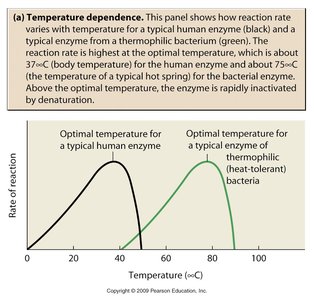
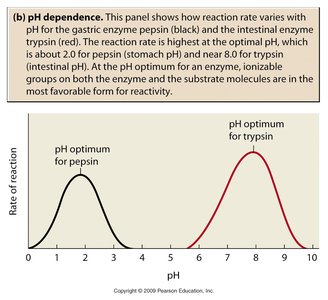
Enzyme activity is influenced by temperature and pH, with optimal conditions for each enzyme:
Temperature: optimal temperature depends on enzyme activity. Human enzymes peak at ~37°C; thermophilic enzymes at higher temperatures. there is animal that increase temperature to speed up metabolism .
pH: Pepsin (stomach) optimal at pH 2; trypsin (intestine, duodenum ) at pH 8.. .
Mechanisms of Enzyme Action
enzymes speed up the rates of biochemical reactions. active site
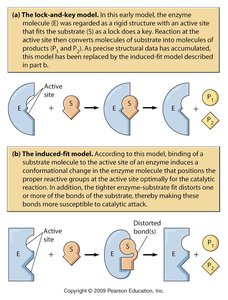
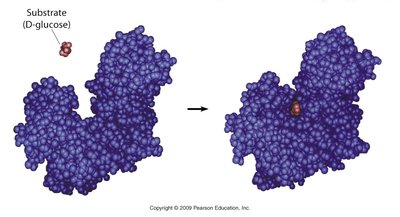
Enzymes bind substrates at their active sites, often inducing a conformational change (induced fit) to facilitate catalysis.
e+s-ES-EP-E+P
enzymes do not alter the reaction equilibrium but they alter the forward and reverse reaction rates
Enzyme Kinetics
In the induced fit model, an enzyme changes its shape when a substrate binds to it, molding tightly around the molecule like a hand putting on a glove.
How Binding Happens
Initial contact: The substrate approaches the enzyme's active site. They recognize each other through weak chemical forces like hydrogen bonds, ionic bonds, and hydrophobic interactions.
Recognition: The active site is complementary to the substrate, but it is not a rigid, perfect lock-and-key fit initially
These weak forces allow the substrate to attach temporarily, trigger the shape change, and easily detach once the reaction is finished.
Enzyme kinetics studies the rates of reactions. The Michaelis-Menten equation describes the relationship between substrate concentration and reaction velocity:
why if you keep increasing substrate concentration you dont have and increase in velocity (Increasing substrate concentration stops increasing the reaction velocity once the enzymes reach a state called saturation, where all available active sites are completely occupied. [1, 2]
Vmax: Maximum velocity at saturating substrate concentration.
Km: Substrate concentration at half-maximal velocity; indicator of enzyme affinity.
how does binding happen ? how does it actually change.
Regulation of Enzyme Activity
Enzyme activity is regulated by several mechanisms:
Feedback Inhibition: Product inhibits the enzyme that catalyzed its formation.
Allosteric Regulation: Effectors bind to sites other than the active site, altering activity.
Covalent Modification: Phosphorylation or proteolytic cleavage activates or inactivates enzymes.
Enzyme Inhibition
Inhibitors can be reversible or irreversible:
Competitive Inhibition: Inhibitor binds to the active site, preventing substrate binding.
Non-competitive Inhibition: Inhibitor binds elsewhere, altering enzyme function.
Irreversible Inhibition: Inhibitor permanently inactivates the enzyme.
Classification of Enzymes ( we went over in lec)
Enzymes are classified based on the type of reaction they catalyze:
Group of Enzyme | Reaction Catalysed | Examples |
|---|---|---|
Oxidoreductases | Transfer of hydrogen and oxygen atoms or electrons | Dehydrogenases, Oxidases |
Transferases | Transfer of a specific group (phosphate, methyl, etc.) | Transaminase, Kinases |
Hydrolases | Hydrolysis of a substrate | Esterases, Digestive enzymes |
Isomerases ( create isomerase) | Change of molecular form of substrate | Phosphohexo isomerase, Fumarase |
Lyases | Nonhydrolytic removal/addition of a group | Decarboxylases, Aldolases |
Ligases | Joining of two molecules by new bonds | Citric acid synthetase |
Models of Enzyme-Substrate Interaction
Two main models explain how enzymes interact with substrates:
substrate - peanuts in shells, enzyme is monkey peanuts inside are product
Lock-and-Key Model: Substrate fits precisely into the enzyme's active site.
Induced Fit Model: Enzyme changes shape upon substrate binding, enhancing catalysis.
Summary Table: Enzyme Regulation and Inhibition
Regulation/Inhibition Type | Mechanism | Example |
|---|---|---|
Feedback Inhibition | Product inhibits enzyme | Glucose-6-phosphate inhibits hexokinase |
Competitive Inhibition | Inhibitor binds active site | Anticoagulant drug blocks vitamin K site |
Non-competitive Inhibition | Inhibitor binds elsewhere | Toxin binds enzyme, prevents product formation |
Irreversible Inhibition | Permanent inactivation | Aspirin inhibits prostaglandin synthetase |
Covalent Modification | Phosphorylation/cleavage activates enzyme | Pepsinogen to pepsin |
Additional info: Academic context was added to clarify enzyme classification, regulation, and thermodynamic principles, as well as to expand on kinetic equations and models of enzyme action.
