 Indietro
Carbohydrates: Structure, Types, and Functions in Cell Biology
Guida di studio - Note intelligenti
 Appunti personalizzati basati sui tuoi materiali, ampliati con definizioni chiave, esempi e contesto.
Carbohydrates: The Molecules of Life
Introduction to Carbohydrates
Carbohydrates, also known as saccharides or colloquially as 'sugars,' are essential biomolecules in all living cells. They serve as energy sources, structural components, and play roles in cell recognition and signaling. Carbohydrates are classified based on the number of monomeric units they contain and their chemical structure.
Classification of Carbohydrates
Monosaccharides
Monosaccharides are the simplest form of carbohydrates, often referred to as 'simple sugars.' They are the building blocks for more complex carbohydrates.
General Formula: where to $7$
Functional Groups: Polyhydroxy aldehydes (aldoses) or polyhydroxy ketones (ketoses)
Examples: Glucose (6C, aldose), Ribose (5C, aldose), Fructose (6C, ketose), Glyceraldehyde (3C, aldose)
Naming: Usually end in '-ose'
Monosaccharides can exist in linear or ring forms. The ring structure is more common in biological systems, especially for 5- and 6-carbon sugars.
Sugar Alcohols
Sugar alcohols are derived from sugars but lack the carbonyl group. Each carbon atom is attached to a hydroxyl group. Glycerol is a key example, important in lipid structure.
Disaccharides
Disaccharides are formed by joining two monosaccharides via a dehydration (condensation) reaction, producing a glycosidic bond.
Examples: Sucrose (glucose + fructose), Maltose (glucose + glucose), Lactose (glucose + galactose)
Functions: Energy and carbon transport, energy source
Oligosaccharides
Oligosaccharides are short chains (typically 3–10 units) of monosaccharides. They are often branched and play important roles in cell recognition, signaling, and protein function.
Example: Fructans (found in plants such as onions and artichokes)
Functions: Osmoregulation, immune function, cell identity (e.g., blood group antigens)
Polysaccharides
Polysaccharides are long chains (hundreds to thousands) of monosaccharide units. They can be linear or branched and serve as energy storage or structural components.
Examples: Starch, Glycogen, Cellulose, Chitin
Functions: Energy storage (starch, glycogen), structure (cellulose, chitin)
Chemical Structure and Isomerism
Aldoses vs. Ketoses
Monosaccharides are classified based on the position of the carbonyl group:
Aldose: Carbonyl group at the end (C1), e.g., glucose
Ketose: Carbonyl group at an internal position (usually C2), e.g., fructose
Ring Structures: Pyranose and Furanose
Monosaccharides with five or more carbons typically form ring structures in solution:
Pyranose: Six-membered ring (5 carbons + 1 oxygen), e.g., glucose
Furanose: Five-membered ring (4 carbons + 1 oxygen), e.g., fructose
Alpha (α) and Beta (β) Anomers
When monosaccharides cyclize, the orientation of the hydroxyl group at the anomeric carbon (C1) determines the form:
α-anomer: OH group is down (opposite side of the ring from CH2OH)
β-anomer: OH group is up (same side as CH2OH)
This distinction is crucial because polymers of α- and β-glucose have different properties and biological roles.
Biologically Important Polysaccharides
Glycogen
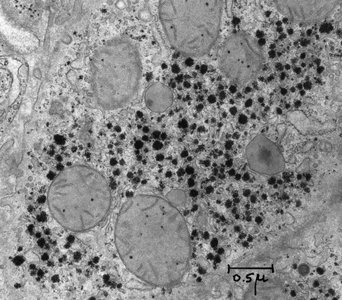
Glycogen is the main storage polysaccharide in animals (and also found in fungi and bacteria). It is a highly branched polymer of α-glucose with α(1→4) glycosidic bonds in the chains and α(1→6) bonds at branch points. Glycogen is stored in the liver and skeletal muscle, providing a rapid source of glucose when needed.
Starch
Starch is the main storage polysaccharide in plants. It consists of two types of molecules:
Amylose: Unbranched chains of α(1→4) linked glucose
Amylopectin: Branched chains with α(1→4) and α(1→6) linkages
Starch is stored in plastids such as chloroplasts.
Cellulose
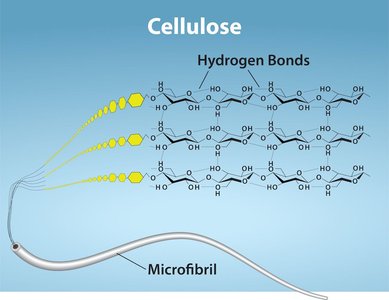
Cellulose is a structural polysaccharide in plant cell walls. It is a linear polymer of β-glucose units joined by β(1→4) glycosidic bonds. Cellulose molecules form strong fibers called microfibrils through hydrogen bonding, providing rigidity to plant cells. Humans cannot digest cellulose due to the lack of enzymes to break β(1→4) linkages.
Chitin
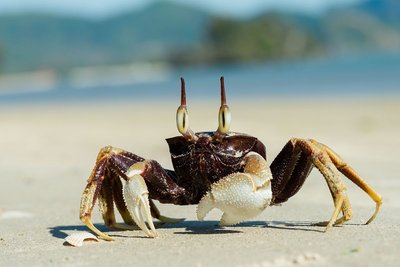
Chitin is a structural polysaccharide found in the exoskeletons of arthropods (such as crabs and insects) and in fungal cell walls. It is composed of N-acetylglucosamine (NAG) units joined by β(1→4) linkages, forming long, straight, unbranched chains.
Functions of Carbohydrates in Cells
Monosaccharides: Chemical energy (e.g., glucose in glycolysis), energy transport, signaling
Disaccharides: Energy transport (e.g., sucrose in plants), osmoprotection, signaling
Oligosaccharides: Cell identity recognition (e.g., blood group antigens), immune function, osmoregulation, protein function
Polysaccharides: Energy storage (glycogen, starch), structure (cellulose, chitin)
Summary Table: Types of Carbohydrates
Type | Number of Units | Examples | Main Functions |
|---|---|---|---|
Monosaccharide | 1 | Glucose, Fructose, Ribose | Energy, signaling |
Disaccharide | 2 | Sucrose, Maltose, Lactose | Energy transport |
Oligosaccharide | ~3–10 | Fructans, Blood group antigens | Cell recognition, signaling |
Polysaccharide | 100–1000+ | Starch, Glycogen, Cellulose, Chitin | Energy storage, structure |
Key Learning Outcomes
Define monosaccharide, disaccharide, oligosaccharide, and polysaccharide.
Give examples of each type of carbohydrate.
Identify whether a monosaccharide is an aldehyde or a ketone, and recognize common modifications.
Draw and recognize the structure of glycerol.
Distinguish between alpha- and beta-glucose and their biological significance.
Explain the roles of cellulose, starch, glycogen, and chitin in cells.
