 Indietro
Enzymes: The Catalysts of Life – Comprehensive Study Notes
Guida di studio - Note intelligenti
 Appunti personalizzati basati sui tuoi materiali, ampliati con definizioni chiave, esempi e contesto.
Ch. 6 – Enzymes: The Catalysts of Life
Introduction to Enzymes
Enzymes are organic catalysts essential for nearly all cellular reactions. They determine whether a reaction can and will occur under cellular conditions by lowering the activation energy required for the reaction to proceed.
Enzyme: A biological catalyst, usually a protein, that accelerates chemical reactions without being consumed.
Catalysis: The process of increasing the rate of a chemical reaction by lowering its activation energy.
Activation Energy and the Metastable State
Many reactions in cells are thermodynamically feasible but do not proceed at appreciable rates due to high activation energy barriers. The reactants must reach a transition state with higher free energy before converting to products.
Activation Energy (EA): The minimum energy required for reactants to reach the transition state.
Metastable State: A state where reactants are thermodynamically unstable but lack sufficient energy to react.
Transition State: The high-energy intermediate state during a reaction.
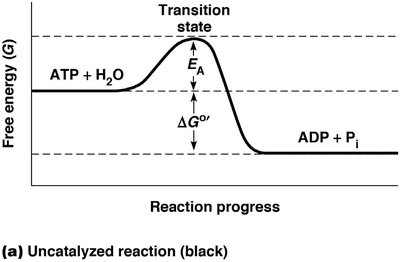
Example: Hydrolysis of ATP to ADP and Pi has a negative ΔG but requires a significant activation energy to proceed.
Catalysts Overcome the Activation Energy Barrier
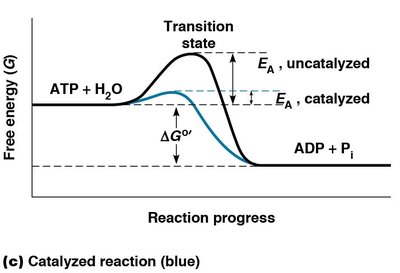
Catalysts, including enzymes, lower the activation energy required for reactions, allowing them to proceed rapidly at cellular temperatures. They do this by providing a surface for reactants to come together and by stabilizing the transition state.
Properties of Enzymes as Biological Catalysts
Increase reaction rates by lowering activation energy (EA).
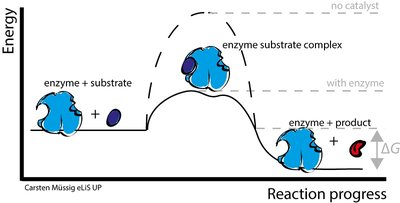
Form transient, reversible complexes with substrates.
Change the rate at which equilibrium is achieved, but not the position of equilibrium.
Enzyme Structure and the Active Site
Most enzymes are proteins, though some RNA molecules (ribozymes) also have catalytic activity. The active site is a specific region where substrates bind and catalysis occurs, formed by the three-dimensional folding of the protein.
Active Site: A groove or pocket in the enzyme where substrates are bound with high specificity and catalysis takes place.
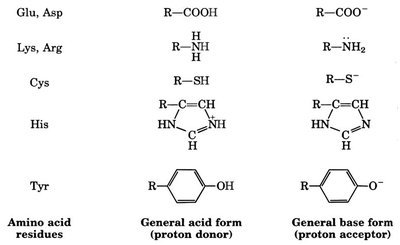
Amino Acids Involved in the Active Site
Only a subset of the 20 amino acids are typically involved in the active site, participating in substrate binding and catalysis, often as proton donors or acceptors.
Cofactors and Coenzymes
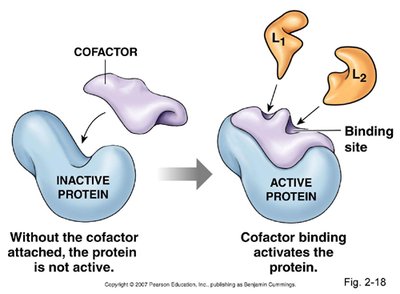
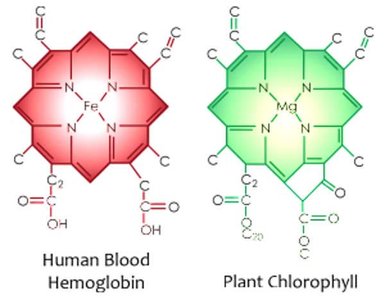
Some enzymes require nonprotein components called cofactors (prosthetic groups) for activity. These may be metal ions or small organic molecules (coenzymes, often derived from vitamins).
Cofactor: Nonprotein component essential for enzyme function.
Coenzyme: Organic cofactor, often derived from vitamins.
Enzyme Specificity
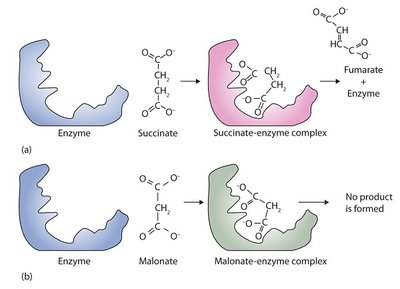
Enzymes exhibit high substrate specificity due to the precise shape and chemical environment of the active site. Some enzymes show group specificity, acting on substrates with a common structural feature.
Enzyme Diversity and Nomenclature
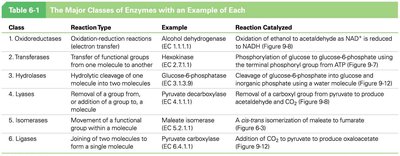
Enzymes are named based on their substrate or function and are classified into six major classes:
Class | Reaction Type | Example | Reaction Catalyzed |
|---|---|---|---|
Oxidoreductase | Oxidation-reduction | Alcohol dehydrogenase | Oxidation of ethanol to acetaldehyde |
Transferase | Transfer of functional groups | Hexokinase | Phosphorylation of glucose |
Hydrolase | Hydrolytic cleavage | Glucose-6-phosphatase | Hydrolysis of glucose-6-phosphate |
Lyase | Removal of a group | Pyruvate decarboxylase | Removal of CO2 from pyruvate |
Isomerase | Isomerization | Maleate isomerase | Cis-trans isomerization of maleate |
Ligase | Joining of molecules | Pyruvate carboxylase | Addition of CO2 to pyruvate |
Sensitivity to Temperature and pH
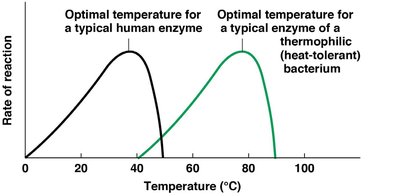
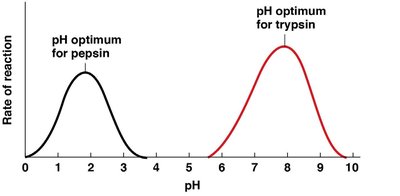
Enzyme activity is sensitive to temperature and pH. Each enzyme has an optimal temperature and pH range. Deviations can lead to denaturation or loss of activity.
At low temperatures, enzyme activity increases with temperature due to increased kinetic energy.
High temperatures can denature enzymes, causing loss of structure and function.
pH affects the ionization of amino acids at the active site, influencing enzyme activity.
Sensitivity to Other Factors
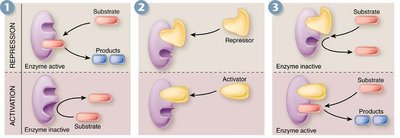
Enzyme activity can also be affected by inhibitors, activators, and the ionic strength of the environment, which influence the enzyme's conformation and interactions.
Substrate Binding and Conformational Change
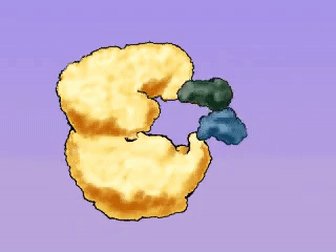
Substrates bind to the enzyme's active site via noncovalent interactions, causing a conformational change that optimally orients the substrate for catalysis. This binding is reversible.
Models of Enzyme-Substrate Interaction
Lock-and-Key Model: The enzyme is rigid, and the substrate fits precisely into the active site.
Induced-Fit Model: Substrate binding induces a conformational change in the enzyme, enhancing the fit and catalytic efficiency.
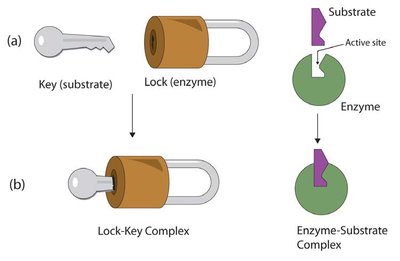
Mechanisms of Substrate Activation
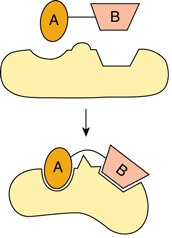
Enzymes activate substrates through bond distortion, proton transfer, and electron transfer, facilitating the conversion to products.
Bond Distortion: Weakens bonds in the substrate, making them more susceptible to catalytic attack.
Proton Transfer: Increases substrate reactivity.
Electron Transfer: Forms temporary covalent bonds between enzyme and substrate.
Ribozymes: Catalytic RNA Molecules
Some RNA molecules, called ribozymes, possess catalytic activity. Examples include self-splicing RNA in Tetrahymena, RNase P, and ribosomal RNA (rRNA).
Tetrahymena RNA: Self-splicing RNA discovered by Thomas Cech and colleagues.
RNase P: Cleaves tRNA precursors; the RNA component alone is catalytic.
rRNA: Catalyzes peptide bond formation in ribosomes.

Regulation of Enzyme Activity
Enzyme activity is regulated by substrate-level regulation, feedback inhibition, allosteric regulation, covalent modification, and proteolytic cleavage.
Substrate-level Regulation: Increased substrate increases reaction rate.
Feedback Inhibition: End product inhibits an earlier step in the pathway.
Allosteric Regulation: Effectors bind to sites other than the active site, altering enzyme conformation and activity.
Covalent Modification: Addition/removal of chemical groups (e.g., phosphorylation) regulates activity.
Proteolytic Cleavage: Irreversible activation by cleavage of a peptide bond (e.g., activation of digestive enzymes).
Enzyme Inhibition
Enzyme inhibitors can be reversible or irreversible. Reversible inhibitors are classified as competitive or noncompetitive based on their binding site and mechanism.
Competitive Inhibitors: Bind to the active site, competing with the substrate.
Noncompetitive Inhibitors: Bind elsewhere, causing conformational changes that reduce activity.
Irreversible Inhibitors: Covalently bind to the enzyme, permanently inactivating it.
Enzyme Kinetics
Enzyme kinetics quantitatively describes the rate of substrate conversion to product, influenced by substrate, product, and inhibitor concentrations. The Michaelis–Menten equation models this relationship.
Initial Velocity (v): Rate measured before substrate depletion affects the reaction.
Michaelis–Menten Equation:
Km (Michaelis constant): Substrate concentration at which the reaction rate is half of Vmax; indicates enzyme affinity for substrate.
Vmax: Maximum reaction velocity at saturating substrate concentration.
Turnover Number (kcat): Number of substrate molecules converted to product per enzyme per second at Vmax.
Lineweaver–Burk (Double-Reciprocal) Plot:
Used to determine Km and Vmax graphically.
Summary Table: Enzyme Regulation Mechanisms
Activation | Inhibition |
|---|---|
Substrate | Product |
Covalent (phosphorylation, methylation, acetylation) | Covalent (phosphorylation, methylation, acetylation) |
Proteolytic cleavage (zymogens) | Nerve gas poisons, insecticides, reducing agents |
Non-covalent (allosteric activators) | Non-covalent (reversible competitive/noncompetitive, allosteric inhibitors) |
Irreversible denaturation (acids, bases, high temp, heavy metals) |
Additional info: These notes provide a comprehensive overview of enzyme structure, function, regulation, and kinetics, suitable for exam preparation in a college-level Cell Biology course.
