 Indietro
Functions of the Cell Membrane: Transport, Endocytosis, and Exocytosis
Guida di studio - Note intelligenti
 Appunti personalizzati basati sui tuoi materiali, ampliati con definizioni chiave, esempi e contesto.
Functions of the Cell Membrane
Overview
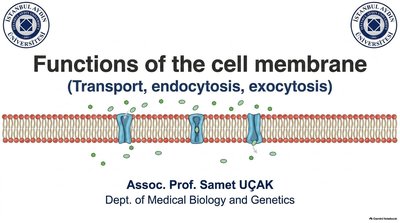
The cell membrane, also known as the plasma membrane, is a dynamic structure that serves as the boundary between the cell and its external environment. It regulates the movement of substances into and out of the cell, maintaining homeostasis and enabling communication and transport processes essential for life.
The Structure of the Cell Membrane
The Lipid Bilayer
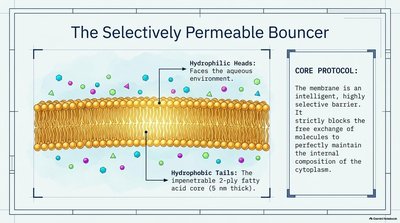
The cell membrane is primarily composed of a phospholipid bilayer, which forms a hydrophobic barrier that separates the cell from its surroundings. The bilayer is interspersed with proteins, cholesterol, and carbohydrates, each contributing to membrane function and fluidity.
Hydrophilic heads: Face the aqueous environment inside and outside the cell.
Hydrophobic tails: Form the core of the membrane, repelling polar molecules and ions.
Membrane Transport Mechanisms
Selective Permeability
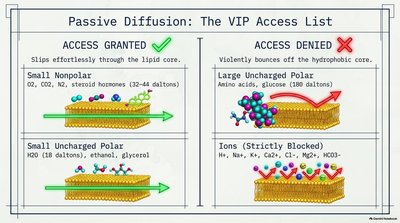
The cell membrane is selectively permeable, allowing certain molecules to pass while restricting others. This property is crucial for maintaining the internal environment of the cell.
Small nonpolar molecules (e.g., O2, CO2) diffuse freely.
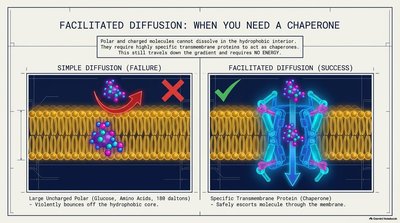
Large or charged molecules (e.g., ions, glucose) require specialized transport proteins.
Passive Transport
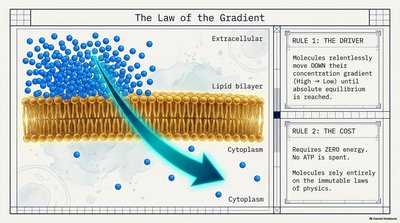
Passive transport involves the movement of molecules down their concentration gradient without the expenditure of cellular energy (ATP).
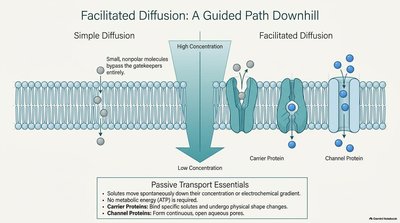
Simple diffusion: Movement of small, nonpolar molecules directly through the lipid bilayer.
Facilitated diffusion: Movement of larger or polar molecules via specific transmembrane proteins (carriers or channels).
Facilitated Diffusion
Facilitated diffusion is a type of passive transport that requires membrane proteins to assist the movement of substances that cannot diffuse directly through the lipid bilayer.
Carrier proteins: Undergo conformational changes to transport specific molecules across the membrane.
Channel proteins: Form hydrophilic pores that allow specific ions or water molecules to pass.
Carrier Proteins
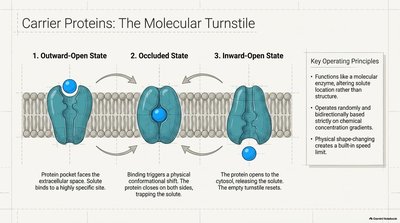
Carrier proteins function like molecular turnstiles, binding to specific solutes and undergoing conformational changes to transport them across the membrane.
Operate in three states: outward-open, occluded, and inward-open.
Transport is specific and can be bidirectional depending on the concentration gradient.
GLUT Transporters
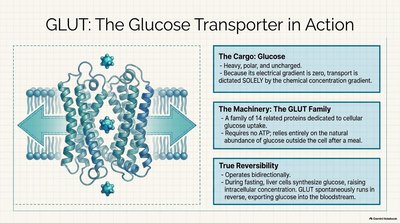
GLUT (Glucose Transporter) proteins are a family of carrier proteins responsible for the facilitated diffusion of glucose across cell membranes.
Transport is reversible and depends solely on the glucose concentration gradient.
GLUT proteins do not require ATP.
Ion Channels
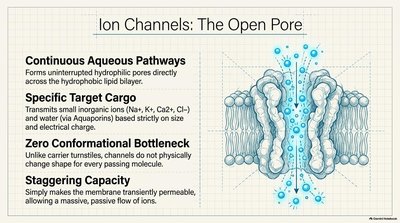
Ion channels are transmembrane proteins that form continuous aqueous pathways, allowing the rapid and selective movement of ions across the membrane.
Highly selective for specific ions (e.g., Na+, K+, Ca2+, Cl-).
Do not undergo conformational changes for each ion transported.
Channel Proteins and Gating
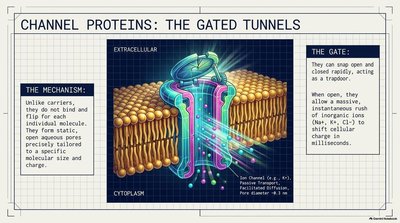
Channel proteins can be gated, opening or closing in response to specific stimuli (e.g., voltage, ligands, mechanical stress), allowing for regulated ion flow.
Enable rapid changes in cellular charge and signaling.
Comparison: Carrier Proteins vs. Channel Proteins
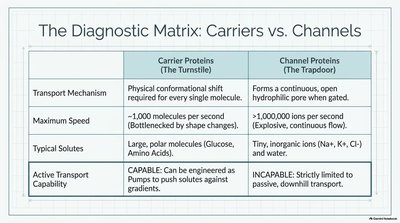
Carrier and channel proteins differ in their mechanisms, speed, and specificity.
Carrier Proteins (The Turnstile) | Channel Proteins (The Trapdoor) | |
|---|---|---|
Transport Mechanism | Physical conformational shift required for every single molecule. | Forms a continuous, open hydrophilic pore when gated. |
Maximum Speed | ~1,000 molecules per second (bottlenecked by shape changes). | >1,000,000 ions per second (explosive, continuous flow). |
Typical Solutes | Large, polar molecules (glucose, amino acids). | Tiny, inorganic ions (Na+, K+, Cl-) and water. |
Active Transport Capability | Capable: Can be engineered as pumps to push solutes against gradients. | Incapable: Strictly limited to passive, downhill transport. |
Summary Table: Passive Transport Mechanisms
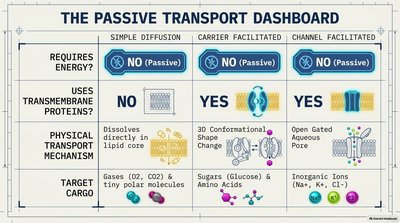
Simple Diffusion | Carrier Facilitated | Channel Facilitated | |
|---|---|---|---|
Requires Energy? | No (Passive) | No (Passive) | No (Passive) |
Uses Transmembrane Proteins? | No | Yes | Yes |
Physical Transport Mechanism | Dissolves directly in lipid core | 3D conformational shape change | Open gated aqueous pore |
Target Cargo | Gases (O2, CO2) & tiny polar molecules | Sugars (glucose) & amino acids | Inorganic ions (Na+, K+, Cl-) |
Osmosis and Water Transport
Osmosis
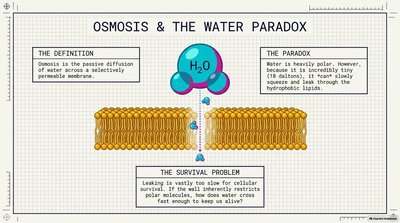
Osmosis is the passive diffusion of water across a selectively permeable membrane, driven by differences in solute concentration.
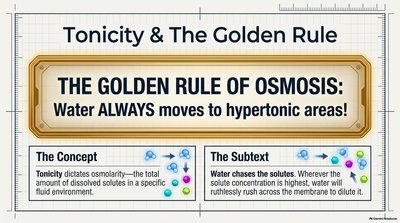
Water moves from areas of low solute concentration to high solute concentration (toward hypertonic regions).
Aquaporins
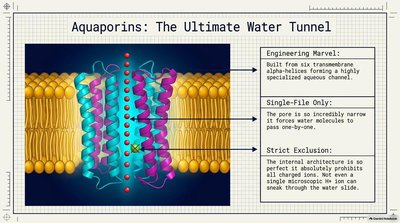
Aquaporins are specialized channel proteins that facilitate the rapid movement of water molecules across the cell membrane, overcoming the slow rate of simple diffusion for polar water molecules.
Highly selective for water; exclude ions and other solutes.
Tonicity and Osmotic Balance
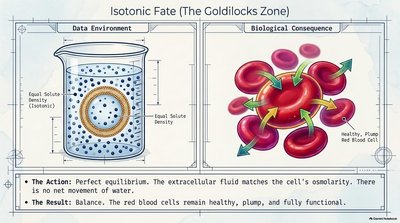
Tonicity refers to the relative concentration of solutes in the extracellular fluid compared to the cytoplasm, dictating the direction of water movement.
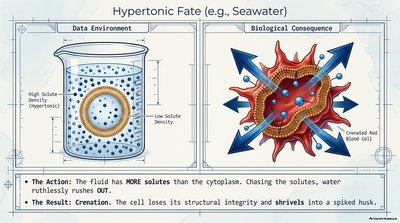
Hypertonic solution: Higher solute concentration outside the cell; water exits the cell, causing shrinkage (crenation).
Isotonic solution: Equal solute concentration; no net water movement, cell remains stable.
Hypotonic solution: Lower solute concentration outside; water enters the cell, potentially causing swelling or lysis.
Summary
The cell membrane's selective permeability is essential for cellular homeostasis.
Passive transport includes simple diffusion, facilitated diffusion via carriers and channels, and osmosis.
Specialized proteins such as carriers, channels, and aquaporins enable the efficient and regulated movement of vital molecules and ions.
Tonicity and osmotic balance are critical for cell survival and function.
