 Indietro
Genomic Organization, Chromatin Structure, and Gene Regulation
Guida di studio - Note intelligenti
 Appunti personalizzati basati sui tuoi materiali, ampliati con definizioni chiave, esempi e contesto.
Genomic Organization and Structure
Genome Size and Complexity
The genome size of eukaryotes varies widely and is not directly proportional to organismal complexity. Eukaryotic genomes contain both coding and non-coding sequences, including repetitive DNA elements and regulatory regions.
Genome size is measured in base pairs (bp) or millions of base pairs (Mb).
Non-coding DNA includes introns, regulatory sequences, and repetitive elements.
Example: The human genome contains approximately 3.2 billion base pairs, while Drosophila melanogaster has about 180 million base pairs.
Structure of Eukaryotic Genes
Eukaryotic genes are composed of exons (coding regions) and introns (non-coding regions). The arrangement of these elements allows for complex regulation and alternative splicing.
Exons: Sequences that code for proteins.
Introns: Non-coding sequences removed during mRNA processing.
Regulatory elements: Promoters, enhancers, and silencers control gene expression.
Gene Structure and Regulation
Introns and Exons
Introns are intervening sequences found within genes that are transcribed into RNA but are removed during mRNA processing. Exons remain in the mature mRNA and are translated into protein.
Discovery of introns was a key finding in molecular biology, revealing that eukaryotic genes are often interrupted by non-coding sequences.
Alternative splicing allows a single gene to produce multiple protein isoforms.
Transcriptional Regulatory Elements
Gene expression is controlled by regulatory DNA sequences that interact with transcription factors and other proteins to increase or decrease transcription.
Promoters: Sites where RNA polymerase binds to initiate transcription.
Enhancers/Silencers: Elements that can increase or repress gene expression, often located far from the gene they regulate.
Alternative Splicing
Alternative splicing is a process by which different combinations of exons are joined together to produce multiple mRNA variants from a single gene, increasing protein diversity.
Example: The human β-globin gene undergoes alternative splicing to produce different hemoglobin subunits during development.
Non-Coding RNAs and Gene Regulation
miRNAs and lncRNAs
MicroRNAs (miRNAs) and long non-coding RNAs (lncRNAs) are important regulators of gene expression. miRNAs typically bind to complementary sequences in mRNA to inhibit translation or promote degradation, while lncRNAs can modulate gene expression through various mechanisms.
miRNAs: Short, non-coding RNAs (~22 nucleotides) that regulate gene expression post-transcriptionally.
lncRNAs: Longer non-coding RNAs (>200 nucleotides) involved in chromatin remodeling, transcriptional regulation, and other processes.
Repetitive DNA and Transposable Elements
Types of Repetitive DNA
Repetitive DNA sequences are abundant in eukaryotic genomes and include satellite DNA, minisatellites, microsatellites, and transposable elements.
Satellite DNA: Highly repetitive sequences, often found in centromeres and heterochromatin.
Transposable elements: DNA sequences that can move within the genome, including LINEs (Long Interspersed Nuclear Elements) and SINEs (Short Interspersed Nuclear Elements).
Movement and Impact of Transposable Elements
Transposable elements can cause mutations, gene duplications, and genome rearrangements, contributing to genetic diversity and evolution.
Retrotransposons move via an RNA intermediate and reverse transcription.
DNA transposons move directly as DNA.
Chromatin Structure and Organization
Nucleosomes and Chromatin
DNA in eukaryotic cells is packaged into chromatin, which consists of DNA wrapped around histone proteins to form nucleosomes. This structure compacts DNA and regulates access for transcription, replication, and repair.
Nucleosome: The basic unit of chromatin, consisting of ~147 bp of DNA wrapped around a histone octamer.
Chromatin condensation varies during the cell cycle, with highly condensed chromosomes visible during mitosis.
Centromeres and Telomeres
Centromeres are specialized chromosomal regions essential for proper segregation during cell division. Telomeres are repetitive DNA sequences at chromosome ends that protect against degradation.
Centromeric DNA: Contains specific repetitive sequences and is associated with specialized proteins (e.g., CENP-A).
Telomeric DNA: Consists of tandem repeats (e.g., TTAGGG in humans) and is maintained by the enzyme telomerase.
Epigenetic Inheritance
Epigenetic mechanisms, such as DNA methylation and histone modification, regulate gene expression without altering the DNA sequence. These modifications can be inherited through cell division.
Example: Inheritance of CENP-A at centromeres ensures proper chromosome segregation.
Comparative Genomics: Drosophila vs. Human Centromeres
Organization of Centromeric DNA
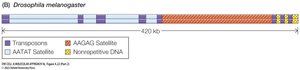
Centromeric regions differ significantly between species in terms of size, sequence composition, and organization. The following images illustrate the structure of centromeric DNA in Drosophila melanogaster and humans.
Drosophila centromeres contain a mix of transposons, satellite DNA (AAGAG, AATAT), and non-repetitive DNA.
Human centromeres are composed almost entirely of satellite DNA, spanning several megabases.

Cell Cycle and Chromosome Dynamics
Phases of the Cell Cycle
The eukaryotic cell cycle consists of four main phases: G1, S, G2, and M (mitosis). Chromatin structure and chromosome condensation change dynamically throughout the cycle.
G1 phase: Cell growth and preparation for DNA synthesis.
S phase: DNA replication.
G2 phase: Preparation for mitosis.
M phase: Mitosis and cytokinesis.
Chromosome Condensation and Segregation
During mitosis, chromatin condenses to form visible chromosomes, which are segregated to daughter cells. The centromere is crucial for proper attachment to the mitotic spindle.
Prophase: Chromosomes condense.
Metaphase: Chromosomes align at the metaphase plate.
Anaphase: Sister chromatids separate.
Telophase: Chromosomes decondense and nuclear envelope reforms.
Summary Table: Characteristics of the Average Human Gene
Feature | Average Value |
|---|---|
Gene length | ~27 kb |
Number of exons | ~9 |
Exon length | ~145 bp |
Intron length | ~3,365 bp |
Protein-coding sequence | ~1.3 kb |
Additional info: | Data from ENCODE Project Consortium, 2012 |
Key Terms and Concepts
Genome: The complete set of genetic material in an organism.
Chromatin: The complex of DNA and proteins that forms chromosomes.
Centromere: The region of a chromosome that links sister chromatids and attaches to spindle fibers during mitosis.
Telomere: The repetitive DNA sequence at the end of a chromosome, protecting it from degradation.
Transposon: A mobile genetic element that can move within the genome.
Satellite DNA: Highly repetitive DNA, often found in centromeric regions.
