 Indietro
Metabolism and Enzyme Function in Cell Biology
Guida di studio - Note intelligenti
 Appunti personalizzati basati sui tuoi materiali, ampliati con definizioni chiave, esempi e contesto.
Metabolism: Organization and Pathways
Metabolic Networks and Pathways
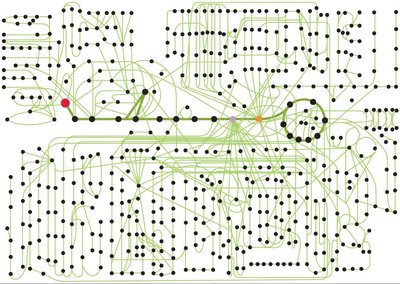
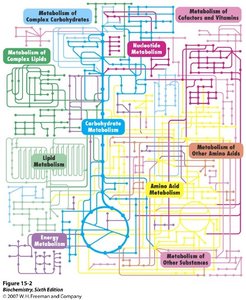
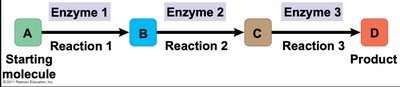
Metabolism in cells consists of thousands of interconnected chemical reactions, each catalyzed by a specific enzyme. These reactions are organized into metabolic pathways, which convert a precursor (starting molecule) into a product through a series of intermediates. Pathways may be linear or cyclic, and together they form the cell's metabolic network.
Metabolic pathway: A series of enzyme-catalyzed reactions converting a starting molecule to a product.
Intermediates: Molecules formed at each step between precursor and product.
Metabolic network: Interconnected pathways within the cell.
Example: Glycolysis, citric acid cycle.
Types of Metabolic Pathways
Anabolic and Catabolic Pathways
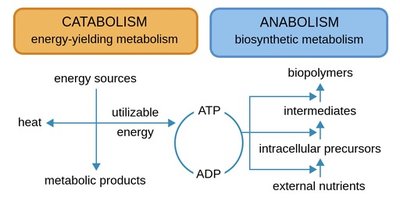
Metabolic pathways are classified as anabolic or catabolic. Anabolic pathways synthesize larger molecules from smaller components and require energy input, involving endergonic reactions. Catabolic pathways break down molecules and release energy, involving exergonic reactions. ATP joins these pathways via energy coupling.
Anabolic pathways: Synthesis of complex molecules; require energy.
Catabolic pathways: Breakdown of molecules; release energy.
Energy coupling: ATP links catabolic and anabolic reactions.
Example: Photosynthesis (anabolic), cellular respiration (catabolic).
Types of Chemical Reactions in Cells
Major Reaction Types
Cellular metabolism involves several types of chemical reactions:
Hydrolysis: Breaking bonds with water.
Condensation: Forming bonds and releasing water.
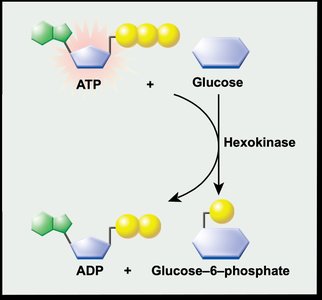
Group Transfer: Transferring functional groups between molecules.
Isomerization: Rearranging atoms within a molecule.
Oxidation-Reduction: Electron transfer between molecules.
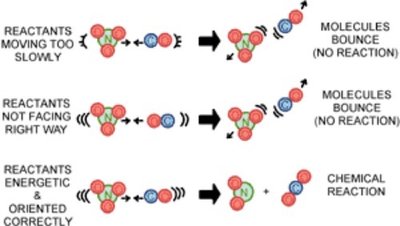
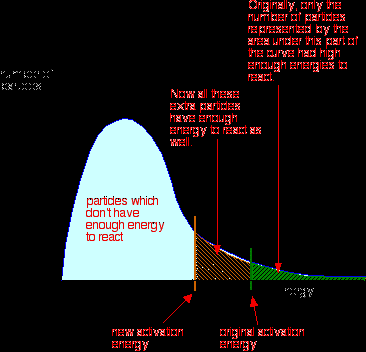
Reactions occur when reactants collide in a precise orientation and have enough kinetic energy to reach the transition state.
Transition State and Activation Energy
Transition State Theory
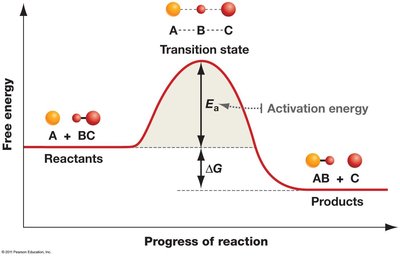
Reaching the transition state requires bond distortion and overcoming repulsive forces.
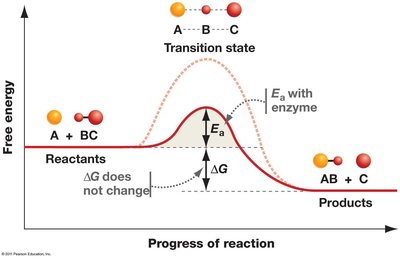
The transition state is a short-lived, unstable intermediate with high free energy.
Activation energy (Ea) is the energy required for reactants to reach the transition state.
A less stable transition state means higher activation energy and a slower reaction rate.
Transition state: Bonds are partially broken and formed.
Activation energy (Ea): Minimum energy needed for reaction.
Free energy change (ΔG): Determines reaction direction.
Factors Affecting Reaction Direction and Rate
Thermodynamics and Kinetics
The direction of a reaction is governed by changes in:
- potential energy (ΔH)
- disorder (ΔS)
- temperature
- reactant/product concentrations.
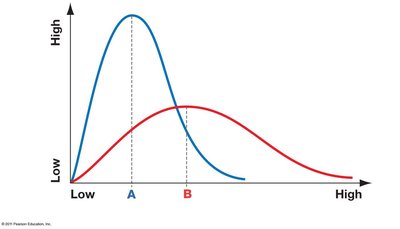
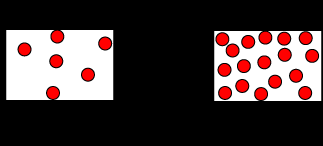
The rate is governed by temperature, reactant concentrations, and catalysis.
Direction: Determined by ΔG (Gibbs free energy).
Rate: Increased by higher temperature, higher reactant concentration, and catalysis.
Successful reactions require proper orientation and sufficient energy.
Catalysis and Enzymes
Role of Catalysts
A catalyst provides an alternative reaction pathway with lower activation energy, increasing the reaction rate. Catalysts do not change ΔG or the direction of the reaction. Enzymes are protein catalysts that accelerate reactions by lowering Ea, often increasing rates by 108 to 1013-fold.
Catalyst: Lowers Ea, increases rate, not consumed.
Enzyme: Protein catalyst, highly efficient.
Enzyme Specificity and Classification
Substrate Specificity
Enzymes vary in specificity. Some act on one substrate, others on a family of related substrates. Enzymes are classified by the type of reaction they catalyze:
Oxidoreductases: Oxidation-reduction reactions.
Transferases: Group-transfer reactions.
Isomerases: Isomerization reactions.
Ligases/Synthetases: Condensation reactions.
Hydrolases: Hydrolysis reactions.
Example: Hexokinase phosphorylates several hexose sugars (broad specificity), glucose oxidase acts primarily on glucose (high specificity).
Enzyme Mechanism: Active Site and Induced Fit
Active Site and Substrate Binding
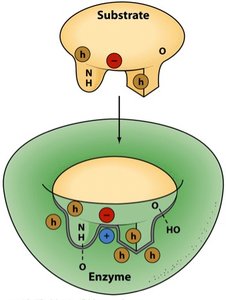
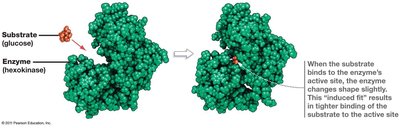
Substrates bind to an enzyme's active site, forming an enzyme-substrate complex. The active site is a three-dimensional pocket formed by specific amino acid side chains, complementary to substrates in shape, charge, and hydrophobic/hydrophilic properties. Substrate binding often induces a conformational change in the enzyme (induced fit), strengthening interactions and promoting catalysis.
Active site: Region where substrate binds and reaction occurs.
Induced fit: Enzyme changes shape to better fit substrate.
Transition-State Facilitation Mechanisms
Enzyme Action Steps
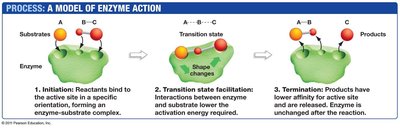
Enzymes facilitate the transition state by:
Substrate orientation: Aligns reactants for productive interactions.
Bond strain: Enzyme binding distorts substrate bonds, bringing substrate closer to transition state.
Chemical catalysis: Amino acid side chains interact chemically with substrate, increasing reactivity.
Transition-state stabilization: Active site forms favorable interactions with transition state, lowering free energy.
Enzyme action involves substrate binding, catalysis/transition-state formation, and product release.



Factors Affecting Enzyme Activity
Enzyme Activity and Regulation
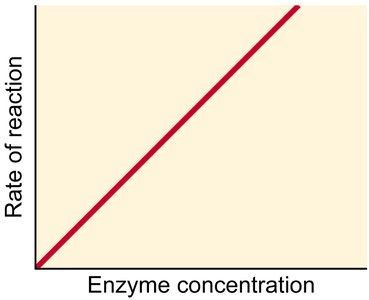
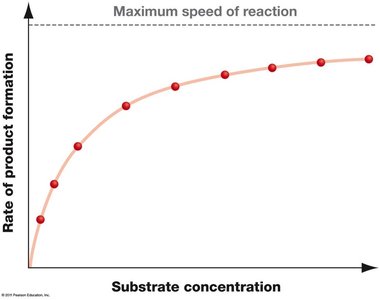
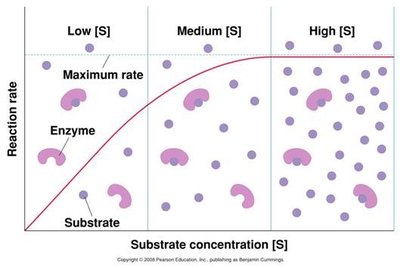
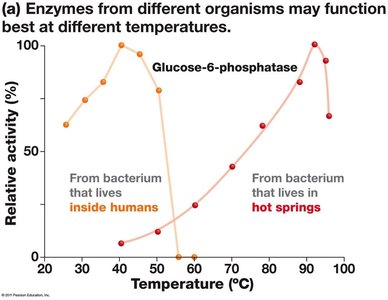
The rate of an enzyme-catalyzed reaction is referred to as enzyme activity. It depends on cofactors, enzyme concentration, substrate concentration, temperature, pH, and regulation.
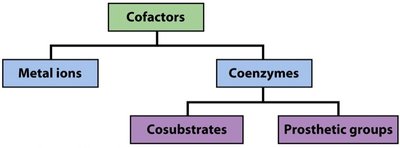
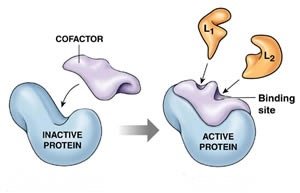
Cofactors: Non-protein molecules required for enzyme function.
Enzyme concentration: More enzyme increases reaction rate (when substrate is abundant).
Substrate concentration: Higher substrate increases rate until saturation.
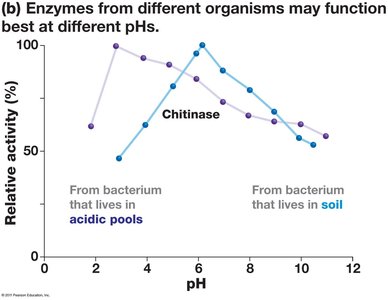
Temperature and pH: Enzymes have optimum values; activity falls outside these ranges.
Regulation: Enzyme activity can be modulated by various mechanisms.
Enzyme Regulation
Mechanisms of Regulation
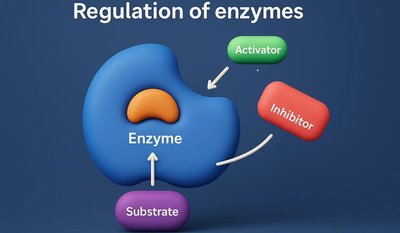
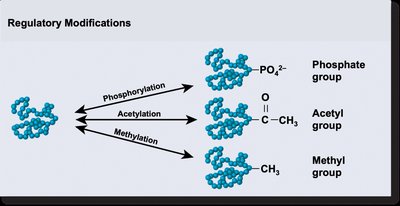
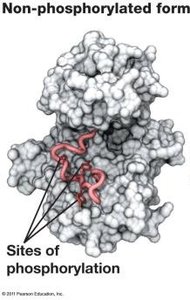
Enzymes can be regulated by covalent modification or by binding of regulatory molecules. These interactions alter enzyme structure and can activate or inhibit activity. Most regulatory mechanisms are reversible, allowing enzyme activity to change in response to cellular conditions.
Covalent modification: Addition/removal of chemical groups (phosphate, acetyl, methyl).
Competitive inhibition: Metabolite competes with substrate for active site, decreasing activity.
Allosteric regulation: Metabolite binds at regulatory site, changing enzyme shape and activity.
Feedback inhibition: End product inhibits an enzyme early in pathway, often via allosteric inhibition.
Summary Table: Types of Enzyme Regulation
Regulation Type | Mechanism | Effect |
|---|---|---|
Covalent Modification | Add/remove chemical groups | Activate/inhibit enzyme |
Competitive Inhibition | Metabolite competes for active site | Decreases activity |
Allosteric Regulation | Metabolite binds at regulatory site | Activates/inhibits enzyme |
Feedback Inhibition | End product inhibits pathway enzyme | Regulates pathway |
Additional info: These notes expand on the original content by providing definitions, examples, and context for each concept, ensuring completeness and academic quality for exam preparation.
