 Indietro
RNA Synthesis and Processing: Transcription and RNA Processing in Prokaryotes and Eukaryotes
Guida di studio - Note intelligenti
 Appunti personalizzati basati sui tuoi materiali, ampliati con definizioni chiave, esempi e contesto.
Chapter 6: RNA Synthesis and Processing
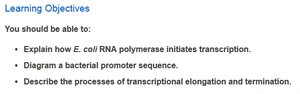
6.1 Transcription in Bacteria
Transcription is the process by which RNA is synthesized from a DNA template. In bacteria, this process is carried out by a single type of RNA polymerase, which recognizes specific DNA sequences called promoters to initiate transcription.
RNA Polymerase Structure: The bacterial RNA polymerase consists of a core enzyme and a sigma (σ) factor. The core enzyme is responsible for RNA synthesis, while the sigma factor enables the enzyme to recognize promoter sequences.
Promoter Sequences: Promoters are specific DNA sequences upstream of the gene that signal the start site for transcription. In E. coli, common promoter elements include the -10 (Pribnow box) and -35 regions.
Transcription Initiation: The sigma factor binds to the core RNA polymerase, forming the holoenzyme, which then binds to the promoter. After the initial synthesis of a short RNA strand, the sigma factor dissociates, and the core enzyme continues elongation.
Transcription Elongation: RNA polymerase moves along the DNA, synthesizing RNA in the 5' to 3' direction. The DNA double helix unwinds ahead of the enzyme and rewinds behind it.
Transcription Termination: Termination occurs when RNA polymerase encounters specific sequences that signal the end of transcription. These can be intrinsic terminators (forming a hairpin structure in the RNA) or require the Rho protein.
Example: The E. coli lac operon is regulated by promoter sequences that control the transcription of genes involved in lactose metabolism.
6.2 Eukaryotic RNA Polymerases and General Transcription Factors
Eukaryotes possess three main RNA polymerases, each responsible for transcribing different classes of genes. Transcription initiation in eukaryotes requires the assembly of a preinitiation complex involving multiple general transcription factors.
RNA Polymerase I: Transcribes ribosomal RNA (rRNA) genes (except 5S rRNA).
RNA Polymerase II: Transcribes messenger RNA (mRNA) and some small nuclear RNAs (snRNAs).
RNA Polymerase III: Transcribes transfer RNA (tRNA), 5S rRNA, and other small RNAs.
General Transcription Factors: Proteins such as TFIID, TFIIB, and others are required for the accurate initiation of transcription by RNA polymerase II. These factors help position the polymerase at the promoter and aid in the unwinding of DNA.
RNA Polymerase | Transcribed Genes |
|---|---|
Pol I | rRNA (except 5S) |
Pol II | mRNA, some snRNA, some scRNA |
Pol III | tRNA, 5S rRNA, some snRNA, some scRNA |
Example: The TATA box is a common promoter element recognized by TFIID during the formation of the RNA polymerase II preinitiation complex.
6.3 RNA Processing and Turnover
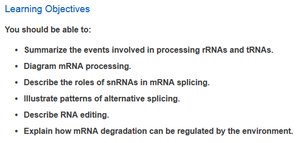
After transcription, primary RNA transcripts undergo several processing steps to become mature, functional RNAs. These processes differ between rRNA, tRNA, and mRNA, and are essential for proper gene expression.
Processing of Ribosomal and Transfer RNAs
rRNA Processing: Ribosomal RNAs are transcribed as large precursors and processed by cleavage, base modification, and assembly with proteins. Small nucleolar ribonucleoproteins (snoRNPs) guide chemical modifications and processing events in the nucleolus.
tRNA Processing: Transfer RNAs are also transcribed as precursors and undergo cleavage, base modification, and addition of the CCA sequence at the 3' end. The mature tRNA has a cloverleaf structure, an anticodon loop, and an amino acid attachment site.
Example: snoRNAs direct methylation and pseudouridylation of specific nucleotides in pre-rRNA.
Processing of Messenger RNAs (mRNAs)
5' Capping: Addition of a 7-methylguanosine cap to the 5' end of the pre-mRNA, which is important for mRNA stability and translation initiation.
3' Polyadenylation: Cleavage of the pre-mRNA and addition of a poly-A tail at the 3' end, enhancing mRNA stability and export from the nucleus.
Splicing: Removal of non-coding introns and joining of exons by the spliceosome, a complex of snRNPs (small nuclear ribonucleoproteins). The major snRNPs involved are U1, U2, U4, U5, and U6.
Example: The β-globin gene undergoes splicing to remove introns and produce mature mRNA.
Alternative Splicing and RNA Editing
Alternative Splicing: A process by which different combinations of exons are joined to produce multiple mRNA variants from a single gene. This increases protein diversity.
RNA Editing: Post-transcriptional modification of RNA nucleotides, such as the conversion of cytidine to uridine, which can alter the coding sequence and protein product.
Example: Alternative splicing of the Dscam gene in Drosophila generates thousands of different mRNA isoforms.
mRNA Degradation and Turnover
mRNA Stability: The half-life of mRNA molecules varies and is regulated by sequences in the mRNA and by environmental signals.
Degradation Pathways: mRNAs are degraded by ribonucleases (RNases) after deadenylation (removal of the poly-A tail) and decapping.
Example: Regulation of mRNA degradation allows cells to rapidly adjust protein synthesis in response to environmental changes.
Genetic Dominance and mRNA Levels
Dominant vs. Recessive Mutations: If a mutation in one gene copy reduces mRNA and protein levels by 50%, the phenotype is dominant if this reduction causes a visible effect; otherwise, it is recessive.
Genotype | mRNA Produced | Protein Produced | Phenotype |
|---|---|---|---|
AA | 200 | 80,000 | Normal |
Aa | 100 | 40,000 | Dominant or Recessive (depends on effect) |
Example: Haploinsufficiency occurs when one functional gene copy is insufficient to maintain normal function, resulting in a dominant phenotype.
Key Terms and Concepts
Promoter: DNA sequence where RNA polymerase binds to initiate transcription.
Spliceosome: A complex of snRNPs and proteins that catalyzes the removal of introns from pre-mRNA.
snoRNP: Small nucleolar ribonucleoprotein, involved in rRNA processing.
snRNP: Small nuclear ribonucleoprotein, involved in mRNA splicing.
Key Equations
Transcription Direction:
Central Dogma:
Additional info: The images included are directly relevant to the learning objectives and reinforce the key concepts of transcription initiation, RNA processing, and mRNA regulation.
