Indietro
Chapter 1: Equations and Inequalities – College Algebra Study Guide
Guida di studio - Note intelligenti
 Appunti personalizzati basati sui tuoi materiali, ampliati con definizioni chiave, esempi e contesto.
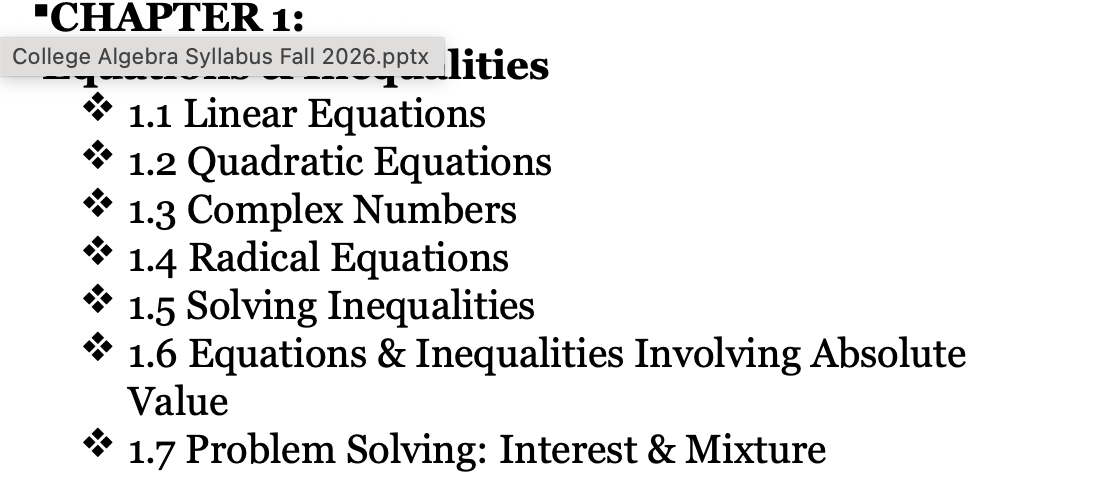
Chapter 1: Equations and Inequalities
1.1 Linear Equations
Linear equations are fundamental in algebra and represent relationships where the highest power of the variable is one. They are used to model real-world situations such as budgeting, distance, and rate problems.
Definition: A linear equation is an equation of the form ax + b = 0, where a and b are constants and x is the variable.
Solution: To solve, isolate x by performing inverse operations.
Example: Solve $2x + 3 = 7$ $2x = 4$ $x = 2$
1.2 Quadratic Equations
Quadratic equations involve variables raised to the second power and are essential for modeling parabolic relationships in physics, engineering, and economics.
Definition: A quadratic equation is of the form ax^2 + bx + c = 0, where a \neq 0.
Solution Methods: Factoring, completing the square, and the quadratic formula.
Quadratic Formula: $x = \frac{-b \pm \sqrt{b^2 - 4ac}}{2a}$
Example: Solve $x^2 - 5x + 6 = 0$ Factors: $(x-2)(x-3) = 0$ Solutions: $x = 2$, $x = 3$
1.3 Complex Numbers
Complex numbers extend the real number system to include solutions to equations that have no real roots, such as $x^2 + 1 = 0$.
Definition: A complex number is of the form a + bi, where a and b are real numbers and i is the imaginary unit ($i^2 = -1$).
Operations: Addition, subtraction, multiplication, and division follow algebraic rules.
Example: $x^2 + 4 = 0$ $x^2 = -4$ $x = \pm 2i$
1.4 Radical Equations
Radical equations contain variables within a root, typically a square root. Solving these equations often requires isolating the radical and then squaring both sides.
Definition: An equation with a variable inside a radical, such as $\sqrt{x} = 5$.
Solution: Remove the radical by raising both sides to the appropriate power.
Example: $\sqrt{x} = 5$ $x = 25$
1.5 Solving Inequalities
Inequalities express relationships where two expressions are not necessarily equal. They are used to describe ranges and constraints in real-world problems.
Types: Linear, quadratic, and rational inequalities.
Solution: Similar to equations, but pay attention to the direction of the inequality when multiplying or dividing by negative numbers.
Example: Solve $2x - 3 > 5$ $2x > 8$ $x > 4$
1.6 Equations & Inequalities Involving Absolute Value
Absolute value equations and inequalities measure the distance from zero and are used in contexts where only magnitude matters, not direction.
Definition: $|x|$ is the distance of x from zero.
Solution: Split into two cases: $x$ and $-x$.
Example: Solve $|x - 3| = 5$ $x - 3 = 5$ or $x - 3 = -5$ $x = 8$ or $x = -2$
1.7 Problem Solving: Interest & Mixture
Interest and mixture problems apply algebraic equations to practical scenarios in finance and chemistry, respectively.
Interest Problems: Use formulas to calculate simple or compound interest.
Mixture Problems: Set up equations to find concentrations or amounts when combining substances.
Simple Interest Formula: $I = Prt$ where $I$ is interest, $P$ is principal, $r$ is rate, and $t$ is time.
Example: If $P = 1000$, $r = 0.05$, $t = 2$, then $I = 1000 \times 0.05 \times 2 = 100$