 Indietro
Chapter 1: Variables, Real Numbers, and Mathematical Models – Study Notes
Guida di studio - Note intelligenti
 Appunti personalizzati basati sui tuoi materiali, ampliati con definizioni chiave, esempi e contesto.
Variables, Real Numbers, and Mathematical Models
Introduction to Algebra: Variables and Mathematical Models
This chapter introduces the foundational concepts of algebra, focusing on variables, algebraic expressions, equations, and mathematical models. Understanding these concepts is essential for solving real-world problems using algebraic methods.
Variables: Letters that represent a variety of different numbers.
Algebraic Expressions: Combinations of variables and numbers using operations such as addition, subtraction, multiplication, division, powers, or roots.
Mathematical Models: Formulas that describe real-world phenomena, relating variables to each other.
Order of Operations
To correctly evaluate algebraic expressions, follow the order of operations:
Perform all operations within grouping symbols (parentheses).
Do all multiplications in the order they occur from left to right.
Do all additions and subtractions in the order they occur from left to right.
Example: Evaluating Expressions
For , evaluate :
For , evaluate :
Translating English Phrases into Algebraic Expressions
Algebra often requires translating verbal statements into mathematical expressions. Key words indicate operations:
Sum: Addition ()
Less than: Subtraction ()
Twice: Multiplication ()
Product: Multiplication ()
Quotient: Division ()
Example: Translating Phrases
The sum of a number and 7:
Ten less than a number:
Twice a number, decreased by 6:
The product of 8 and a number:
Three more than the quotient of a number and 11:
Equations and Solutions
An equation is a statement that two algebraic expressions are equal, always containing the equality symbol (=). A solution is a value for the variable that makes the equation true.
To determine if a number is a solution, substitute it for the variable and check if both sides are equal.
Example: Determining Solutions
Is 5 a solution for ?
Since both sides are equal, 5 is a solution.
Is 7 a solution for ?
,
Since , 7 is not a solution.
Translating English Sentences into Algebraic Equations
English sentences can be translated into equations using key words for equality, such as "equals," "gives," "yields," "is the same as," and "is/was/will be."
Example: Translating Sentences
The product of 8 and a number is 48:
Nine less than 4 times a number gives 26:
Formulas and Mathematical Models
A formula is an equation expressing a relationship between two or more variables. Mathematical modeling is the process of finding formulas to describe real-world phenomena.
Formulas are used to predict or describe outcomes based on variable values.
Mathematical models consist of formulas and the meaning assigned to their variables.
Application Example: Age at Marriage and Probability of Divorce
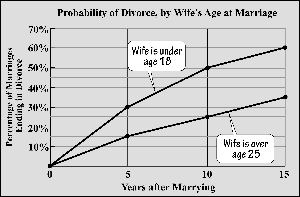
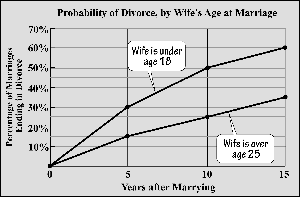
Mathematical models can be used to analyze real-world data, such as the probability of divorce based on the wife's age at marriage. The following models approximate the percentage of marriages ending in divorce:
Wife under 18:
Wife over 25:
Where is the number of years after marriage and is the percentage of marriages ending in divorce.
Example: Using the Model
For years, wife under 18:
According to the model, 65% of marriages end in divorce after 15 years when the wife is under 18.
Comparison with Actual Data
The line graph shows that 60% of marriages end in divorce after 15 years when the wife is under 18.
The mathematical model overestimates the actual percentage by 5%.
Summary Table: Key Concepts
Concept | Definition | Example |
|---|---|---|
Variable | Letter representing a number | x in |
Algebraic Expression | Combination of variables and numbers with operations | |
Equation | Statement that two expressions are equal | |
Solution | Value making the equation true | x = 6 for |
Formula | Equation relating variables | |
Mathematical Model | Formula describing real-world phenomena | Divorce probability model |
Additional info: Academic context was added to clarify definitions, provide examples, and ensure completeness for exam preparation.
