 Indietro
Chapter 1: Variables, Real Numbers, and Mathematical Models – Study Notes
Guida di studio - Note intelligenti
 Appunti personalizzati basati sui tuoi materiali, ampliati con definizioni chiave, esempi e contesto.
Variables, Real Numbers, and Mathematical Models
The Real Numbers
This section introduces the foundational sets that compose the real numbers, their representation on the number line, and their classification. Understanding these concepts is essential for all further study in algebra.
Set: A collection of objects whose contents can be clearly determined. The objects in a set are called elements.
Notation: Sets are denoted by braces { }, with elements separated by commas.
Example: The set of counting numbers: {1, 2, 3, 4, 5, ...}
Sets of Numbers
There are several important sets of numbers within mathematics, each with distinct properties and uses.
Natural Numbers: {1, 2, 3, 4, 5, ...} – Used for counting.
Whole Numbers: {0, 1, 2, 3, 4, 5, ...} – Natural numbers plus zero.
Integers: {..., -3, -2, -1, 0, 1, 2, 3, ...} – Whole numbers and their negatives.
Example: Practical Examples of Negative Integers
Debt of $500: -500
282 feet below sea level: -282
Number Line
The number line is a visual tool used to represent integers and other real numbers. It extends indefinitely in both directions, with zero separating positive and negative numbers.
Positive integers: Located to the right of zero.
Negative integers: Located to the left of zero.
Zero: Neither positive nor negative.
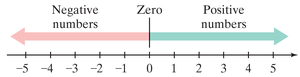
Example: Graphing Integers on a Number Line
Graph: -4 is placed four units to the left of zero.
Rational Numbers
Rational numbers are numbers that can be expressed as the quotient of two integers, where the denominator is not zero.
Definition: , where a and b are integers and b ≠ 0.
Numerator: The integer a.
Denominator: The integer b.
Example: Graphing Rational Numbers on a Number Line
Graph: -1.2 is placed between -1 and -2 on the number line.
Expressing Rational Numbers as Decimals
Every rational number can be written as a fraction and as a decimal. The decimal representation will either terminate or repeat.
Terminating decimal: The decimal stops after a finite number of digits.
Repeating decimal: One or more digits repeat infinitely.
Conversion: Divide the denominator into the numerator to obtain the decimal form.
Example: Expressing Rational Numbers as Decimals
Example: (terminating decimal)
Example: (repeating decimal)
Irrational Numbers
Irrational numbers are real numbers that cannot be written as a ratio of two integers. Their decimal representations are non-terminating and non-repeating.
Examples: , ,
Decimal form: Never terminates or repeats.
The Set of Real Numbers
The set of real numbers includes all numbers that can be represented on the number line. It is the union of rational and irrational numbers.
Every real number: Is either rational or irrational.
Classifying Real Numbers
Numbers can belong to multiple sets. Classification helps in understanding their properties and uses.
Natural numbers: Counting numbers.
Whole numbers: Counting numbers plus zero.
Integers: Whole numbers and their negatives.
Rational numbers: Numbers expressible as fractions.
Irrational numbers: Numbers not expressible as fractions.
Real numbers: All numbers on the number line.
Ordering the Real Numbers
Real numbers can be compared and ordered using inequality symbols. The position on the number line determines their order.
Inequality symbols: < (less than), > (greater than)
Rule: A number to the left is less than a number to the right.
Example: Using Inequality Symbols
–19 < –6: –19 is to the left of –6 on the number line.
Example: Determining Truth of Inequalities
–2 = –2: True, since both sides are equal.
–4 > 1: False, since –4 is less than 1.
Absolute Value
The absolute value of a real number is its distance from zero on the number line. Absolute value is always non-negative.
Notation: |a|
Definition: if , if
Example: Finding Absolute Value
|–4| = 4: –4 is 4 units from zero.
|9| = 9: 9 is 9 units from zero.
