 Indietro
College Algebra: Course Syllabus and Content Overview
Guida di studio - Note intelligenti
 Appunti personalizzati basati sui tuoi materiali, ampliati con definizioni chiave, esempi e contesto.
Course Overview
This study guide provides a structured overview of the College Algebra course, focusing on the main topics, objectives, and expectations as outlined in the syllabus for MATH 245. The course covers foundational and advanced algebraic concepts, preparing students for further studies in mathematics and related fields.
Course Description and Structure
Course Title: College Algebra (MATH 245)
Delivery: Online (Canvas platform)
Prerequisite: Intermediate Algebra or equivalent
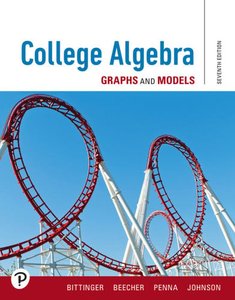
Textbook: College Algebra: Graphs and Models (Bittinger, Beecher, Penna, Johnson, 7th Edition, Pearson+)
Required Materials: MyMathLab access; physical textbook optional
Content Outline and Main Topics
The course is organized into eight main chapters, each focusing on a core area of college algebra. Below is a summary of the topics and subtopics covered:
Chapter 1 – Graphs, Functions, and Models
Introduction to Graphing: Understanding the Cartesian plane and plotting points.
Functions and Graphs: Definition of a function, domain and range, and function notation.
Linear Functions, Slopes, and Applications: Slope formula, interpreting slope, and real-world applications.
Equations of Lines and Modeling: Point-slope and slope-intercept forms; modeling with linear equations.
Linear Equations, Functions, Zeros, and Applications: Solving linear equations and finding zeros of functions.
Solving Linear Inequalities: Techniques for solving and graphing inequalities.
Chapter 2 – More on Functions
Increasing, Decreasing, and Piecewise Functions: Identifying intervals of increase/decrease; understanding piecewise definitions.
The Algebra of Functions: Operations with functions (addition, subtraction, multiplication, division).
The Composition of Functions: Function composition and its properties.
Symmetry: Even and odd functions; graphical symmetry.
Transformations: Shifts, reflections, stretches, and compressions of function graphs.
Chapter 3 – Quadratic Functions and Equations; Inequalities
The Complex Numbers: Definition, arithmetic, and applications of complex numbers.
Quadratic Equations, Functions, Zeros, and Models: Solving quadratics by factoring, completing the square, and quadratic formula.
Analyzing Graphs of Quadratic Functions: Vertex, axis of symmetry, and graphing parabolas.
Solving Rational and Radical Equations: Techniques for equations involving fractions and roots.
Solving Equations and Inequalities with Absolute Value: Methods for handling absolute value expressions.
Chapter 4 – Polynomial Functions and Rational Functions
Polynomial Functions and Modeling: Structure and applications of polynomial functions.
Graphing Polynomial Functions: End behavior, turning points, and sketching graphs.
Polynomial Division: Long division and synthetic division.
The Remainder Theorem and the Factor Theorem: Theoretical tools for analyzing polynomials.
Rational Functions: Definition, asymptotes, and graphing rational functions.
Polynomial and Rational Inequalities: Solving and interpreting inequalities involving polynomials and rational expressions.
Chapter 5 – Exponential Functions and Logarithmic Functions
Inverse Functions: Definition and finding inverses algebraically and graphically.
Exponential Functions and Graphs: Properties and applications of exponential growth and decay.
Logarithmic Functions and Graphs: Definition, properties, and graphing logarithms.
Properties of Logarithmic Functions: Laws of logarithms and their use in simplifying expressions.
Solving Exponential and Logarithmic Equations: Techniques for solving equations involving exponents and logs.
Applications and Models: Growth and Decay; Compound Interest: Real-world applications in finance and science.
Chapter 6 – Systems of Equations and Matrices
Systems of Equations in Three Variables: Methods for solving linear systems (substitution, elimination, matrices).
Systems of Inequalities: Graphical solutions and interpretation.
Introduction to Partial Fractions: Decomposition of rational expressions.
Chapter 7 – Conic Sections
Nonlinear Systems of Equations and Inequalities: Solving and graphing conic sections (parabolas, ellipses, hyperbolas, circles).
Chapter 8 – Sequences, Series, and Combinatorics
Sequences and Series: Definitions, notation, and basic properties.
Arithmetic Sequences and Series: Formulas for nth term and sum.
Geometric Sequences and Series: Formulas for nth term and sum.
Permutations, Combinations, and Probability: Counting principles and basic probability concepts.
Course Requirements and Grading
Assignments: Homework, quizzes, labs, and exams for each chapter.
Exams: Four unit exams and a comprehensive final exam (proctored via YuJa).
Grading Breakdown:
Tests: 30%
Homework: 15%
Quizzes: 15%
Discussions/Labs: 15%
Required Zoom Meetings: 5%
Final Exam: 20%
Letter Grades:
90-100%: A
80-89%: B
70-79%: C
60-69%: D
59% or below: F
Student Learning Outcomes (SLOs)
Calculate sums and terms of sequences and series.
Solve and/or graph higher order equations, functions, systems of equations and inequalities, along with their applications.
Additional Information
Attendance: Active participation required; two mandatory Zoom meetings.
Academic Honesty: Strict policy against cheating and plagiarism, including AI-generated work.
Accessibility: Accommodations available through DSPS for students with disabilities.
Support Services: Tutoring, counseling, financial aid, and more are available to support student success.
Key Formulas and Concepts (Selected Examples)
Slope of a Line:
Quadratic Formula:
Exponential Growth/Decay:
Sum of Arithmetic Series:
Sum of Geometric Series: , for
Additional info: This guide is based on the official course syllabus and is intended to provide a comprehensive overview for exam preparation and course planning.
