 Indietro
College Algebra Study Guidance: Rational Expressions, Algebraic Evaluation, and Graphs
Guida di studio - Note intelligenti
 Appunti personalizzati basati sui tuoi materiali, ampliati con definizioni chiave, esempi e contesto.
Q1. Evaluate the algebraic expression 3x - y for x = 10 and y = 6.
Background
Topic: Evaluating Algebraic Expressions
This question tests your ability to substitute given values for variables into an algebraic expression and simplify.
Key Terms and Formulas:
Algebraic Expression: An expression involving variables and constants.
Substitution: Replacing variables with their given values.
Step-by-Step Guidance
Identify the expression: .
Substitute and into the expression.
Calculate and subtract $6$ from the result.
Try solving on your own before revealing the answer!
Final Answer: 24
Substituting the values and simplifying gives the result.
Q2. Find all numbers for which the rational expression is undefined.
Background
Topic: Rational Expressions and Domain
This question tests your understanding of when a rational expression is undefined, which occurs when the denominator equals zero.
Key Terms and Formulas:
Rational Expression: An expression of the form where .
Domain: The set of all real numbers for which the expression is defined.
Step-by-Step Guidance
Identify the denominator: .
Set the denominator equal to zero: .
Solve for to find values that make the denominator zero.
Try solving on your own before revealing the answer!
Final Answer: 4, -4
The expression is undefined for and because these values make the denominator zero.
Q3. Find all numbers that must be excluded from the domain of the rational expression .
Background
Topic: Domain of Rational Expressions
This question tests your ability to determine which values make the denominator zero, thus excluding them from the domain.
Key Terms and Formulas:
Domain: All real numbers except those that make the denominator zero.
Factoring: Expressing a polynomial as a product of its factors.
Step-by-Step Guidance
Identify the denominator: .
Set the denominator equal to zero: .
Factor the quadratic and solve for .
Try solving on your own before revealing the answer!
Final Answer: -1, -8
The expression is undefined for and because these values make the denominator zero.
Q4. Simplify the rational expression and find all numbers that must be excluded from the domain of the simplified expression.
Background
Topic: Simplifying Rational Expressions and Domain
This question tests your ability to simplify rational expressions and determine the domain of the simplified form.
Key Terms and Formulas:
Simplification: Reducing the expression to lowest terms.
Domain: Values excluded due to the denominator being zero.
Step-by-Step Guidance
Factor the numerator and denominator: and .
Simplify the expression by canceling common factors.
Identify values that make the original denominator zero.
Try solving on your own before revealing the answer!
Final Answer: x ≠ 3
The simplified expression is , but must be excluded from the domain because it makes the original denominator zero.
Q5. Simplify the rational expression and find all numbers that must be excluded from the domain of the simplified expression.
Background
Topic: Simplifying Rational Expressions and Domain
This question tests your ability to factor and simplify rational expressions, and to identify domain restrictions.
Key Terms and Formulas:
Factoring: Expressing polynomials as products of their factors.
Domain: Values excluded due to the denominator being zero.
Step-by-Step Guidance
Factor the numerator and denominator: and .
Simplify the expression by canceling common factors.
Identify values that make the original denominator zero.
Try solving on your own before revealing the answer!
Final Answer: x ≠ 6
The simplified expression is , but must be excluded from the domain because it makes the original denominator zero.
Q6. Simplify the rational expression and find all numbers that must be excluded from the domain of the simplified expression.
Background
Topic: Simplifying Rational Expressions and Domain
This question tests your ability to factor and simplify rational expressions, and to identify domain restrictions.
Key Terms and Formulas:
Factoring: Expressing polynomials as products of their factors.
Domain: Values excluded due to the denominator being zero.
Step-by-Step Guidance
Factor the numerator and denominator: and .
Simplify the expression by canceling common factors.
Identify values that make the original denominator zero.
Try solving on your own before revealing the answer!
Final Answer: y ≠ 9, -5
The simplified expression is , but and must be excluded from the domain because they make the original denominator zero.
Q7. Simplify the rational expression and find all numbers that must be excluded from the domain of the simplified expression.
Background
Topic: Simplifying Rational Expressions and Domain
This question tests your ability to factor and simplify rational expressions, and to identify domain restrictions.
Key Terms and Formulas:
Factoring: Expressing polynomials as products of their factors.
Domain: Values excluded due to the denominator being zero.
Step-by-Step Guidance
Factor the numerator and denominator: and .
Simplify the expression by canceling common factors.
Identify values that make the original denominator zero.
Try solving on your own before revealing the answer!
Final Answer: 4, -4
The simplified expression is , but and must be excluded from the domain because they make the original denominator zero.
Q8. Evaluate the algebraic expression for .
Background
Topic: Evaluating Algebraic Expressions
This question tests your ability to substitute a given value for a variable and simplify the expression.
Key Terms and Formulas:
Algebraic Expression: An expression involving variables and constants.
Substitution: Replacing variables with their given values.
Step-by-Step Guidance
Identify the expression: .
Substitute into the expression.
Calculate and , then add the results.
Try solving on your own before revealing the answer!
Final Answer: 16
Substituting the value and simplifying gives the result.
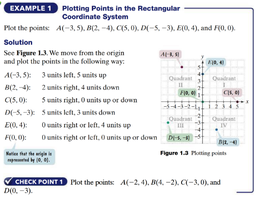
Q9. Plot the points A(-3, 5), B(2, -4), C(5, 0), D(-5, -3), E(0, 4), and F(0, 0) in the rectangular coordinate system.
Background
Topic: Plotting Points in the Rectangular Coordinate System
This question tests your ability to locate and plot points given as ordered pairs (x, y) on a coordinate grid.
Key Terms and Formulas:
Ordered Pair: (x, y) represents a point in the plane.
Rectangular Coordinate System: The x-axis (horizontal) and y-axis (vertical) intersect at the origin (0, 0).
Step-by-Step Guidance
For each point, identify the x-coordinate (horizontal movement) and y-coordinate (vertical movement).
Move from the origin: right for positive x, left for negative x; up for positive y, down for negative y.
Plot each point accordingly on the grid.
Try solving on your own before revealing the answer!
Final Answer:
The points are plotted as follows: A(-3, 5) is 3 units left and 5 units up from the origin, B(2, -4) is 2 units right and 4 units down, C(5, 0) is 5 units right and 0 units up/down, D(-5, -3) is 5 units left and 3 units down, E(0, 4) is 0 units right/left and 4 units up, F(0, 0) is at the origin.
Q10. What is an x-intercept of a graph?
Background
Topic: Intercepts of Graphs
This question tests your understanding of the definition and significance of x-intercepts in the context of graphing equations.
Key Terms and Formulas:
x-intercept: The x-coordinate where the graph crosses the x-axis.
At an x-intercept, the y-coordinate is always zero.
Step-by-Step Guidance
Recall that the x-axis is the horizontal axis in the coordinate plane.
At the x-intercept, the graph crosses the x-axis, so y = 0.
To find x-intercepts, set y = 0 in the equation and solve for x.
Try solving on your own before revealing the answer!
Final Answer:
An x-intercept is the x-coordinate of a point where the graph crosses the x-axis. At this point, the y-coordinate is always zero.
