 Indietro
College Algebra Study Guide: Functions and Their Properties
Guida di studio - Note intelligenti
 Appunti personalizzati basati sui tuoi materiali, ampliati con definizioni chiave, esempi e contesto.
Functions, Domain, and Range
Definition and Representation of Functions
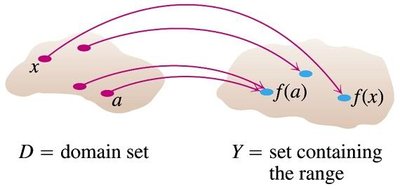
A function is a mathematical rule that assigns each input from a set called the domain to exactly one output in a set called the range. Functions can be represented by equations, graphs, tables, or verbal descriptions.
Input (domain): The set of all possible values for the independent variable, usually denoted as x.
Output (range): The set of all possible values for the dependent variable, usually denoted as f(x).


Types of Intervals
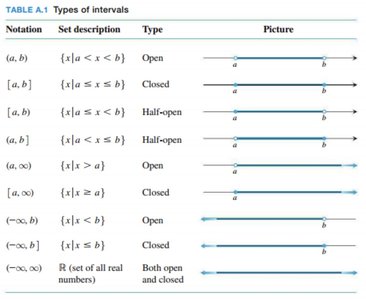
Domains and ranges are often described using intervals. Intervals can be open, closed, or half-open, and are used to specify the set of real numbers included.
Notation | Set Description | Type | Picture |
|---|---|---|---|
(a, b) | {x | a < x < b} | Open | Open interval |
[a, b] | {x | a ≤ x ≤ b} | Closed | Closed interval |
(a, b] | {x | a < x ≤ b} | Half-open | Half-open interval |
[a, b) | {x | a ≤ x < b} | Half-open | Half-open interval |
(a, ∞) | {x | x > a} | Open | Open interval |
[a, ∞) | {x | x ≥ a} | Closed | Closed interval |
(-∞, b) | {x | x < b} | Open | Open interval |
(-∞, b] | {x | x ≤ b} | Closed | Closed interval |
ℝ | Set of all real numbers | Both open and closed | Entire real line |
Domain and Range Examples
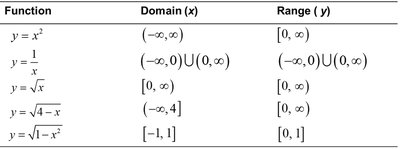
Different functions have different domains and ranges, depending on their formulas.
Function | Domain (x) | Range (y) |
|---|---|---|
y = x^2 | (-∞, ∞) | [0, ∞) |
y = 1/x | (-∞, 0) ∪ (0, ∞) | (-∞, 0) ∪ (0, ∞) |
y = √x | [0, ∞) | [0, ∞) |
y = √(4 - x) | (-∞, 4] | [0, ∞) |
y = √(1 - x^2) | [-1, 1] | [0, 1] |
Finding Domain and Range
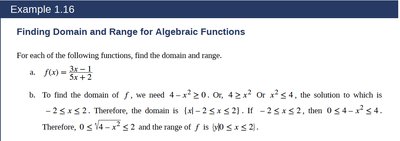
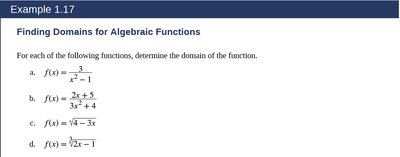
To determine the domain and range of a function, consider restrictions such as division by zero, even roots of negative numbers, and logarithms of non-positive numbers.
Example: For each function, determine its domain and range.

Zeros and Intercepts of Functions
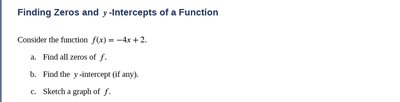
The zeros of a function are the values of x for which f(x) = 0. The y-intercept is the value of the function at x = 0.
Example: For f(x) = -4x + 2, find all zeros, the y-intercept, and sketch its graph.
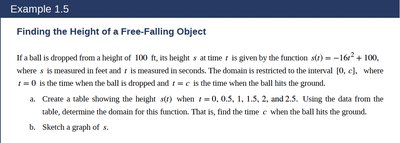
Applications: Free-Falling Object
Functions can model real-world phenomena, such as the height of a free-falling object over time.
Example: s(t) = -16t^2 + 100 models the height of a ball dropped from 100 ft. Create a table of values, determine the domain, and sketch the graph.
Graphs of Functions
Vertical Line Test
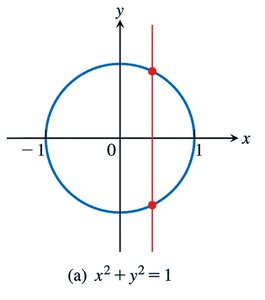
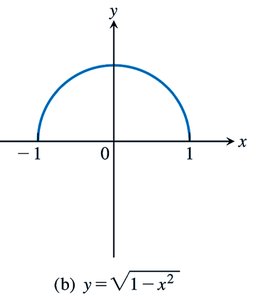
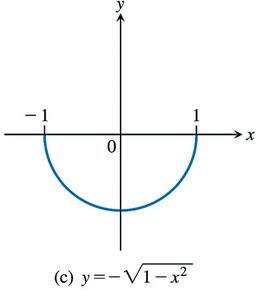
The vertical line test is used to determine if a graph represents a function. If any vertical line intersects the graph more than once, it is not a function.

Combining and Composing Functions
Combining Functions with Mathematical Operations
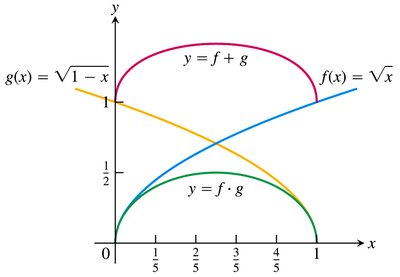
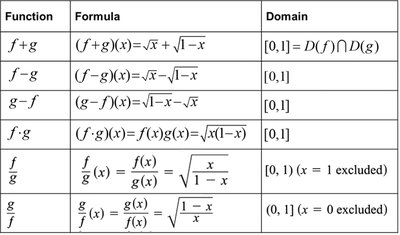
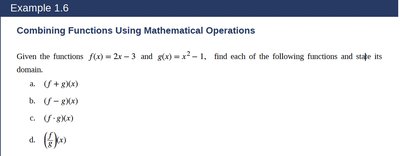
Functions can be added, subtracted, multiplied, or divided. The domain of the resulting function is typically the intersection of the domains of the original functions.
Function | Formula | Domain |
|---|---|---|
f + g | (f + g)(x) = √x + √(1 - x) | [0, 1] |
f - g | (f - g)(x) = √x - √(1 - x) | [0, 1] |
g - f | (g - f)(x) = √(1 - x) - √x | [0, 1] |
f · g | (f · g)(x) = √x · √(1 - x) = √(x(1 - x)) | [0, 1] |
f / g | f(x) / g(x) = √x / √(1 - x) | (0, 1) (x = 1 excluded) |
g / f | g(x) / f(x) = √(1 - x) / √x | (0, 1) (x = 0 excluded) |
Composing Functions
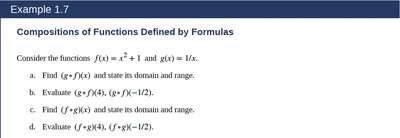
The composition of two functions f and g, written as (f ∘ g)(x), means applying g first, then f to the result: .
The domain of the composition is the set of x in the domain of g for which g(x) is in the domain of f.
Increasing and Decreasing Functions
Definitions
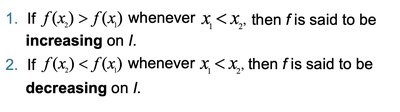
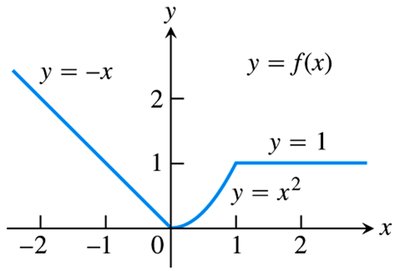
A function is increasing on an interval if its output grows as the input increases. It is decreasing if its output decreases as the input increases.
If whenever , then f is increasing.
If whenever , then f is decreasing.
Even and Odd Functions: Symmetry
Definitions
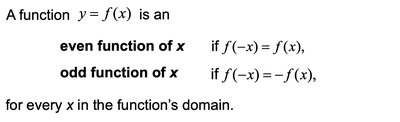
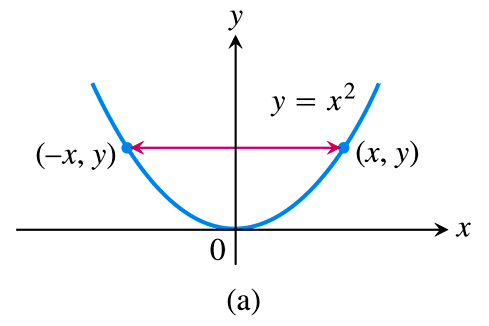
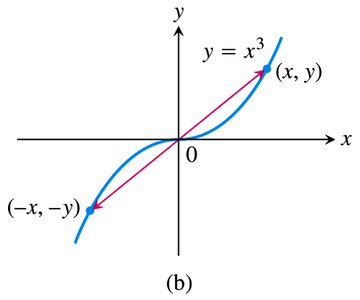
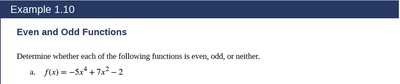
A function is even if for all x in its domain, and odd if for all x in its domain.
Examples
Even function: y = x^2 is symmetric about the y-axis.
Odd function: y = x^3 is symmetric about the origin.
Absolute Value and Absolute Value Function
Definition and Properties
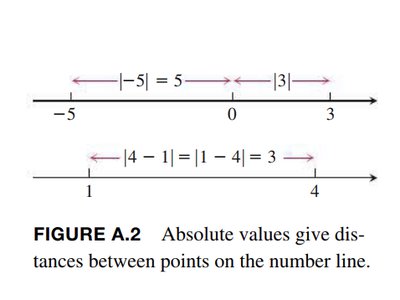
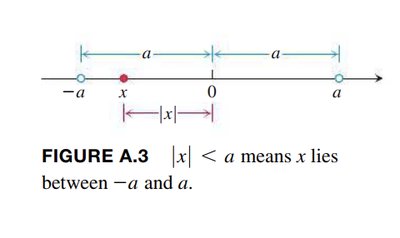
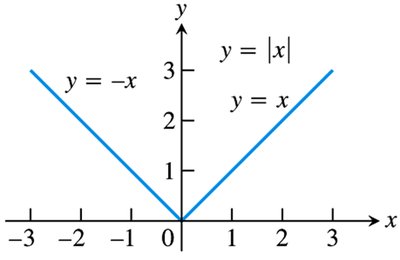
The absolute value of a real number x, denoted |x|, is its distance from zero on the number line. It is defined as:
|x| measures distance: |x| is the distance from x to 0; |x - y| is the distance between x and y.
Absolute Value Function
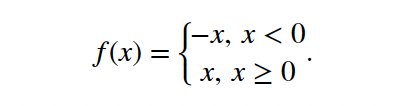
The absolute value function is defined as . Its domain is all real numbers, and its range is .
Basic Classes of Functions
Overview
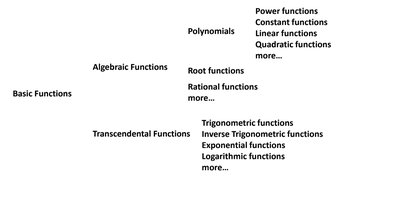
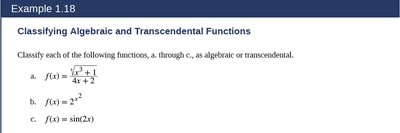
Functions are classified into several types based on their algebraic structure:
Polynomial functions: Linear, quadratic, cubic, etc.
Algebraic functions: Rational, root functions.
Transcendental functions: Trigonometric, exponential, logarithmic.
Linear Functions and Slope
Cartesian Coordinates
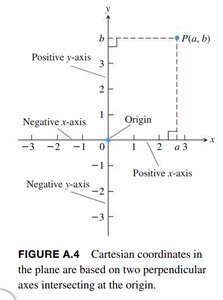
The Cartesian coordinate system is used to plot points and graphs in the plane, with axes intersecting at the origin.

Slope of a Line
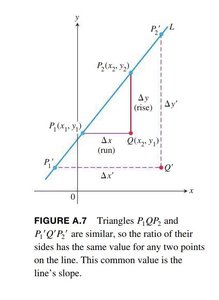
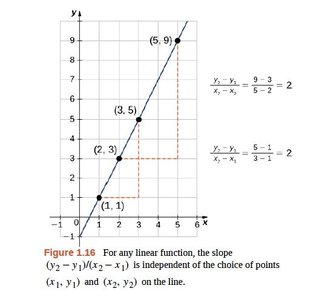
The slope of a line measures its steepness and is calculated as the ratio of the change in y to the change in x between two points:
Equations of Lines
Point-Slope and Slope-Intercept Forms
The equation of a line can be written in several forms:
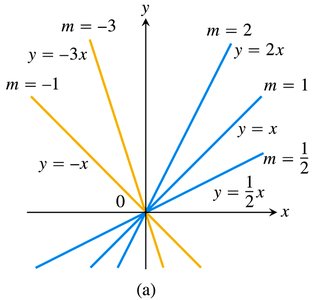
Point-slope form:
Slope-intercept form:

Polynomial Functions
Definition and Types
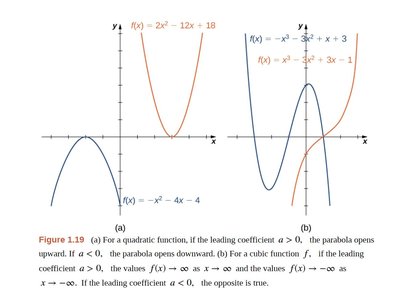
A polynomial function is any function that can be written as , where n is a non-negative integer and .
Degree: The highest power of x.
Leading coefficient: The coefficient of the highest power.

Algebraic and Transcendental Functions
Algebraic Functions
Algebraic functions include rational and root functions. Rational functions are ratios of polynomials, and root functions involve fractional exponents.
Transcendental Functions
Transcendental functions cannot be expressed using only algebraic operations. Examples include trigonometric, exponential, and logarithmic functions.

Piecewise-Defined Functions
Definition and Example
A piecewise-defined function uses different formulas for different parts of its domain. For example:
Transformations of Functions
Shifting, Scaling, and Reflecting
Transformations change the position or shape of a function's graph:
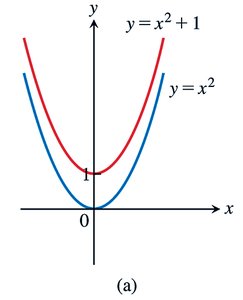
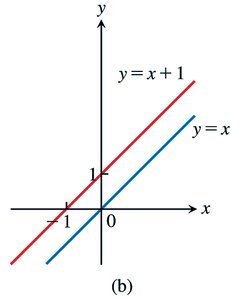
Vertical shift: Add a constant to f(x).
Horizontal shift: Add a constant to x.
Scaling: Multiply f(x) or x by a constant.
Reflection: Multiply f(x) or x by -1.

Trigonometric Functions
Definition and Properties
Trigonometric functions relate angles to ratios of sides in a right triangle. The six basic functions are sine, cosine, tangent, cosecant, secant, and cotangent.
Summary Table: Function Types and Properties
Type | Definition | Example |
|---|---|---|
Linear | Degree 1 polynomial | y = mx + b |
Quadratic | Degree 2 polynomial | y = ax^2 + bx + c |
Rational | Ratio of polynomials | y = (x^2 + 1)/(x - 2) |
Root | Fractional exponent | y = √x |
Trigonometric | Relates angles and sides | y = sin(x) |
Exponential | Variable in exponent | y = 2^x |
Logarithmic | Inverse of exponential | y = log(x) |
