 Indietro
College Algebra Study Guide: Functions, Graphs, and Applications
Guida di studio - Note intelligenti
 Appunti personalizzati basati sui tuoi materiali, ampliati con definizioni chiave, esempi e contesto.
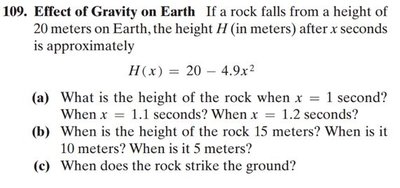
Q1. Effect of Gravity on Earth: Height of a Falling Rock
Background
Topic: Quadratic Functions & Applications
This question tests your ability to use a quadratic function to model the height of a falling object under gravity, and to solve for values and times using function evaluation and algebraic manipulation.
Key Terms and Formulas:
Quadratic function:
Height (in meters) after seconds
Function evaluation: Substitute values for to find
Solving for when is given: Rearranging and solving quadratic equations
Step-by-Step Guidance
For part (a), substitute , , and into the function to find the height at each time.
For part (b), set equal to the given heights (15, 10, 5 meters) and solve for using the equation .
Rearrange the equation to isolate : .
Divide both sides by 4.9 and take the square root to solve for .
For part (c), set and solve for to find when the rock strikes the ground.
Try solving on your own before revealing the answer!
Final Answer:
(a) meters, meters, meters.
(b) The rock is at 15 meters at seconds, at 10 meters at seconds, and at 5 meters at seconds.
(c) The rock strikes the ground when , so seconds.
These answers are found by substituting values and solving the quadratic equation for .
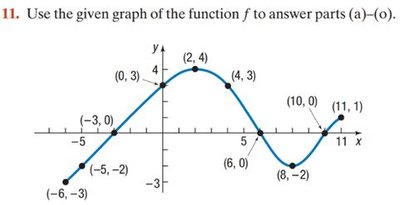
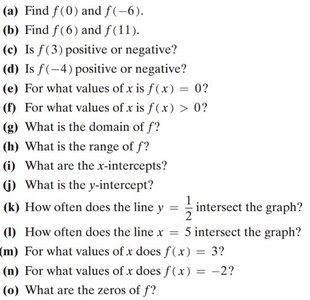
Q2. Use the given graph of the function to answer parts (a)-(o)
Background
Topic: Function Evaluation, Graph Interpretation
This question tests your ability to read and interpret function values, intercepts, domain, range, and other properties from a graph.
Key Terms and Formulas:
Function value: is the -value at a given
Intercepts: Points where the graph crosses the axes
Domain: Set of all possible values
Range: Set of all possible values
Zeros: Values of where
Step-by-Step Guidance
For parts (a)-(d), locate the points on the graph corresponding to the given values and read the values.
For parts (e)-(f), identify where the graph is above or on the -axis.
For parts (g)-(h), determine the domain and range by observing the extent of the graph along the and axes.
For parts (i)-(j), find where the graph crosses the axes for intercepts.
For parts (k)-(o), analyze the graph for intersections, values, and zeros as described.
Try solving on your own before revealing the answer!
Final Answer:
(a) ,
(b) ,
(c) (positive)
(d) (positive)
(e) at
(f) for between and $4x and $11$
(g) Domain:
(h) Range:
(i) -intercepts:
(j) -intercept:
(k) intersects graph twice
(l) intersects graph once
(m) at
(n) at
(o) Zeros:
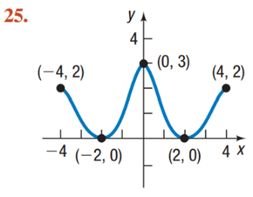
Q3. Graph Analysis: Intercepts, Domain, Range, Intervals, Even/Odd
Background
Topic: Graphs of Functions
This question tests your ability to analyze a function graph for intercepts, domain, range, intervals of increase/decrease, and symmetry (even/odd/neither).
Key Terms and Formulas:
Intercepts: -intercepts and -intercepts
Domain: All possible values
Range: All possible values
Intervals: Where the function is increasing, decreasing, or constant
Even function: ; Odd function:
Step-by-Step Guidance
Identify the -intercepts and -intercepts by finding where the graph crosses the axes.
Determine the domain by observing the horizontal extent of the graph.
Determine the range by observing the vertical extent of the graph.
Analyze the graph to find intervals where the function is increasing, decreasing, or constant.
Check for symmetry to determine if the function is even, odd, or neither.

Try solving on your own before revealing the answer!
Final Answer:
(a) -intercepts: ; -intercept:
(b) Domain: ; Range:
(c) Increasing on and ; Decreasing on and
(d) The function is even (symmetric about the -axis).
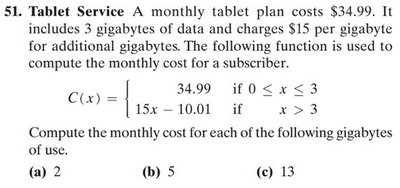
Q4. Tablet Service: Piecewise Function for Monthly Cost
Background
Topic: Piecewise Functions & Function Evaluation
This question tests your ability to evaluate a piecewise function for different values and understand how the function changes based on the input.
Key Terms and Formulas:
Piecewise function:
Evaluate for
Step-by-Step Guidance
For , check which piece of the function applies and substitute .
For , use the second piece since and substitute .
For , use the second piece and substitute .
Calculate the expressions for each value, but stop before the final computation.
Try solving on your own before revealing the answer!
Final Answer:
(a)
(b)
(c)
Each value is found by plugging into the correct piece of the function.
Q5. Physics: Falling Objects – Proportional Relationships
Background
Topic: Direct Variation & Quadratic Relationships
This question tests your understanding of direct variation, specifically how distance fallen relates to the square of time.
Key Terms and Formulas:
Direct variation:
Find using given values, then use it to solve for other times/distances.
Step-by-Step Guidance
Use the given information ( feet when second) to solve for .
Use the formula to find the distance for seconds.
Set feet and solve for using the formula.
Try solving on your own before revealing the answer!
Final Answer:
For seconds: feet
For feet: seconds
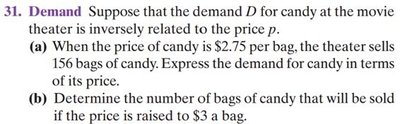
Q6. Demand: Inverse Variation Application
Background
Topic: Inverse Variation
This question tests your ability to model and solve inverse variation problems, relating demand to price.
Key Terms and Formulas:
Inverse variation:
Find using given values, then use it to solve for other prices/demands.
Step-by-Step Guidance
Use the given information ( when ) to solve for .
Write the demand function in terms of .
For , substitute into the function to find .
Try solving on your own before revealing the answer!
Final Answer:
Demand function:
For : bags
