 Indietro
College Algebra Study Guide: Quadratic, Rational, Radical, and Absolute Value Equations
Guida di studio - Note intelligenti
 Appunti personalizzati basati sui tuoi materiali, ampliati con definizioni chiave, esempi e contesto.
Quadratic Functions and Equations
Definition and Properties
Quadratic functions are fundamental in algebra and are defined by the general form , where and , , are real numbers. Quadratic equations are written as and are in standard form when arranged as such.
Domain: All real numbers ().
Range: Depends on the direction the parabola opens.
Extrema: The minimum or maximum value occurs at the vertex.
Zeros: The solutions to ; these are the x-intercepts of the graph if real.
Graphing Quadratic Functions
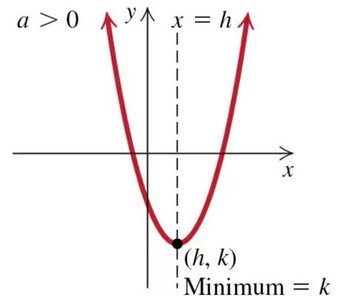
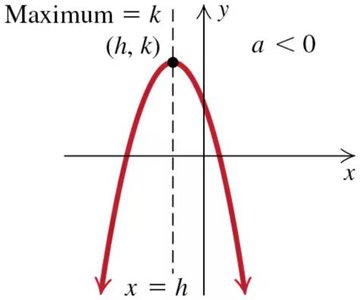
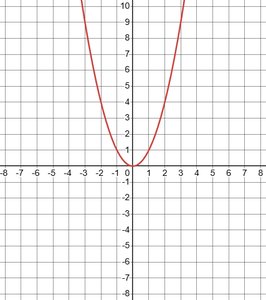
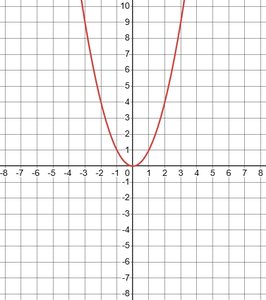
The graph of a quadratic function is a parabola. The vertex represents the turning point, and the axis of symmetry passes through the vertex.
Vertex:
Axis of Symmetry:
Opens Up: If
Opens Down: If
Solving Quadratic Equations
Quadratic equations can be solved by factoring, completing the square, or using the quadratic formula.
Factoring: Express as a product of two binomials.
Completing the Square: Transform the equation into and solve for .
Quadratic Formula:
Example: Solving by Factoring
Factor :
Find two numbers that multiply to and add to $2 and ).
Factored form:
Example: Solving by Completing the Square
Solve :
Isolate variable terms:
Add to both sides:
Rewrite:
Apply square roots:
Example: Solving by Quadratic Formula
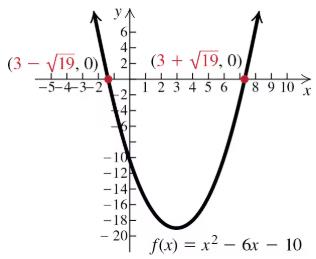
Solve :
Standard form:
Apply formula:
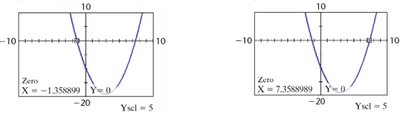
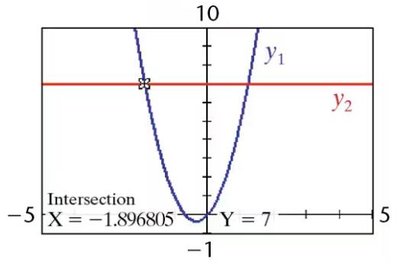
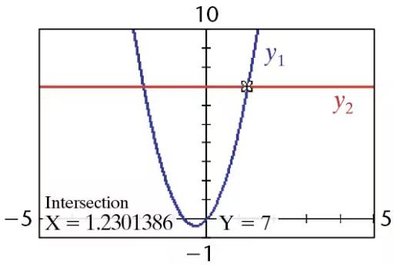
Approximate solutions: and
The Discriminant
The discriminant determines the nature of the solutions:
: Two distinct real solutions
: One real solution (repeated root)
: Two imaginary solutions (complex conjugates)
Complex Numbers
A complex number is any number of the form , where and are real numbers and .
Add/Subtract: Combine real and imaginary parts.
Multiply: Use .
Conjugate: The conjugate of is .
Factoring Quadratic Expressions
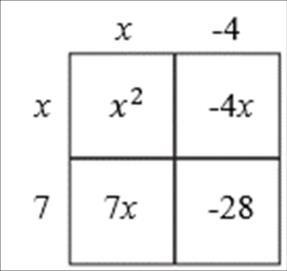
Multiplying Binomials (Area Model/Box Method)
The area model helps visualize the multiplication of binomials.
Example:
Box entries: , , ,
Combine:
Factoring Trinomials
To factor , find two numbers and such that and .
Example: factors to
Graphing Quadratic Functions in Vertex Form
Transformations
The vertex form allows for easy identification of transformations:
a: Vertical stretch/shrink and reflection
h: Horizontal translation
k: Vertical translation
Quadratic Applications
Real-World Problems
Projectile Motion: models height over time.
Optimization: Quadratic functions are used to maximize or minimize area, cost, etc.
Rational Equations
Solving Rational Equations
Rational equations contain fractions with variables in the denominator. To solve:
Multiply both sides by the least common denominator (LCD) to clear fractions.
Check for extraneous solutions by substituting back into the original equation.
Example:
Solve :
LCD is 6.
Multiply both sides:
Solve:
Radical Equations
Solving Radical Equations
Radical equations have variables under a root. To solve:
Isolate the radical.
Apply the principle of powers (raise both sides to the appropriate power).
Check for extraneous solutions.
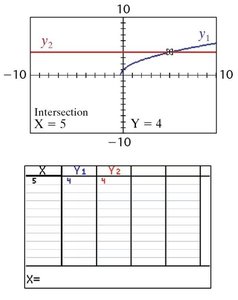
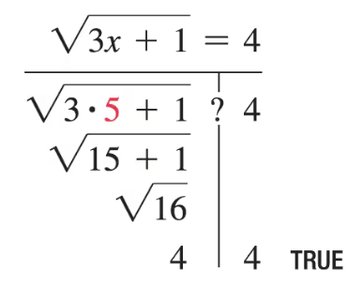
Example:
Solve :
Square both sides:
Absolute Value Equations and Inequalities
Solving Absolute Value Equations
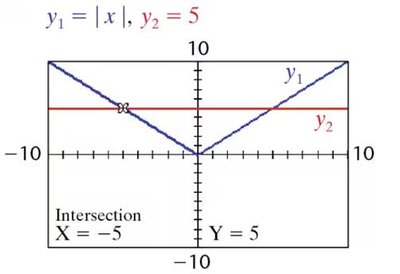
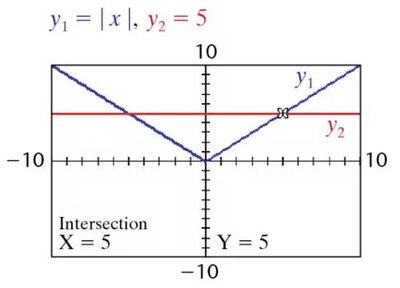
The absolute value is equivalent to or for .
For , is equivalent to .
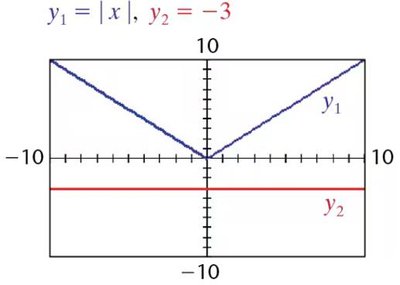
For , has no solution.
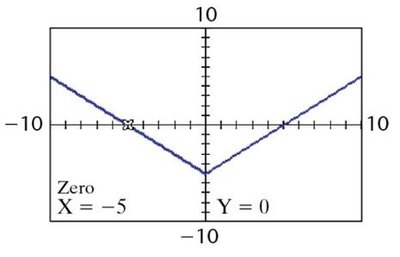
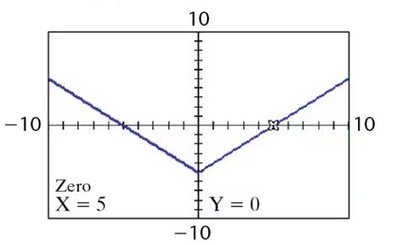
Example:
Solve :
Solutions: or
Solving Absolute Value Inequalities
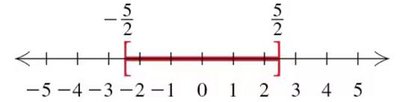
is equivalent to
is equivalent to or
Summary Table: Nature of Quadratic Solutions
Discriminant () | Number/Nature of Solutions |
|---|---|
Positive | Two distinct real solutions |
Zero | One real solution (repeated root) |
Negative | Two imaginary solutions (complex conjugates) |
Additional info:
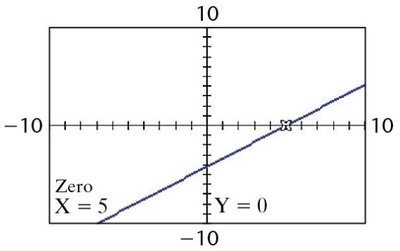
TI-83/84 calculators can be used to graph functions, find zeros, and check solutions.
Quadratic models are widely used in physics, engineering, and economics for optimization and modeling.
