Indietro
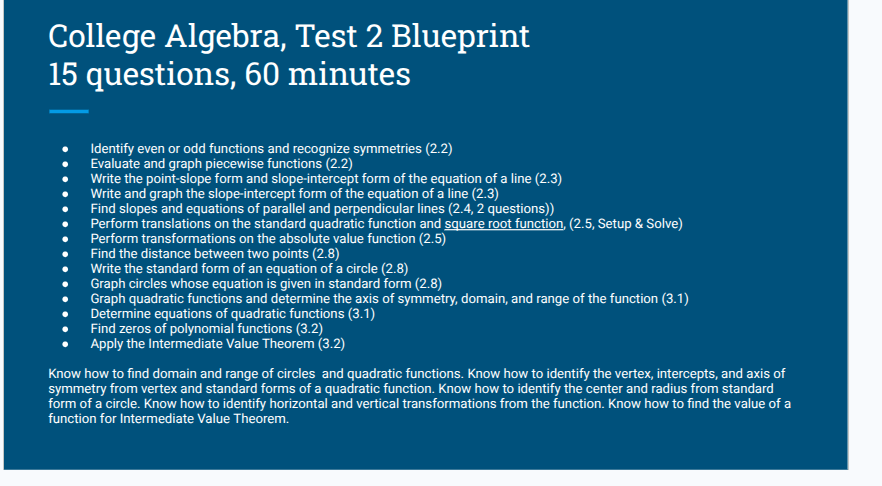
College Algebra Test 2 Blueprint: Study Guide
Guida di studio - Note intelligenti
 Appunti personalizzati basati sui tuoi materiali, ampliati con definizioni chiave, esempi e contesto.
Functions and Symmetry
Even and Odd Functions; Symmetries
Understanding the classification of functions as even or odd is fundamental in algebra. These classifications help recognize symmetries in graphs.
Even Function: A function f(x) is even if $f(-x) = f(x)$ for all x in its domain. Its graph is symmetric about the y-axis.
Odd Function: A function f(x) is odd if $f(-x) = -f(x)$ for all x in its domain. Its graph is symmetric about the origin.
Symmetry: Even functions show y-axis symmetry; odd functions show origin symmetry.
Example: $f(x) = x^2$ is even; $f(x) = x^3$ is odd.
Piecewise Functions
Piecewise functions are defined by different expressions for different intervals of the domain.
Definition: A function that uses multiple rules depending on the input value.
Graphing: Plot each segment according to its rule and domain interval.
Example: $f(x) = \begin{cases} x+2 & x < 0 \\ x^2 & x \geq 0 \end{cases}$
Linear Equations and Graphs
Point-Slope and Slope-Intercept Forms
Linear equations can be written in several forms, each useful for different purposes.
Point-Slope Form: $y - y_1 = m(x - x_1)$, where m is the slope and $(x_1, y_1)$ is a point on the line.
Slope-Intercept Form: $y = mx + b$, where m is the slope and b is the y-intercept.
Graphing: Use the slope and y-intercept to plot the line.
Example: If m = 2 and b = -3, the equation is $y = 2x - 3$.
Parallel and Perpendicular Lines
Lines can be classified based on their slopes.
Parallel Lines: Have equal slopes ($m_1 = m_2$).
Perpendicular Lines: Slopes are negative reciprocals ($m_1 \cdot m_2 = -1$).
Example: If one line has slope 3, a perpendicular line has slope $-\frac{1}{3}$.
Transformations of Functions
Translations and Transformations
Transformations change the position or shape of a function's graph.
Translation: Shifts the graph horizontally or vertically.
Quadratic Function: $f(x) = a(x-h)^2 + k$ shifts the graph h units horizontally and k units vertically.
Square Root Function: $f(x) = \sqrt{x-h} + k$ shifts similarly.
Absolute Value Function: $f(x) = |x-h| + k$.
Example: $f(x) = (x-2)^2 + 3$ is shifted 2 units right and 3 units up.
Distance and Circles
Distance Between Two Points
The distance formula calculates the length between two points in the plane.
Formula: $d = \sqrt{(x_2 - x_1)^2 + (y_2 - y_1)^2}$
Example: Between (1,2) and (4,6): $d = \sqrt{(4-1)^2 + (6-2)^2} = \sqrt{9 + 16} = \sqrt{25} = 5$
Equation and Graph of a Circle
The standard form of a circle's equation reveals its center and radius.
Standard Form: $(x-h)^2 + (y-k)^2 = r^2$
Center: (h, k)
Radius: r
Graphing: Plot the center and use the radius to draw the circle.
Example: $(x-3)^2 + (y+2)^2 = 16$ has center (3, -2) and radius 4.
Quadratic and Polynomial Functions
Graphing Quadratic Functions
Quadratic functions have parabolic graphs. Key features include the vertex, axis of symmetry, domain, and range.
Vertex Form: $f(x) = a(x-h)^2 + k$
Axis of Symmetry: $x = h$
Domain: All real numbers
Range: Depends on a: $y \geq k$ if $a > 0$, $y \leq k$ if $a < 0$
Example: $f(x) = 2(x-1)^2 + 5$ has vertex (1,5), axis $x=1$, opens upward.
Zeros of Polynomial Functions
Zeros are the x-values where the function equals zero.
Finding Zeros: Set $f(x) = 0$ and solve for x.
Example: $f(x) = x^2 - 4$; $x^2 - 4 = 0 \Rightarrow x = 2, -2$
Intermediate Value Theorem
This theorem helps determine if a function has a root in an interval.
Theorem: If f is continuous on [a, b] and $f(a)$ and $f(b)$ have opposite signs, then f has at least one root in (a, b).
Application: Check values at endpoints; if signs differ, a root exists between them.
Example: $f(x) = x^3 - x$ on [0,2]: $f(0) = 0$, $f(2) = 6$; since $f(0)$ and $f(2)$ are not opposite, but if $f(0) = -1$, $f(2) = 3$, a root exists.
Domain, Range, and Key Features
Domain and Range of Circles and Quadratics
Understanding domain and range is essential for graphing and analyzing functions.
Quadratic Functions: Domain: all real numbers; Range: depends on vertex and direction.
Circles: Domain and range are limited by the radius and center.
Example: For $(x-2)^2 + (y-3)^2 = 9$, domain: $x \in [2-3, 2+3]$, range: $y \in [3-3, 3+3]$
Identifying Vertex, Intercepts, Axis of Symmetry
Key features of quadratic functions can be found from their forms.
Vertex: From vertex form $f(x) = a(x-h)^2 + k$, vertex is (h, k).
Intercepts: Set $x=0$ for y-intercept; set $f(x)=0$ for x-intercepts.
Axis of Symmetry: $x = h$
Identifying Center and Radius of Circles
The standard form of a circle reveals its center and radius directly.
Center: (h, k) from $(x-h)^2 + (y-k)^2 = r^2$
Radius: $r = \sqrt{r^2}$
Horizontal and Vertical Transformations
Transformations shift graphs horizontally and vertically.
Horizontal Shift: $f(x-h)$ shifts right by h units.
Vertical Shift: $f(x) + k$ shifts up by k units.
Example: $f(x) = (x-3)^2 + 2$ is shifted 3 units right and 2 units up.
Intermediate Value Theorem: Finding Function Values
To apply the Intermediate Value Theorem, evaluate the function at interval endpoints and check for sign changes.
Step 1: Compute $f(a)$ and $f(b)$.
Step 2: If $f(a)$ and $f(b)$ have opposite signs, a root exists in (a, b).