 Indietro
Domain and Range from Graphs – College Algebra Study Guidance
Guida di studio - Note intelligenti
 Appunti personalizzati basati sui tuoi materiali, ampliati con definizioni chiave, esempi e contesto.
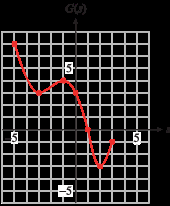
Q1a. Find the domain and range of the function from its graph (Graph G(x)).
Background
Topic: Domain and Range from Graphs
This question tests your ability to determine the set of all possible input values (domain) and output values (range) for a function by analyzing its graph.
Key Terms and Concepts:
Domain: The set of all x-values for which the function is defined (look left to right on the graph).
Range: The set of all y-values that the function attains (look bottom to top on the graph).
Open circle (○): Endpoint not included.
Closed circle (●): Endpoint included.
Arrow: The graph continues indefinitely in that direction.
Step-by-Step Guidance
Examine the graph from left to right to determine the smallest and largest x-values the graph reaches. Note if the endpoints are open or closed circles, or if there are arrows indicating the graph continues.
Write the domain using interval notation, being careful to use parentheses for open endpoints and brackets for closed endpoints.
Next, look from the bottom to the top of the graph to find the smallest and largest y-values the graph attains. Again, check for open/closed circles or arrows.
Write the range using interval notation, following the same rules for open and closed endpoints.
Double-check your intervals to ensure you have not missed any gaps or discontinuities in the graph.
Try solving on your own before revealing the answer!
Final Answer:
Domain: (the graph starts at and ends at , both included)
Range: (the lowest -value is and the highest is $5$, both included)
Both endpoints are closed circles, so both are included in the domain and range.
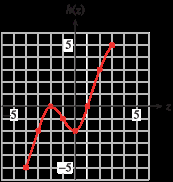
Q1b. Find the domain and range of the function from its graph (Graph h(z)).
Background
Topic: Domain and Range from Graphs
This question also tests your ability to read domain and range from a graph, focusing on the endpoints and the direction of the graph.
Key Terms and Concepts:
Domain: All possible -values (inputs) for which is defined.
Range: All possible -values (outputs) that attains.
Check for arrows (graph continues) and open/closed circles (included or not).
Step-by-Step Guidance
Look at the leftmost and rightmost points of the graph to determine the domain. Are there arrows or endpoints?
Write the domain in interval notation, using brackets for included endpoints and parentheses for excluded ones.
Look at the lowest and highest points on the -axis that the graph reaches to determine the range.
Write the range in interval notation, again noting open or closed endpoints.
Check for any breaks or gaps in the graph that might affect the domain or range.
Try solving on your own before revealing the answer!
Final Answer:
Domain: (the graph covers all -values from to $5$)
Range: (the lowest -value is , the highest is $5$)
Both endpoints are included, as indicated by closed circles.
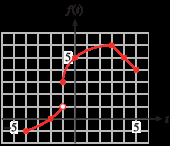
Q1c. Find the domain and range of the function from its graph (Graph f(t)).
Background
Topic: Domain and Range from Graphs
This question asks you to interpret the domain and range from a graph that may have open or closed endpoints.
Key Terms and Concepts:
Domain: All -values for which is defined.
Range: All -values that attains.
Open circle: Endpoint not included; Closed circle: Endpoint included.
Step-by-Step Guidance
Identify the leftmost and rightmost -values on the graph. Note if the endpoints are open or closed circles.
Write the domain in interval notation, using parentheses for open circles and brackets for closed circles.
Identify the lowest and highest -values the graph reaches. Again, check for open or closed circles.
Write the range in interval notation, using the correct symbols for open/closed endpoints.
Check for any gaps or discontinuities in the graph that might affect the domain or range.
Try solving on your own before revealing the answer!
Final Answer:
Domain: (the graph starts at with a closed circle and ends at with an open circle)
Range: (the lowest -value is (closed), the highest is $5$ (closed))
The open circle at means $t = 5$ is not included in the domain.
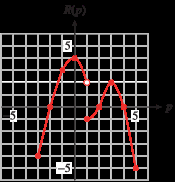
Q1d. Find the domain and range of the function from its graph (Graph R(p)).
Background
Topic: Domain and Range from Graphs
This question involves interpreting a graph with both open and closed endpoints to determine the domain and range.
Key Terms and Concepts:
Domain: All -values for which is defined.
Range: All -values that attains.
Open circle: Endpoint not included; Closed circle: Endpoint included.
Step-by-Step Guidance
Identify the leftmost and rightmost -values on the graph, noting open or closed circles.
Write the domain in interval notation, using parentheses for open circles and brackets for closed circles.
Identify the lowest and highest -values the graph reaches, and note the type of endpoints.
Write the range in interval notation, using the correct symbols for open/closed endpoints.
Check for any gaps or discontinuities in the graph that might affect the domain or range.
Try solving on your own before revealing the answer!
Final Answer:
Domain: (the graph starts at (closed) and ends at (closed))
Range: (the lowest -value is (closed), the highest is $5$ (open))
The open circle at the top means is not included in the range.
