 Indietro
Foundations of College Algebra: Sets, Properties, Notation, and Operations
Guida di studio - Note intelligenti
 Appunti personalizzati basati sui tuoi materiali, ampliati con definizioni chiave, esempi e contesto.
Sets and Set Notation
Definition and Basic Concepts
A set is a collection of distinct objects, called elements. Sets are denoted by curly braces { } and named with capital letters. For example, S = {2, 5, 8}.
Element notation: If 2 is an element of S, we write 2 ∈ S. If 9 is not an element, we write 9 ∉ S.
Subset: A set A is a subset of B if every element of A is also in B. Notation: A ⊂ B or A ⊆ B.
Common sets of numbers:
N: Natural numbers {1, 2, 3, ...}
N0: Whole numbers {0, 1, 2, ...}
Z: Integers {..., -2, -1, 0, 1, 2, ...}
Q: Rational numbers (can be written as p/q, q ≠ 0)
I: Irrational numbers (decimals neither terminate nor repeat, e.g., , )
R: Real numbers (all rational and irrational numbers)
Set Notation Types
Roster notation: Listing elements, e.g., N = {1, 2, 3, ...}
Set-builder notation: Describes properties, e.g., D = {x | x > 5 and x is even}
Interval notation: Used for intervals of numbers, e.g., (-2, 9]
Interval Types, Notation, and Graphs
Intervals are used to describe subsets of real numbers. The table below summarizes the main types, their notation, and graphical representation.
Type | Interval Notation | Set Notation | Graph |
|---|---|---|---|
Open | (a, b) | {x | a < x < b} |
|
Closed | [a, b] | {x | a ≤ x ≤ b} | See image above |
Half-open | [a, b) | {x | a ≤ x < b} | See image above |
Half-open | (a, b] | {x | a < x ≤ b} | See image above |
Open | (a, ∞) | {x | x > a} | See image above |
Half-open | [a, ∞) | {x | x ≥ a} | See image above |
Open | (−∞, b) | {x | x < b} | See image above |
Half-open | (−∞, b] | {x | x ≤ b} | See image above |
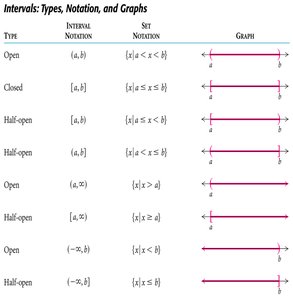
Additional info: The image visually demonstrates how open and closed endpoints are represented on the number line, which is essential for understanding interval notation in algebra.
Properties of Real Numbers
Basic Properties
Commutative property: ,
Associative property: ,
Additive identity:
Additive inverse:
Multiplicative identity:
Multiplicative inverse: (for )
Distributive property:
Example: illustrates the commutative property of multiplication.
Absolute Value and Distance
Absolute Value
The absolute value of a real number , denoted , is its distance from 0 on the number line.
If ,
If ,
Example: ,
Distance Between Two Points
The distance between real numbers and is .
Example: Distance between and $4|-7 - 4| = |-11| = 11$
Exponents and Their Properties
Definition and Rules
For any positive integer , means multiplied by itself $n$ times.
Product rule:
Quotient rule: ,
Power rule:
Product to a power:
Quotient to a power: ,
Zero exponent:
Example:
Scientific Notation
Definition and Usage
Scientific notation expresses numbers as , where and is an integer.
Example:
Example:
Order of Operations
Rules
Calculate within grouping symbols first (parentheses, brackets).
Evaluate exponents.
Multiply and divide from left to right.
Add and subtract from left to right.
Example:
Polynomials and Operations
Definition and Structure
A polynomial in one variable is an expression of the form , where is a nonnegative integer and are real coefficients.
Degree: The highest exponent of the variable.
Leading coefficient: The coefficient of the term with the highest degree.
Constant term: The term without a variable.
Example: has degree 7, leading coefficient 4, constant term -9.
Like Terms and Operations
Like terms: Terms with the same variables raised to the same powers.
Adding/Subtracting: Combine like terms.
Example:
Multiplying and Factoring Polynomials
Multiplication
Use the distributive property:
FOIL method for binomials: First, Outer, Inner, Last terms
Example:
Special Products
Square of a sum:
Square of a difference:
Product of sum and difference:
Factoring Techniques
Factor out common factors first.
Factoring by grouping: Group terms to factor common binomials.
Trinomials: Find two numbers whose product is and sum is .
Special factorizations: Difference of squares, sum/difference of cubes.
Example:
Equations and Principles
Linear and Quadratic Equations
Linear equation:
Quadratic equation:
Solving Principles
Addition Principle: If , then
Multiplication Principle: If , then
Zero Product Principle: If , then or
Square Root Principle: If , then or
Example: Solve
Rational Expressions
Domain and Simplification
The domain of an expression is the set of real numbers for which it is defined. Division by zero is undefined.
Example: Find the domain of Denominator factors: Domain: ,
Operations with Rational Expressions
Simplify, multiply, divide, add, and subtract using common denominators.
Complex rational expressions: Use LCD or reciprocal methods to simplify.
Radical Expressions
Roots and Properties
A number is an nth root of if . The symbol denotes the nth root.
If is even,
If is odd,
Example: , ,
