Indietro
Fractions, Mixed Numbers, and Factors: Foundations for College Algebra
Guida di studio - Note intelligenti
 Appunti personalizzati basati sui tuoi materiali, ampliati con definizioni chiave, esempi e contesto.
Fractions and Mixed Numbers
Introduction to Fractions
Fractions are a fundamental concept in algebra, representing parts of a whole. Understanding fractions is essential for solving equations, working with ratios, and interpreting mathematical relationships.
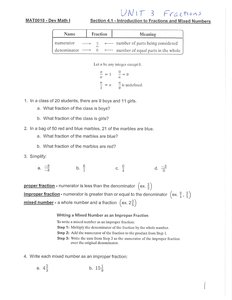
Fraction: A number of the form a/b, where a is the numerator and b is the denominator (with b ≠ 0).
Numerator: The number of parts being considered.
Denominator: The total number of equal parts in the whole.
Examples of fractions:
Proper fraction:
Improper fraction:
Mixed number:
Types of Fractions
Proper Fraction: Numerator is less than the denominator (e.g., ).
Improper Fraction: Numerator is greater than or equal to the denominator (e.g., ).
Mixed Number: A whole number and a fraction combined (e.g., ).
Examples and Applications
In a class of 20 students, if there are 9 boys and 11 girls:
Fraction of boys:
Fraction of girls:
If 3 out of 10 math students are girls:
If 7 out of 10 math students are boys:
Writing Improper Fractions as Mixed Numbers or Whole Numbers
To convert an improper fraction to a mixed number:
Divide the numerator by the denominator.
The quotient is the whole number part; the remainder over the denominator is the fractional part.
Example:
(since 7 divided by 4 is 1 with a remainder of 3)
Factors and Simplest Form
Prime and Composite Numbers
Understanding factors is crucial for simplifying fractions and solving algebraic equations.
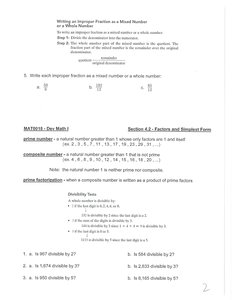
Prime Number: A natural number greater than 1 that has only two factors: 1 and itself (e.g., 2, 3, 5, 7, 11, 13, ...).
Composite Number: A natural number greater than 1 that is not prime; it has more than two factors (e.g., 4, 6, 8, 9, 10, ...).
Prime Factorization
Prime Factorization: Writing a composite number as a product of prime factors.
Example:
Prime factorization of 12: or
Divisibility Tests
Divisibility tests help determine if one number is divisible by another without performing full division.
Divisible by 2: The last digit is even (0, 2, 4, 6, 8).
Divisible by 3: The sum of the digits is divisible by 3.
Divisible by 5: The last digit is 0 or 5.
Divisible by 10: The last digit is 0.
Examples
Is 987 divisible by 3? (9 + 8 + 7 = 24; 24 is divisible by 3, so yes.)
Is 2,025 divisible by 5? (Last digit is 5, so yes.)