 Indietro
Geometry Essentials for College Algebra: Circles, Triangles, and Solids
Guida di studio - Note intelligenti
 Appunti personalizzati basati sui tuoi materiali, ampliati con definizioni chiave, esempi e contesto.
Geometry Fundamentals
Square Roots and Irrational Numbers
Understanding square roots is essential for solving equations and working with geometric formulas. The square root of a negative number is not defined in the set of real numbers.
Square Root Definition: The square root of a positive number x is a value y such that .
Examples: , ,
Not Defined: is not defined in real numbers.
Parallel and Perpendicular Lines: Parallel lines never intersect; perpendicular lines intersect at a right angle.
Parallel:
Perpendicular:
Angle:
Similarity and Congruence
Shapes can be classified as similar or congruent based on their properties.
Similar Shapes: Same shape, angles, and proportions.
Congruent Shapes: Same shape, angles, proportions, and size.
Proofs: Reasoning and logic are used to establish geometric facts.
Circles
Area and Circumference
The area and circumference of a circle are fundamental concepts in geometry.
Area: Measure of the space inside a circle.
Radius (r): Distance from center to circumference.
Diameter (d):
Circumference: Distance around the circle.
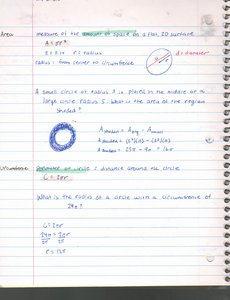
Annulus (Ring-Shaped Region)
An annulus is the region between two concentric circles.
Area of Annulus: , where R is the outer radius and r is the inner radius.
Sectors and Arcs
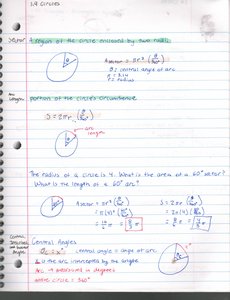
A sector is a region of a circle bounded by two radii and the arc between them. An arc is a portion of the circle's circumference.
Area of Sector: (where is in radians)
Arc Length:
Central and Inscribed Angles
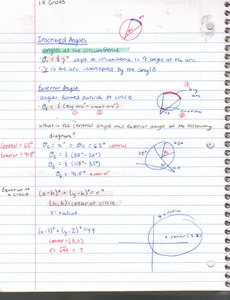
Central angles are formed at the center of the circle, while inscribed angles are formed on the circumference.
Central Angle: Angle whose vertex is at the center.
Inscribed Angle: Angle whose vertex is on the circle; its measure is half the central angle.
Triangles
Triangle Properties
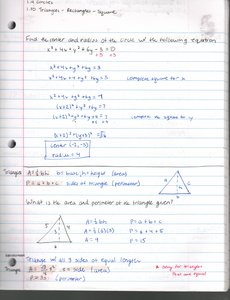
Triangles are classified by their sides and angles. The area and perimeter are key properties.
Area:
Perimeter: Sum of all sides.
Equilateral Triangle: All sides equal;
Right Triangles and Pythagorean Theorem
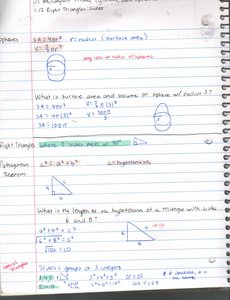
Right triangles have one 90-degree angle. The Pythagorean theorem relates the sides.
Pythagorean Theorem: (where c is the hypotenuse)
Rectangles and Squares
Rectangle Properties
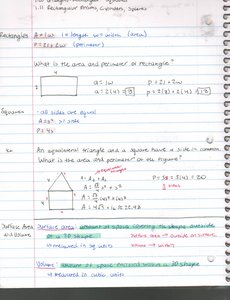
Rectangles have opposite sides equal and all angles are right angles.
Area:
Perimeter:
Square Properties
Squares are rectangles with all sides equal.
Area:
Perimeter:
Solids: Prisms, Cylinders, and Spheres
Rectangular Prisms
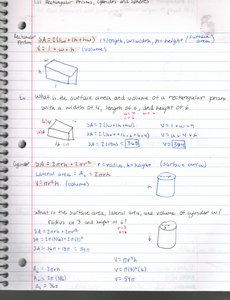
Prisms are three-dimensional shapes with rectangular faces.
Surface Area:
Volume:
Cylinders
Cylinders have circular bases and a curved surface.
Surface Area:
Lateral Area:
Volume:
Spheres
Spheres are perfectly round three-dimensional objects.
Surface Area:
Volume:
Defining Area and Volume
Area
Area is measured in square units and refers to the space inside a 2D shape.
Volume
Volume is measured in cubic units and refers to the space inside a 3D shape.
Summary Table: Area and Volume Formulas
Shape | Area Formula | Perimeter/Surface Area Formula | Volume Formula |
|---|---|---|---|
Circle | — | ||
Rectangle | — | ||
Square | — | ||
Triangle | — | ||
Rectangular Prism | — | ||
Cylinder | — | ||
Sphere | — |
