 Indietro
Graphing Techniques in College Algebra: Transformations, Symmetry, and Function Properties
Guida di studio - Note intelligenti
 Appunti personalizzati basati sui tuoi materiali, ampliati con definizioni chiave, esempi e contesto.
Graphing Techniques
Stretching and Shrinking
Graph transformations such as stretching and shrinking alter the shape of a function's graph by changing its steepness or width. These transformations can be vertical or horizontal, depending on how the function is modified.
Vertical Stretching: If a function is multiplied by a constant a where a > 1, the graph is stretched vertically. Each y-value is multiplied by a.
Vertical Shrinking: If 0 < a < 1, the graph is shrunk vertically. Each y-value is multiplied by a.
Horizontal Stretching: If the input variable x is multiplied by a constant a where 0 < a < 1, the graph is stretched horizontally.
Horizontal Shrinking: If a > 1, the graph is shrunk horizontally.
Formula: (vertical stretch/shrink) (horizontal stretch/shrink) Example: The graph of is a vertical stretch of by a factor of 2. 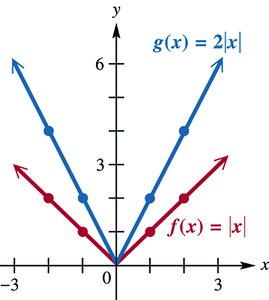 Example: The graph of is a vertical shrink of by a factor of 1/2.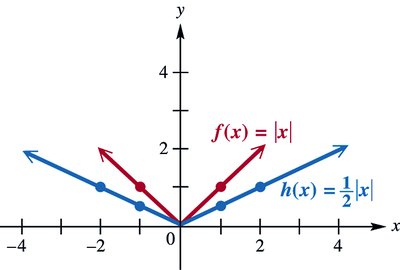
Reflecting
Reflection creates a mirror image of a graph across a specified axis. There are two main types:
Reflection across the x-axis: The graph of is the reflection of across the x-axis. Each y-value is multiplied by -1.
Reflection across the y-axis: The graph of is the reflection of across the y-axis. Each x-value is replaced by its opposite.
Example: The graph of is the reflection of across the x-axis. 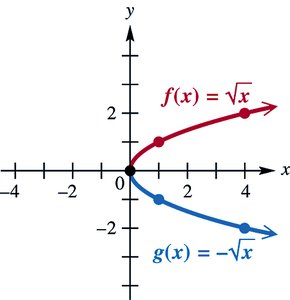 Example: The graph of is the reflection of across the y-axis.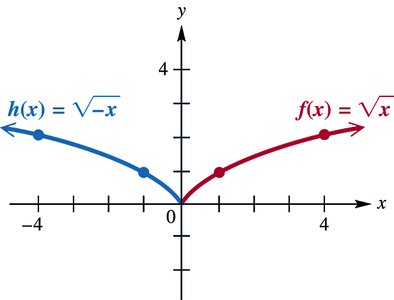
Symmetry
Symmetry in graphs helps identify patterns and properties of equations. There are three main types:
y-axis Symmetry: The graph is unchanged when x is replaced by -x. Indicates an even function.
x-axis Symmetry: The graph is unchanged when y is replaced by -y. (Note: Such graphs do not represent functions.)
Origin Symmetry: The graph is unchanged when both x and y are replaced by -x and -y, respectively. Indicates an odd function.
Example: The graph of is symmetric with respect to the y-axis. 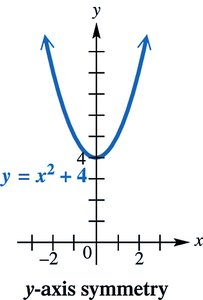 Example: The graph of has no x-axis or y-axis symmetry.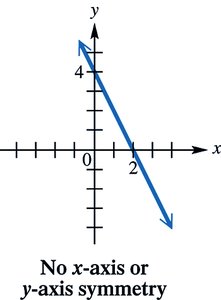
Even and Odd Functions
Functions can be classified based on their symmetry:
Even Function: for all x in the domain. The graph is symmetric with respect to the y-axis.
Odd Function: for all x in the domain. The graph is symmetric with respect to the origin.
Neither: If neither condition is satisfied, the function is neither even nor odd.
Translations
Translations shift the graph of a function without changing its shape. There are two main types:
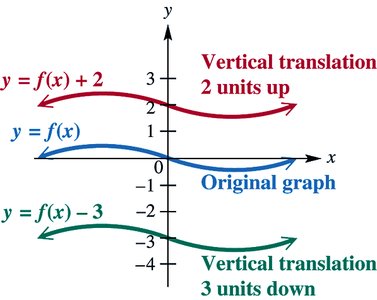
Vertical Translation: Adding or subtracting a constant k to a function shifts the graph up or down.
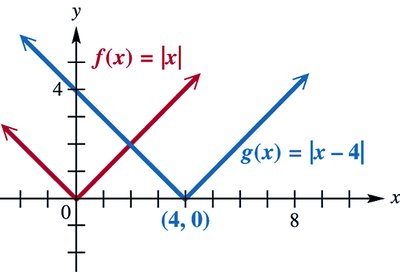
Horizontal Translation: Adding or subtracting a constant h inside the function argument shifts the graph left or right.
Formulas: (vertical translation) (horizontal translation) Example: The graph of is a vertical translation of downward by 4 units. 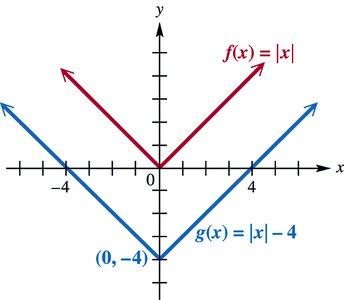 Example: The graph of is a vertical translation of up by 2 units; is a translation down by 3 units.
  Example: The graph of is a horizontal translation of right by 4 units.
  Example: The graph of is a horizontal translation of left by 2 units; is a translation right by 3 units.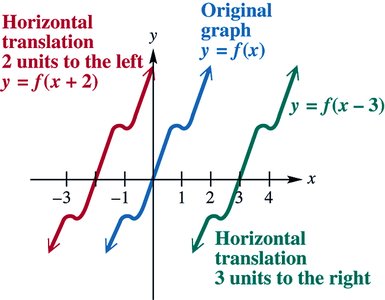
Multiple Transformations
Functions can undergo several transformations simultaneously, such as stretching, reflecting, and translating. The order of operations can affect the final graph.
Example: The graph of involves a reflection across the x-axis, a horizontal translation left by 3 units, and a vertical translation up by 1 unit. 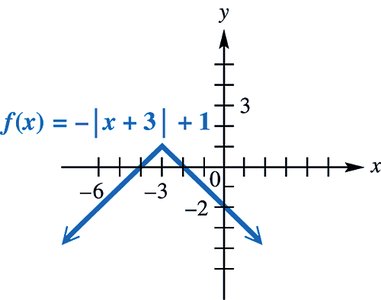 Example: The graph of involves a vertical shrink by 1/2, reflection across the x-axis, and a vertical translation up by 4 units.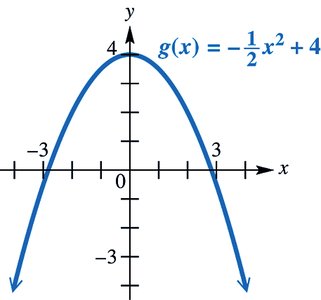
Summary Table: Types of Symmetry
Symmetry Type | Test | Example |
|---|---|---|
y-axis | Replace x with -x | |
x-axis | Replace y with -y | |
Origin | Replace x with -x and y with -y |
Summary of Graphing Techniques
The graph of is translated k units up.
The graph of is translated k units down.
The graph of is translated h units to the left.
The graph of is translated h units to the right.
The graph of is a vertical stretching if and a vertical shrinking if .
The graph of is a horizontal shrinking if and a horizontal stretching if .
The graph of is reflected across the x-axis.
The graph of is reflected across the y-axis.
Graphing Translations and Reflections of a Given Graph
Given a base graph , you can apply the above transformations to sketch new graphs. For example:
shifts the graph up by 3 units.
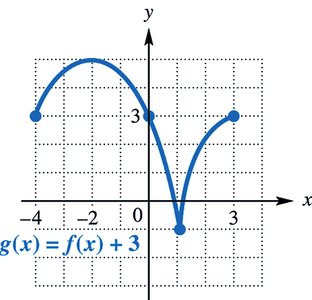
shifts the graph left by 3 units.
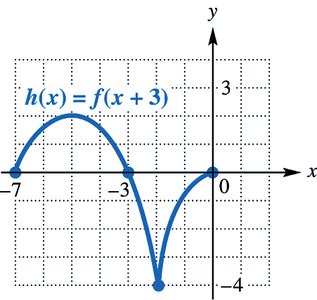
shifts the graph right by 2 units and up by 3 units.
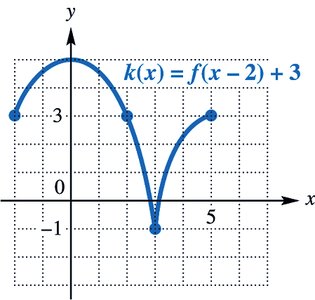
reflects the graph across the x-axis.
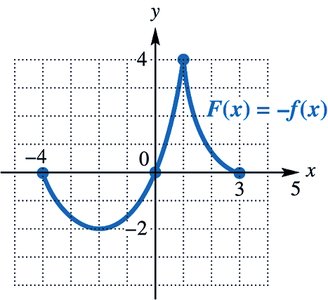
Additional info: Understanding these transformations is essential for analyzing and sketching the graphs of algebraic functions, which is a foundational skill in College Algebra.
