 Indietro
Inverse Functions and Their Representations
Guida di studio - Note intelligenti
 Appunti personalizzati basati sui tuoi materiali, ampliati con definizioni chiave, esempi e contesto.
Inverse Functions and Their Representations
Definition of Inverse Functions
An inverse function reverses the effect of the original function. If \( f(x) \) is a function, its inverse is denoted as \( f^{-1}(x) \). The inverse function satisfies the property:
\( f(f^{-1}(x)) = x \) for every \( x \) in the domain of \( f^{-1} \)
\( f^{-1}(f(x)) = x \) for every \( x \) in the domain of \( f \)
Domain of \( f \): Range of \( f^{-1} \) and Domain of \( f^{-1} \): Range of \( f \).
To find \( f^{-1}(x) \), solve the equation \( y = f(x) \) for \( x \) and then interchange \( x \) and \( y \).
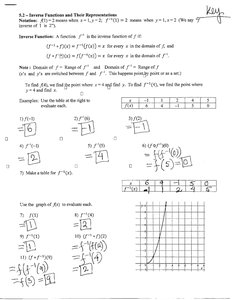
Finding Inverse Values from a Table
Given a table of values for \( f(x) \), the inverse function \( f^{-1}(x) \) can be found by swapping the input and output values.
For example, if \( f(2) = 5 \), then \( f^{-1}(5) = 2 \).
Example: If the table for \( f(x) \) is:
x | f(x) |
|---|---|
1 | 3 |
2 | 5 |
3 | 7 |
Then the table for \( f^{-1}(x) \) is:
x | f-1(x) |
|---|---|
3 | 1 |
5 | 2 |
7 | 3 |
Evaluating Inverse Functions Using Graphs
To evaluate \( f^{-1}(x) \) using a graph, locate the value \( x \) on the y-axis of \( f(x) \) and find the corresponding \( x \)-value.
Graphing Inverse Functions
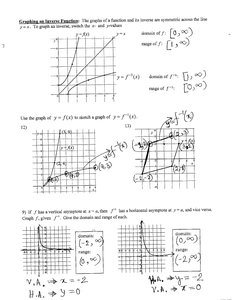
Symmetry Across the Line \( y = x \)
The graph of a function and its inverse are symmetric across the line \( y = x \). To graph the inverse, reflect the graph of \( f(x) \) over the line \( y = x \).
The domain of \( f \) becomes the range of \( f^{-1} \), and vice versa.
Horizontal and Vertical Asymptotes
If \( f(x) \) has a vertical asymptote at \( x = a \), then \( f^{-1}(x) \) has a horizontal asymptote at \( y = a \), and vice versa.
Vertical asymptote: \( x = a \)
Horizontal asymptote: \( y = b \)
Example: If \( f(x) = \frac{1}{x} \), then \( f^{-1}(x) = \frac{1}{x} \) as well, and both have asymptotes at \( x = 0 \) and \( y = 0 \).
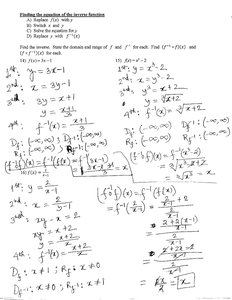
Finding the Equation of the Inverse Function
Steps to Find the Inverse
Replace \( f(x) \) with \( y \).
Solve for \( x \) in terms of \( y \).
Replace \( y \) with \( f^{-1}(x) \).
Example: Find the inverse of \( f(x) = 2x - 1 \):
Let \( y = 2x - 1 \)
Solve for \( x \): \( y + 1 = 2x \Rightarrow x = \frac{y + 1}{2} \)
So, \( f^{-1}(x) = \frac{x + 1}{2} \)
State the domain and range for both \( f \) and \( f^{-1} \):
Domain of \( f \): \( (-\infty, \infty) \)
Range of \( f \): \( (-\infty, \infty) \)
Domain of \( f^{-1} \): \( (-\infty, \infty) \)
Range of \( f^{-1} \): \( (-\infty, \infty) \)
One-to-One Functions and the Horizontal Line Test
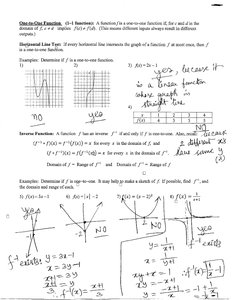
Definition of One-to-One Function
A function is one-to-one if each output value corresponds to exactly one input value. This property is necessary for a function to have an inverse that is also a function.
If different inputs produce the same output, the function is not one-to-one.
Horizontal Line Test
If any horizontal line intersects the graph of a function more than once, the function is not one-to-one and does not have an inverse function.
Examples and Applications
\( f(x) = x^2 \) is not one-to-one (fails the horizontal line test).
\( f(x) = 2x - 1 \) is one-to-one (passes the horizontal line test).
Additional info: For quadratic functions, restricting the domain to \( x \geq 0 \) or \( x \leq 0 \) can make the function one-to-one, allowing for an inverse on that restricted domain.
