 Indietro
Key Concepts and Practice: Roots, Rational Exponents, and Complex Numbers
Guida di studio - Note intelligenti
 Appunti personalizzati basati sui tuoi materiali, ampliati con definizioni chiave, esempi e contesto.
Q1. What is the imaginary unit i and how is it defined?
Background
Topic: Complex Numbers
This question is about understanding the definition of the imaginary unit, which is foundational for working with complex numbers in algebra.
Key Terms and Formulas:
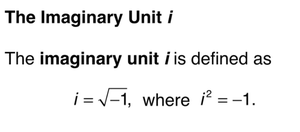
The imaginary unit is defined as .
It follows that .
Step-by-Step Guidance
Recall that the square root of a negative number is not a real number, so mathematicians defined to represent .
Understand that by the definition of .
Recognize that all complex numbers can be written in the form , where and are real numbers.
Try solving on your own before revealing the answer!
Final Answer:
The imaginary unit is defined as , and .
This definition allows us to work with square roots of negative numbers and forms the basis for complex numbers.
Q2. Multiply the complex numbers and write the result in standard form .
Background
Topic: Multiplying Complex Numbers
This question tests your ability to multiply complex numbers using the distributive property (FOIL method) and simplify the result.
Key Terms and Formulas:
Standard form:
FOIL method: Multiply First, Outer, Inner, Last terms.
Remember:
Step-by-Step Guidance
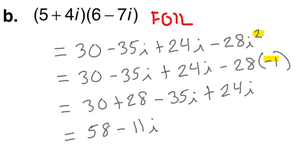
Apply the distributive property (FOIL) to expand .
Multiply each pair: , , , .
Combine like terms and remember to replace with .
Group the real and imaginary parts to write the answer in form.
Try solving on your own before revealing the answer!
Final Answer:
After expanding and simplifying, you combine like terms and use to get the result in standard form.
Q3. What is the complex conjugate of and what happens when you multiply a complex number by its conjugate?
Background
Topic: Complex Conjugates
This question is about understanding the concept of the complex conjugate and its properties, especially when multiplying conjugate pairs.
Key Terms and Formulas:
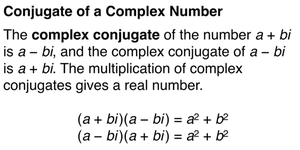
The complex conjugate of is .
Multiplying conjugates:
Step-by-Step Guidance
Write the conjugate of as .
Multiply using the distributive property.
Expand: .
Notice that the imaginary terms cancel and .
Try solving on your own before revealing the answer!
Final Answer:
The complex conjugate of is . When you multiply a complex number by its conjugate, you get a real number: .
This is useful for rationalizing denominators and simplifying expressions involving complex numbers.
Q4. Evaluate and state whether the result is a real number.
Background
Topic: Square Roots and Real Numbers
This question tests your understanding of square roots and how to determine if the result is a real number.
Key Terms and Formulas:
Square root: is the number that, when squared, gives .
If , is a real number.
Step-by-Step Guidance
Check if the number under the square root is positive, negative, or zero.
Find the number that, when squared, equals 121.
Decide if the result is a real number based on your answer.
Try solving on your own before revealing the answer!
Final Answer:
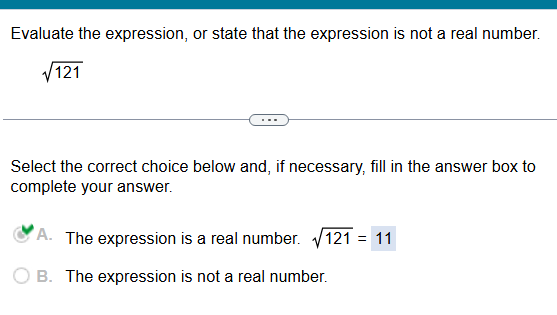
, which is a real number because .
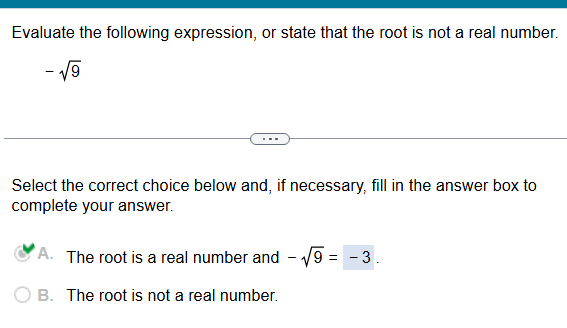
Q5. Evaluate and state whether the result is a real number.
Background
Topic: Square Roots and Real Numbers
This question checks your understanding of negative signs outside the square root and how to interpret the result.
Key Terms and Formulas:
Negative sign outside the root: means take the square root of first, then apply the negative sign.
If , is real, so is also real.
Step-by-Step Guidance
Find the square root of 9.
Apply the negative sign to the result.
Determine if the result is a real number.
Try solving on your own before revealing the answer!
Final Answer:
, which is a real number because .
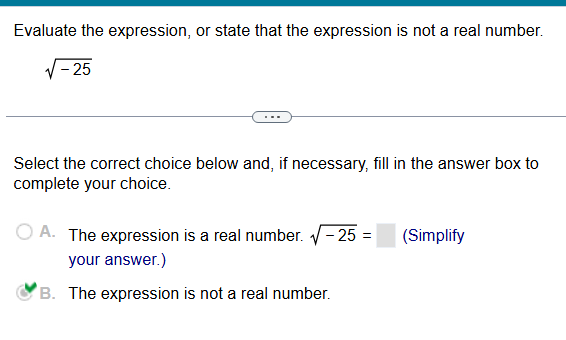
Q6. Evaluate and state whether the result is a real number.
Background
Topic: Square Roots of Negative Numbers
This question tests your understanding of when a square root is not a real number.
Key Terms and Formulas:
Square root of a negative number: is not a real number (unless using complex numbers).
Step-by-Step Guidance
Check if the number under the square root is negative.
Recall that the square root of a negative number is not a real number.
Decide which answer choice is correct based on this rule.
Try solving on your own before revealing the answer!
Final Answer:
is not a real number. The square root of a negative number is not defined in the real number system.
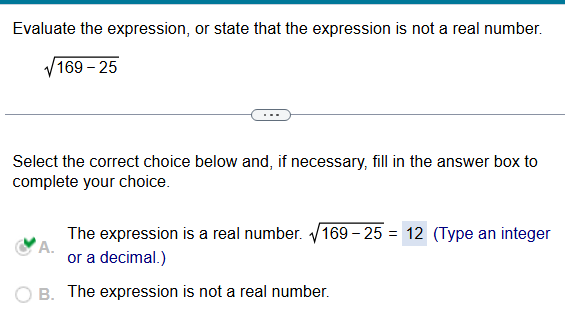
Q7. Evaluate and state whether the result is a real number.
Background
Topic: Order of Operations and Square Roots
This question tests your ability to simplify inside the radical before evaluating the square root.
Key Terms and Formulas:
Order of operations: Simplify inside the radical first.
Square root: is real if .
Step-by-Step Guidance
Subtract 25 from 169 to simplify inside the radical.
Find the square root of the result.
Determine if the result is a real number.
Try solving on your own before revealing the answer!
Final Answer:
, which is a real number.
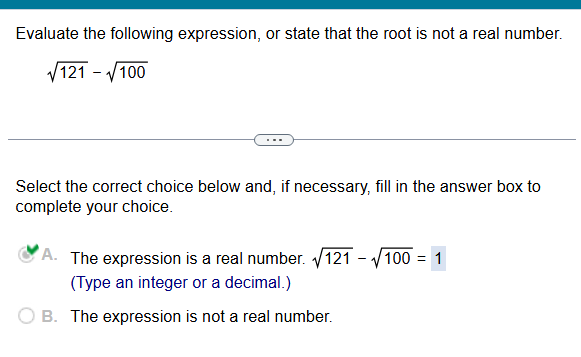
Q8. Evaluate and state whether the result is a real number.
Background
Topic: Square Roots and Subtraction
This question tests your ability to evaluate square roots separately and then subtract the results.
Key Terms and Formulas:
Evaluate each square root separately.
Subtract the results to get the final answer.
Step-by-Step Guidance
Find and separately.
Subtract the two results.
Check if the result is a real number.
Try solving on your own before revealing the answer!
Final Answer:
, which is a real number.
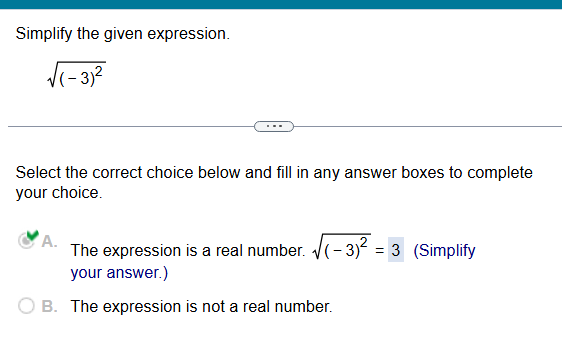
Q9. Simplify and state whether the result is a real number.
Background
Topic: Square Roots and Squaring
This question tests your understanding of how squaring a number and then taking the square root relates to absolute value.
Key Terms and Formulas:
is always non-negative.
(absolute value of ).
Step-by-Step Guidance
Square to get a positive number.
Take the square root of the result.
Express the answer as the absolute value of .
Try solving on your own before revealing the answer!
Final Answer:
, which is a real number.
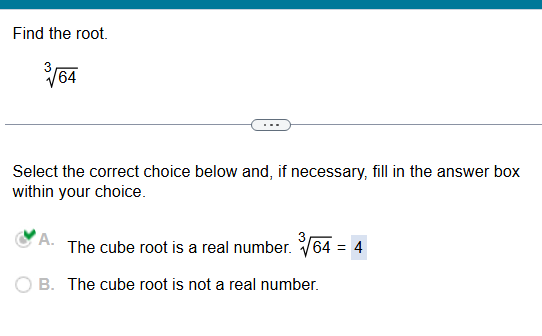
Q10. Find the cube root of $64$.
Background
Topic: Cube Roots
This question tests your understanding of cube roots and how to find them.
Key Terms and Formulas:
Cube root: is the number that, when multiplied by itself three times, gives .
Step-by-Step Guidance
Ask: What number multiplied by itself three times equals 64?
Try small positive integers to see which one works.
Once you find the number, check if it is a real number.
Try solving on your own before revealing the answer!
Final Answer:
, which is a real number because .
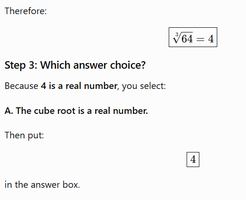
Q11. Simplify and state whether the result is a real number.
Background
Topic: Cube Roots of Negative Numbers
This question tests your understanding of cube roots when the radicand is negative.
Key Terms and Formulas:
Cube root: is real for all real , including negatives.
Step-by-Step Guidance
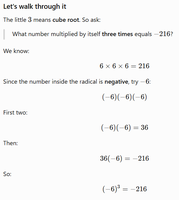
Ask: What number multiplied by itself three times equals ?
Try negative integers to see which one works.
Check if the result is a real number.
Try solving on your own before revealing the answer!
Final Answer:
, which is a real number because .
Q12. Find the indicated root or state that the expression is not a real number: .
Background
Topic: Even Roots of Negative Numbers
This question tests your understanding of when an even root of a negative number is real or not.
Key Terms and Formulas:
Even root of a negative number is not a real number.
Odd root of a negative number is real.
Step-by-Step Guidance
Check if the root is even or odd (here, 4th root is even).
Check if the number inside the root is negative.
Recall the rule: Even root + negative inside = not real.
Try solving on your own before revealing the answer!
Final Answer:
is not a real number because you cannot take an even root of a negative number in the real number system.
