 Indietro
Linear Equations and Properties of Exponents: Foundations for College Algebra
Guida di studio - Note intelligenti
 Appunti personalizzati basati sui tuoi materiali, ampliati con definizioni chiave, esempi e contesto.
Review of Algebra
Properties of Exponents
Exponents provide a concise way to represent repeated multiplication of the same factor. Understanding the rules of exponents is essential for simplifying algebraic expressions and solving equations.
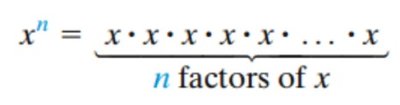
Definition: For a real number x and a positive integer n, the expression means multiplying x by itself n times.
Base: The number being multiplied.
Exponent: The number of times the base is used as a factor.
Product Rule:
Power Rule:
Power of a Product Rule:
Power of a Quotient Rule: , where
Quotient Rule: , where
Zero Exponent Rule: , where
Equations & Inequalities
Recognizing Linear Equations
A linear equation in one variable is an equation where the variable is raised only to the first power and can be written in the form , where , , and are real numbers and .
Examples of Linear Equations:
Examples of Non-Linear Equations:
Review of Simplifying Algebraic Expressions
Algebraic expressions can often be simplified by combining like terms and applying the distributive property. This process is essential for solving equations efficiently.
Combining Like Terms: Add or subtract coefficients of terms with the same variable and exponent.
Distributive Property:
Example:
When parentheses are present, use the distributive property to remove them, then combine like terms.
Review of Properties of Equality
The properties of equality allow us to manipulate equations to isolate variables and solve for unknowns while maintaining equivalence.
Addition Property of Equality: If , then for any real number .
Multiplication Property of Equality: If and , then .
These properties also apply to subtraction and division (as division is multiplication by the reciprocal).
Solving Linear Equations with Integer Coefficients
To solve a linear equation, isolate the variable by performing inverse operations using the properties of equality. The solution is the value of the variable that makes the equation true.
Goal: Get all variable terms on one side and constants on the other.
Check: Substitute the solution back into the original equation to verify.
Solving Linear Equations Involving Fractions
Equations with fractions can be simplified by clearing denominators. Multiply both sides by the least common denominator (LCD) to obtain an equation with integer coefficients.
Least Common Denominator (LCD): The smallest number divisible by each denominator in the equation.
Strategy: Multiply both sides by the LCD, then solve as usual.
Solving Linear Equations Involving Decimals
To eliminate decimals, multiply both sides of the equation by the smallest power of 10 that converts all decimal coefficients to integers. This simplifies the equation and makes it easier to solve.
Determine the Power of 10: Count the maximum number of decimal places in any term, then use where is that number.
Example: If the greatest number of decimal places is 2, multiply both sides by 100.
