 Indietro
Linear Equations, Functions, and Applications – Study Notes
Guida di studio - Note intelligenti
 Appunti personalizzati basati sui tuoi materiali, ampliati con definizioni chiave, esempi e contesto.
1.5 Linear Equations, Functions, and Applications
Linear Equations
Linear equations are foundational in algebra and are used to model a wide variety of real-world situations. Understanding how to solve and apply linear equations is essential for further study in mathematics and its applications.
Definition of a Linear Equation
Linear Equation in One Variable: An equation that can be expressed in the form , where m and b are real numbers and .

Equivalent Equations
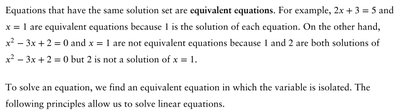
Equivalent Equations: Equations that have the same solution set. For example, and are equivalent because $x = 1$ is the solution to both.
Equations that do not have the same solution set are not equivalent. For example, and are not equivalent because $x^2 - 3x + 2 = 0$ has two solutions ($x = 1$ and ), but $x = 1$ only has one solution.
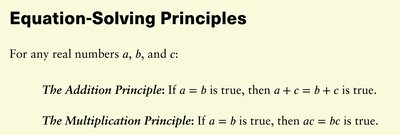
Equation-Solving Principles
Addition Principle: If is true, then is also true for any real number .
Multiplication Principle: If is true, then is also true for any real number .
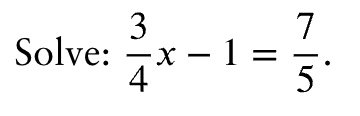
Example: Solving a Linear Equation with Fractions
To solve , it is often convenient to multiply both sides by the least common denominator (LCD) to clear fractions.
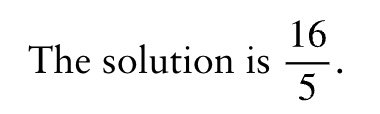
Solution: Multiply both sides by 20 (the LCD of 4 and 5), then solve for :
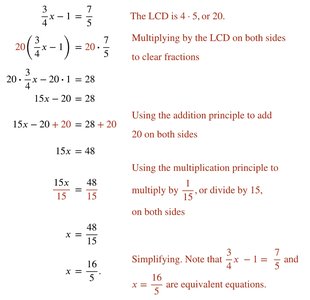
The solution is .
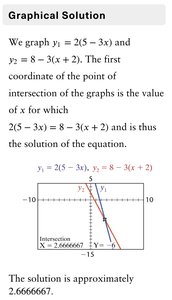
Graphical Solution and the Intersect Method
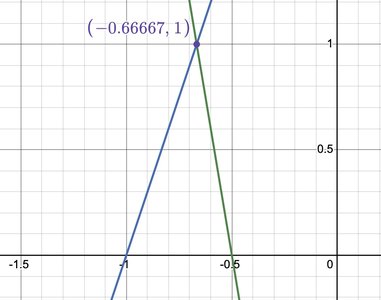
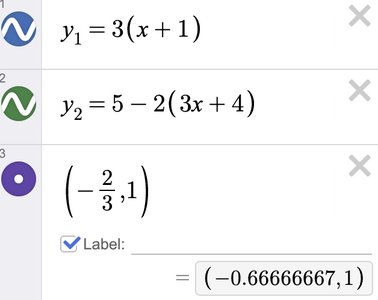
Graphical calculators can be used to solve equations by graphing both sides as separate functions and finding their intersection point.
For , graph and ; the -coordinate of their intersection is the solution.
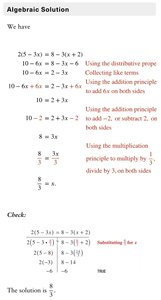
Solving Linear Equations: Algebraic and Graphical Methods
Use algebraic manipulation (distributive property, combining like terms, addition/multiplication principles) to isolate the variable.
Check the solution by substituting back into the original equation.
Graphical solutions involve plotting both sides as functions and finding their intersection.
Special Cases in Linear Equations
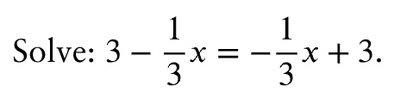
No Solution: If solving leads to a false statement (e.g., ), the equation has no solution.
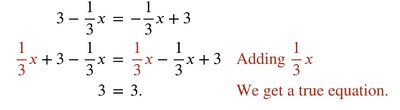
Infinitely Many Solutions: If solving leads to a true statement (e.g., ), any real number is a solution.
Applications Using Linear Models
Five Steps for Problem Solving
Solving real-world problems with linear equations involves a systematic approach:
Familiarize: Understand the problem, make drawings, list facts, assign variables, and organize information.
Translate: Express the problem in mathematical language or equations.
Carry Out: Use mathematical methods to solve the equation.
Check: Verify the solution in the context of the problem.
State: Clearly state the answer in a complete sentence.

Example: Studying Abroad
Given the total number of students and the difference between two groups, set up and solve a linear equation to find the number in each group.

The Motion Formula
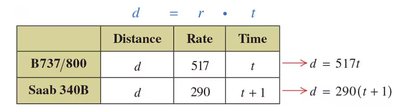
The distance traveled by an object moving at rate for time is given by:
Example: Airplane Speed
To find when one plane overtakes another, set their distances equal and solve for time.
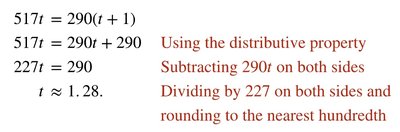
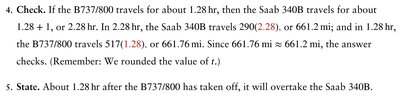

Example: Train Speeds
Similar to the airplane example, use the motion formula to determine when a faster train overtakes a slower one that had a head start.
The Simple-Interest Formula
The simple interest on a principal at interest rate for years is:

Example: Student Loans
Given the total amount borrowed and the total interest paid, set up a system of equations to find the amount borrowed at each rate.
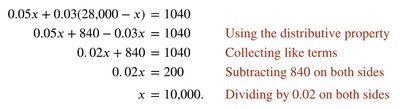
Example: Investment Income
Given the total investment and total interest earned, use the simple interest formula to find how much was invested at each rate.
Applications: Geometry and Perimeter
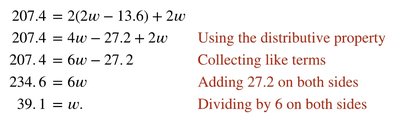
Example: Solar Panels
Given relationships between length and width and the perimeter, set up and solve a linear equation to find the dimensions.

Summary Table: Key Linear Equation Applications
Application | Key Formula | Example |
|---|---|---|
Motion | Airplane/Train overtaking problems | |
Simple Interest | Student loans, investments | |
Geometry | Perimeter formulas | Finding dimensions of rectangles |
