 Indietro
Linear Equations in One Variable: Properties, Solution Methods, and Equation Types
Guida di studio - Note intelligenti
 Appunti personalizzati basati sui tuoi materiali, ampliati con definizioni chiave, esempi e contesto.
Equations & Inequalities
Linear Equations in One Variable
Solving a linear equation in one variable involves finding all values of the variable that make the equation true. These values are called solutions of the equation. Linear equations can be solved using systematic algebraic properties and steps.
Addition Property of Equations: If , then for any real number . This means you can add or subtract the same value from both sides without changing the solution set.
Multiplication Property of Equations: If and , then . You can multiply or divide both sides by the same nonzero value without changing the solution set.
Steps for Solving Linear Equations
Clear Fractions: If fractions are present, find the Least Common Denominator (LCD) and multiply all terms by it to eliminate fractions.
Clear Parentheses: Use the distributive property to remove parentheses.
Simplify Each Side: Combine like terms on each side of the equation.
Group Variable Terms: Use the addition property to collect all variable terms on one side and constants on the other.
Isolate the Variable: Use the multiplication property to solve for the variable.
Types of Equations in One Variable
Conditional Equation: True for some, but not all, values of the variable.
Identity: True for all values of the variable (within the domain).
Contradiction: False for all values of the variable; no solution exists.
Example 1: Solving a Linear Equation with Parentheses
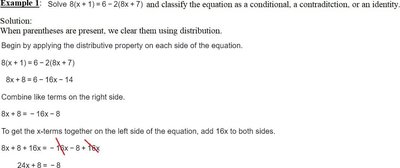
Problem: Solve and classify the equation.
Solution: When parentheses are present, clear them using distribution:
Apply the distributive property:
Combine like terms:
Add to both sides:
Simplify:
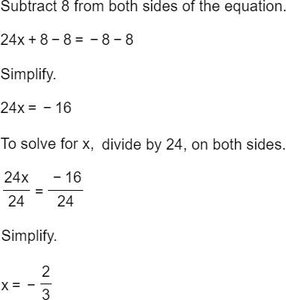
Subtract $8
Divide both sides by $24x = -\frac{2}{3}$
Classification: The equation is conditional since it is true only for .
Example 2: Contradiction
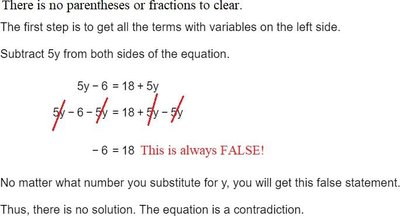
Problem: Solve and classify the equation.
Solution:
Subtract from both sides:
This is always false; there is no value of that makes the equation true.
Classification: The equation is a contradiction (no solution).
Example 3: Identity
Problem: Solve and classify the equation.
Solution:
Simplify both sides:
Subtract from both sides:
This is always true for any value of .
Classification: The equation is an identity (solution: all real numbers).
Example 4: Clearing Fractions
Problem: Solve an equation with denominators 3, 4, and 2.
Solution:
Find the LCD of 3, 4, and 2: LCD = 12.
Multiply all terms by 12 to clear fractions.
Distribute, combine like terms, and solve for the variable as in previous examples.
Classification: If the equation is true for only one value, it is conditional.
Additional info: The process of clearing fractions and simplifying is essential for solving equations efficiently and accurately.
