 Indietro
Linear Functions, Slope, and Rate of Change: Study Notes for College Algebra
Guida di studio - Note intelligenti
 Appunti personalizzati basati sui tuoi materiali, ampliati con definizioni chiave, esempi e contesto.
Linear Equations and Their Forms
Standard Form of a Linear Equation
The standard form of a linear equation in two variables is given by:
Ax + By = C, where A and B are real numbers and not both zero.
This form is useful for quickly finding the x-intercept and y-intercept of the line.
The values of A, B, and C can also be used to determine the slope of the line.
Intercepts of a Line
The intercepts are the points where the line crosses the axes:
x-intercept: Set y = 0 and solve for x.
y-intercept: Set x = 0 and solve for y.
Forms of Linear Equations
There are three main forms of linear equations:
Standard Form:
Slope-Intercept Form:
Point-Slope Form:
Classification of Lines by Slope
Lines can be classified based on their slope:
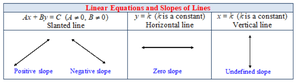
Slanted Line: (A, B ≠ 0) - can have positive or negative slope.
Horizontal Line: (k is a constant) - slope is zero.
Vertical Line: (k is a constant) - slope is undefined.
Graphing Linear Equations
Graphing from Standard Form
To graph a linear equation in standard form:
Find the x-intercept by setting y = 0.
Find the y-intercept by setting x = 0.
Plot both intercepts and draw a straight line through them.
Examples
Slope of a Line
Definition and Formula
The slope of a line measures its steepness and is calculated using two points and :
Slope formula:
Also described as "rise over run" or the change in y divided by the change in x.
If , the slope is undefined (vertical line).
Examples
Find the slope between and :
Find the slope between and :
For , the slope is 0 (horizontal line).
For , the slope is undefined (vertical line).
Point-Slope Form
The point-slope form is useful for writing the equation of a line given a point and the slope:
Slope-Intercept Form
Definition
The slope-intercept form of a line is:
Where m is the slope and b is the y-intercept.
Example
Write the equation of a line passing through with slope 5: (find b using the point).
Average Rate of Change
Definition and Formula
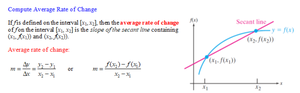
The average rate of change of a function on the interval is the slope of the secant line connecting and :
This measures how the function changes on average between two points.
Examples
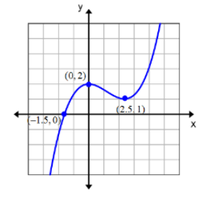
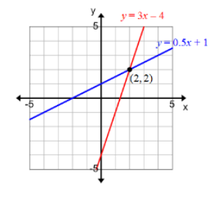
From to
From to
Solving Linear Equations
Example Equation
Solve
Steps:
Move all terms involving x to one side:
Simplify:
Divide:
Summary Table: Linear Equations and Slope Types
The following table summarizes the types of linear equations and their slopes:
Equation Form | Line Type | Slope |
|---|---|---|
Ax + By = C (A, B ≠ 0) | Slanted Line | Positive or Negative |
y = k | Horizontal Line | Zero |
x = k | Vertical Line | Undefined |
Key Points to Remember
Two points determine a unique line.
The slope is undefined for vertical lines.
The slope is zero for horizontal lines.
Linear equations can be written in standard, slope-intercept, or point-slope form.
The average rate of change is a fundamental concept for understanding how functions behave between two points.
