 Indietro
Lines: Slope, Equations, and Graphs
Guida di studio - Note intelligenti
 Appunti personalizzati basati sui tuoi materiali, ampliati con definizioni chiave, esempi e contesto.
Lines in the Coordinate Plane
Introduction
Lines are fundamental objects in algebra and analytic geometry. Understanding their properties, equations, and graphical representations is essential for solving a wide range of mathematical problems. This section covers the calculation and interpretation of slope, various forms of linear equations, and the relationships between lines such as parallelism and perpendicularity.
Slope of a Line
Definition of Slope
The slope of a line measures its steepness and direction. It is defined as the ratio of the vertical change to the horizontal change between two distinct points on the line.
Formula: For points \( P = (x_1, y_1) \) and \( Q = (x_2, y_2) \), the slope \( m \) is given by:
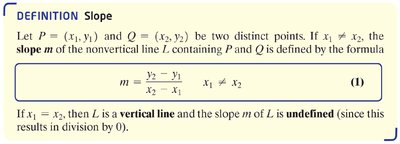
If \( x_1 = x_2 \), the line is vertical and the slope is undefined.
Examples of Calculating Slope
Example 1a: Find the slope between (-3, -2) and (0, 4):
Example 1b: Find the slope between (-2, 4) and (-2, -1): (undefined; vertical line)
Example 1c: Find the slope between (3, 2) and (-2, 2): (horizontal line)
Equations of Lines
Equation of a Vertical Line
A vertical line has an equation of the form:
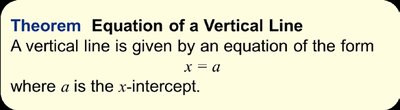
Here, a is the x-intercept.
Example: The line through (-2, 4) and (-2, -1) is .
Equation of a Horizontal Line
A horizontal line has an equation of the form:
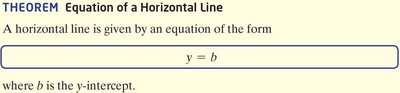
Here, b is the y-intercept.
Example: The line through (3, 2) and (-2, 2) is .
Slope-Intercept Form
The slope-intercept form of a line is useful for quickly identifying the slope and y-intercept:
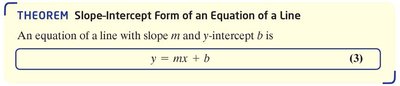
m is the slope.
b is the y-intercept.
Example: For , solve for y: Slope: , y-intercept: .
Point-Slope Form
The point-slope form is used when you know the slope and a point on the line:
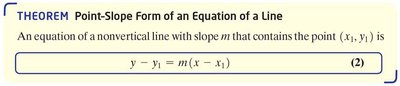
Example: Find the equation of a line with slope -2 through (-3, 1): Simplify to slope-intercept form:
General Form of a Line
The general form of a line is:
Example: The line through (2, 3) and (-4, 5): Slope: Using point-slope form: Slope-intercept form: General form:
Graphing Lines Using Intercepts
To graph a line in general form, find the x- and y-intercepts:
Set y = 0 to find the x-intercept.
Set x = 0 to find the y-intercept.
Parallel and Perpendicular Lines
Parallel Lines
Parallel lines have the same slope but different y-intercepts.
If , the lines are parallel.
Example: and are parallel.
Perpendicular Lines
Perpendicular lines have slopes that are negative reciprocals of each other.
If , the lines are perpendicular.
Example: and are perpendicular.
Examples: Parallelism and Perpendicularity
Example 6: Determine if and are parallel, perpendicular, or neither. Rewrite both in slope-intercept form: Both have slope , so they are parallel.
Finding Equations of Parallel and Perpendicular Lines
To find a line parallel to through point , use the same slope and point-slope form.
To find a line perpendicular to through , use slope and point-slope form.
Summary Table: Forms of Linear Equations
Form | Equation | When to Use |
|---|---|---|
Slope-Intercept | When slope and y-intercept are known | |
Point-Slope | When slope and a point are known | |
Vertical Line | Vertical lines (undefined slope) | |
Horizontal Line | Horizontal lines (zero slope) | |
General Form | Standard algebraic representation |
Graphical Representation
Lines can be visualized on the Cartesian plane. The slope determines the angle, and the intercepts determine where the line crosses the axes.

Additional info: For practice, use graphing tools such as Desmos or PhET to visualize lines and their properties.
