 Indietro
Percent Increase and Decrease Problems in Algebra
Guida di studio - Note intelligenti
 Appunti personalizzati basati sui tuoi materiali, ampliati con definizioni chiave, esempi e contesto.
Percent Increase and Decrease Problems
Introduction to Percent Change
Percent increase and decrease problems are common in both business and consumer contexts. These problems involve determining how a quantity changes relative to its original value, either by increasing or decreasing by a certain percentage. Understanding these concepts is essential for solving real-world algebraic problems involving growth, reduction, and comparison of values over time.
Identifying Increase and Decrease Problems
Recognizing Increase Problems
An increase problem involves finding a new value that is greater than the original value by a certain percentage. The new value is the sum of the original value (base) and the increase.
Key Phrases: "an increase of," "more than," "greater than"
Formula:
Recognizing Decrease Problems
A decrease problem involves finding a new value that is less than the original value by a certain percentage. The new value is the original value minus the decrease.
Key Phrases: "after a decrease of," "less than," "after a reduction of"
Formula:
Solving Increase and Decrease Problems
Using Diagrams for Visualization
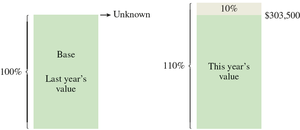
Diagrams can help visualize the relationship between the base, the percent increase or decrease, and the new value. These diagrams typically show the base as 100% and the new value as the sum or difference of the base and the percent change.
Basic Percent Formula
The basic percent formula relates the part, base, and rate (percent):
Percent Formula:
To solve for the base when the part and rate are known:
Examples of Increase and Decrease Problems
Example 1: Finding the Original Value After an Increase
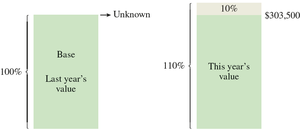
Problem: The value of a home this year is $303,500, which is 10% more than last year’s value. Find last year’s value.
Let the base (last year’s value) be 100%.
This year’s value is 110% of last year’s value.
Set up the equation:
Solve for the base:
Example 2: Successive Percent Increases
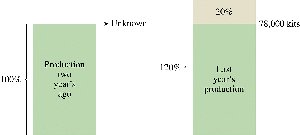
Problem: A company increased production of testing kits by 20% per year for two years. This year’s production is 93,600 kits. Find the number of kits produced two years ago.
Step 1: Find last year’s production.
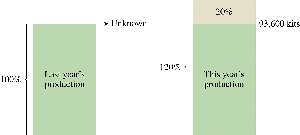
Step 2: Find production two years ago.
Example 3: Finding the Original Price After a Decrease
Problem: After a 10% discount, the price of running shoes is $135. What was the original price?
The original price is the base (100%).
After a 10% decrease, the new price is 90% of the original price.
Set up the equation:
Solve for the base:
Summary Table: Increase and Decrease Formulas
Type of Problem | Formula | Example Calculation |
|---|---|---|
Increase | ||
Decrease |
Key Takeaways
Always identify whether the problem involves an increase or decrease.
Express percent changes as decimals when using formulas (e.g., 10% = 0.10).
Use diagrams to visualize the relationship between base, percent change, and new value.
Apply the basic percent formula to solve for unknowns in both increase and decrease scenarios.
