Indietro
Piecewise-Defined Functions, Greatest Integer Function, and Direct Variation
Guida di studio - Note intelligenti
 Appunti personalizzati basati sui tuoi materiali, ampliati con definizioni chiave, esempi e contesto.
Piecewise-Defined Functions
Definition and Properties
A piecewise-defined function is a function that is defined by different expressions for different intervals of its domain. If each piece is a linear function, the overall function is called a piecewise-linear function.
Domain: The set of all input values (x-values) for which the function is defined.
Continuity: A piecewise-defined function may or may not be continuous, depending on whether the pieces connect without gaps or jumps.
Example: Evaluating and Graphing a Piecewise-Defined Function
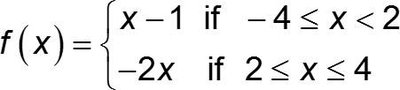
Consider the function:
$ f(x) = \begin{cases} x - 1 & \text{if } -4 \leq x < 2 \\ -2x & \text{if } 2 \leq x \leq 4 \end{cases} $
Domain: $[-4, 4]$
Evaluations:
$f(-3) = -3 - 1 = -4$
$f(2) = -2 \cdot 2 = -4$
$f(4) = -2 \cdot 4 = -8$
$f(5)$ is undefined (5 is not in the domain)
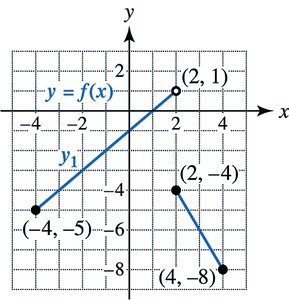
Graph: The graph consists of two line segments:
From $x = -4$ to $x = 2$ (not including $x = 2$), the graph is $y = x - 1$.
From $x = 2$ to $x = 4$, the graph is $y = -2x$.
Continuity: The function is not continuous at $x = 2$ because there is a break in the graph.
Greatest Integer Function
Definition and Properties
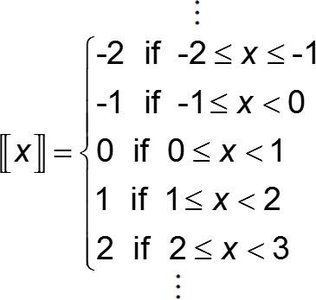
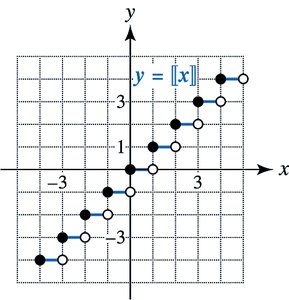
The greatest integer function, also known as the floor function, is defined as $f(x) = \lfloor x \rfloor$. For any real number $x$, $\lfloor x \rfloor$ is the greatest integer less than or equal to $x$.

Piecewise Representation:
$\lfloor x \rfloor = -2$ if $-2 \leq x < -1$
$\lfloor x \rfloor = -1$ if $-1 \leq x < 0$
$\lfloor x \rfloor = 0$ if $0 \leq x < 1$
$\lfloor x \rfloor = 1$ if $1 \leq x < 2$
$\lfloor x \rfloor = 2$ if $2 \leq x < 3$
Graph: The graph of $y = \lfloor x \rfloor$ consists of horizontal segments with closed circles on the left and open circles on the right of each integer value.
Applications of Piecewise Functions: Fujita Scale
Fujita Scale as a Piecewise Function
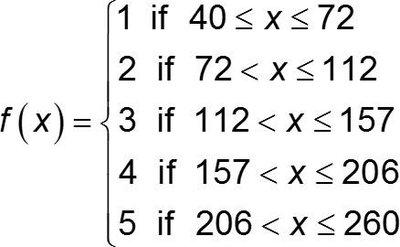
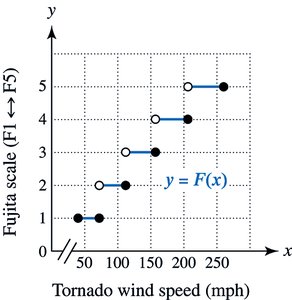
The Fujita scale is used to classify tornadoes based on wind speed. It can be represented as a piecewise function:
$ f(x) = \begin{cases} 1 & \text{if } 40 \leq x \leq 72 \\ 2 & \text{if } 72 < x \leq 112 \\ 3 & \text{if } 112 < x \leq 157 \\ 4 & \text{if } 157 < x \leq 206 \\ 5 & \text{if } 206 < x \leq 260 \end{cases} $
Graph: The graph is a step function, with each step corresponding to a range of wind speeds and a Fujita scale value.
Variation Problems
Direct Variation
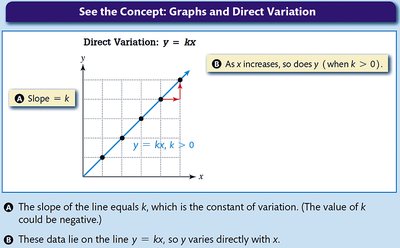
In direct variation, one variable is a constant multiple of another. The general form is $y = kx$, where $k$ is the constant of variation.
Steps to Solve Direct Variation Problems:
Write the general equation for the type of variation.
Substitute given values to solve for $k$.
Substitute $k$ back into the equation.
Use the equation to find the requested quantity.
Example: Solving a Direct Variation Problem
Let $T$ vary directly with $x$, and suppose $T = 33$ when $x = 5$. Find $T$ when $x = 31$.
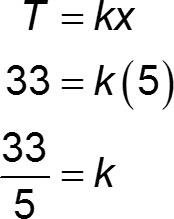
General equation: $T = kx$
Substitute: $33 = k(5) \implies k = \frac{33}{5} = 6.6$
Find $T$ when $x = 31$: $T = 6.6 \times 31 = 204.6$
Graphs and Direct Variation
The graph of a direct variation equation $y = kx$ is a straight line passing through the origin. The slope of the line is $k$.
If $k > 0$, as $x$ increases, $y$ increases.
If $k < 0$, as $x$ increases, $y$ decreases.