 Indietro
Quadratic Equations: Methods, Applications, and Problem Solving
Guida di studio - Note intelligenti
 Appunti personalizzati basati sui tuoi materiali, ampliati con definizioni chiave, esempi e contesto.
Equations and Inequalities
Quadratic Equations
A quadratic equation in x is an equation that can be written in the general form:
where a, b, and c are real numbers, with a ≠ 0. Quadratic equations are also called second-degree polynomial equations in x.
Factoring and the Zero Product Principle
Factoring a polynomial means expressing it as a product of simpler polynomials. Common methods include factoring out the greatest common factor (GCF) and factoring trinomials.
Zero Product Principle: If the product of two algebraic expressions is zero, then at least one of the factors must be zero.
Steps to Solve a Quadratic Equation by Factoring:
Rewrite the equation in the form .
Factor the quadratic expression completely.
Set each factor containing a variable equal to zero.
Solve the resulting linear equations.
Check the solutions in the original equation.
Example: Solve by factoring. Factor: Set each factor to zero: or Solutions: or
Solving Quadratic Equations by the Square Root Property
The square root property states that if , then .
Isolate the squared term.
Take the square root of both sides, remembering to include both the positive and negative roots.
Example: Solve
Solving Quadratic Equations by Completing the Square
Completing the square is a method used to solve quadratic equations by converting the equation into a perfect square trinomial.
Move the constant term to the other side of the equation.
Add the square of half the coefficient of to both sides to create a perfect square trinomial.
Factor the perfect square trinomial.
Solve for using the square root property.
Example: Solve by completing the square. Move constant: Add to both sides: Factor:
The Quadratic Formula
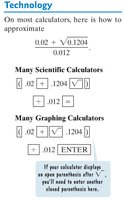
The quadratic formula provides a general solution for any quadratic equation :
This formula is derived by completing the square on the general quadratic equation.
Choosing the Most Efficient Method
When solving quadratic equations, choose the method based on the equation's structure:
Factoring: Use when the equation factors easily.
Square Root Property: Use when the equation is in the form .
Completing the Square: Use when the coefficient of is 1 and the equation does not factor easily.
Quadratic Formula: Use for any quadratic equation, especially when factoring is difficult or impossible.
Applications of Quadratic Equations
Quadratic equations are used to model a variety of real-world problems, such as projectile motion, area, and optimization problems.
Example: A man’s normal systolic blood pressure, , at age , is modeled by the equation . Find the age when mm Hg.
Set up the equation: Solve using the quadratic formula.
Geometric Applications: The Pythagorean Theorem
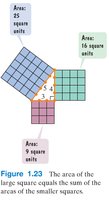
Quadratic equations often arise in geometry, especially with right triangles. The Pythagorean Theorem states:
where and are the legs and is the hypotenuse of a right triangle.
Example: Wheelchair Ramp Problem
A wheelchair ramp with a length of 122 inches has a horizontal distance of 120 inches. What is the ramp’s vertical distance?
Let be the vertical distance. By the Pythagorean Theorem:
Solve for :
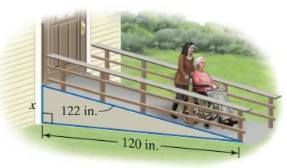
Application: Construction laws require every vertical rise of 1 inch to have a horizontal run of 12 inches. Check if the ramp meets this requirement by comparing the calculated vertical distance to the horizontal run.
Example: Right Triangle Property Problem
A piece of property has the shape of a right triangle. The longer leg is 20 m longer than twice the length of the shorter leg. The hypotenuse is 10 m longer than the length of the longer leg. Find the lengths of the sides.
Let the shorter leg be .
Longer leg:
Hypotenuse:
Apply the Pythagorean Theorem:
Expand and solve the resulting quadratic equation for .
Summary Table: Methods for Solving Quadratic Equations
Method | When to Use | Example Equation |
|---|---|---|
Factoring | Equation factors easily | |
Square Root Property | Equation in the form | |
Completing the Square | Coefficient of is 1, not easily factorable | |
Quadratic Formula | Any quadratic equation |
