 Indietro
Chapter 3 /3.1/ Quadratic Functions: Features, Graphing, and Applications
Guida di studio - Note intelligenti
 Appunti personalizzati basati sui tuoi materiali, ampliati con definizioni chiave, esempi e contesto.
Quadratic Functions and Their Features
Definition and Key Vocabulary
Quadratic functions are a fundamental topic in College Algebra, characterized by their unique graph shapes and properties. Understanding their vocabulary is essential for graphing and solving related problems.
Quadratic function: A function of the form with . The highest power of is 2.
Parabola: The graph of a quadratic function. It appears as a smooth bowl (opens up) or an upside-down bowl (opens down).
Vertex: The turning point of the parabola. It is the lowest point if the graph opens up, and the highest if it opens down.
Axis of symmetry: The vertical line passing through the vertex, dividing the parabola into two mirror-image halves.
Leading coefficient (a): The coefficient of in . Its sign determines the opening direction of the parabola.
Vertex form: . The vertex is .
General (standard) form: . The coefficients , , and define the parabola's shape and position.
x-intercept: A point where the graph meets the x-axis. Found by solving .
Zero or root: An input such that . Real zeros correspond to x-intercepts.
y-intercept: The point . Substitute to find it; in general form, it is .
Domain: All allowed -values. For unrestricted quadratics, the domain is .
Range: All possible -values. Determined by the vertex height and the opening direction.
Minimum or maximum: The smallest or largest output, which is the vertex's -value at .
Formulas and Graphing Steps
Vertex and Intercepts
To analyze and graph a quadratic function, follow these steps and formulas:
Vertex from vertex form: gives vertex ; axis of symmetry .
Vertex from general form: , . The vertex is .
Opening direction: means the parabola opens up (minimum); means it opens down (maximum).
Range: Opens up: ; opens down: .
x-intercepts: Solve by factoring, square roots, or the quadratic formula.
Quadratic formula: .
Number of real zeros: Discriminant : (two zeros), (one repeated zero), (no real zeros).
y-intercept: Compute ; point is .
Graphing Routine
Identify the form and coefficient to determine opening direction.
Find the vertex and draw the axis of symmetry.
Solve for real x-intercepts.
Find the y-intercept by substituting .
Plot the vertex and intercepts; add a reflected point if needed, then draw a smooth curve.
State domain, range, and minimum or maximum as required.
Common Mistakes
Sign inside parentheses: means .
Missing coefficient: means .
Vertex formula: Divide by the entire .
Square roots: Include both and when solving positive number.
Answer format: Zero is an x-value; intercept is a point; axis is a line ; minimum/maximum value is at .
Infinity always uses a parenthesis.
Shape reminder: Compared with at the same vertex, is narrower, is wider.
Worked Example: Vertex Form
Example:
This example demonstrates how to analyze and graph a quadratic in vertex form.
Step 1: Identify , , . The graph opens down. Vertex: . Axis: .
Step 2: Find x-intercepts by solving :
or
x-intercepts: and
Step 3: Find y-intercept: . Point: . Reflection: .
Step 4: Domain: . Range: . Maximum value: $4x = 1$.
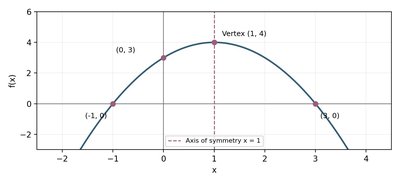
Identification check: Point to the vertex, both x-intercepts, the y-intercept, and the axis of symmetry. Cover the labels and identify them again.
Worked Example: General Form
Example:
This example demonstrates how to analyze and graph a quadratic in general form.
Step 1: Find the vertex:
, ,
Vertex: ; Axis:
Step 2: Find intercepts:
x-intercepts: Use quadratic formula:
Intercepts: and (approx. and )
y-intercept: , so . Reflection: .
Step 3: Domain: . Range: . Maximum value: $5x = 2$.
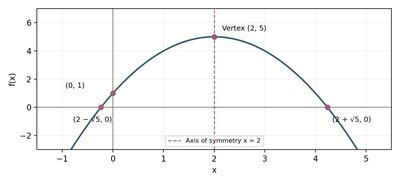
Self-check: The two real zeros average to $2$, the x-coordinate of the vertex. Both intercepts are equidistant from the axis.
Minimum, Maximum, and Applications
Finding Minimum or Maximum Values
The vertex provides the minimum or maximum value of a quadratic function, which is often used in optimization problems.
Example 1:
(opens up, minimum)
Minimum value: $984x = 2(2, 984)$
Domain: ; Range:
Example 2: Maximum area with 120 feet of fencing
Let = width, = length; Area
Perimeter:
Area function: (, maximum)
Best width: feet
Other dimension: feet
Maximum area: square feet
Recognizing optimization questions: Look for phrases like largest area, smallest cost, highest value, maximum, or minimum. Define the quantity, write a function in one variable, find the vertex, and interpret both coordinates with units.
Context: Word problems may restrict the domain (e.g., for rectangle dimensions).
Practice and Readiness Check
Vocabulary and Identification
Axis of symmetry: The vertical mirror line of a parabola.
Zero: An input that makes equal zero.
Range: The set of possible output values.
Vertex: The turning point of the graph.
y-intercept: The point found by setting .
Domain: The set of permitted input values.
Graphing and Problem Solving
Identify , , , vertex, axis, minimum/maximum for given functions.
Find intercepts, domain, range, and plot points for various quadratic functions.
Apply the quadratic formula to find real zeros and corresponding intercepts.
Explain why some quadratics have no real x-intercepts (e.g., ).
Applications and Error Checking
Model area problems with quadratic functions and interpret answers with units.
Correct common errors in vertex identification and maximum/minimum values.
State axis, domain, range, and minimum/maximum for given vertex and opening direction.
Summary Table: Quadratic Function Properties
Form | Vertex | Axis | Opening | Range | Intercepts |
|---|---|---|---|---|---|
Vertex form | up, down | Up: Down: | Solve for x-intercepts; for y-intercept | ||
General form | , | up, down | Up: Down: | Quadratic formula for x-intercepts; for y-intercept |
Readiness Checklist
Identify vocabulary in equations and graphs
Find the full vertex from either equation form
Find intercepts and sketch a parabola
State domain, range, and minimum/maximum correctly
Model an area problem and explain the answer with units
Next step: Review missed skills, study worked examples, and solve similar problems independently.
