 Indietro
Quadratic Functions: Forms, Properties, and Applications
Guida di studio - Note intelligenti
 Appunti personalizzati basati sui tuoi materiali, ampliati con definizioni chiave, esempi e contesto.
Quadratic Functions
Introduction to Quadratic Functions
Quadratic functions are a fundamental class of functions in algebra, characterized by the presence of an x2 term. They model many real-world phenomena, such as the path of a thrown object. The general (standard) form of a quadratic function is:
Standard Form: , where a, b, and c are constants, and a ≠ 0.
Quadratic Term: ; a is the leading coefficient.
Linear Term:
Constant Term: ; this is also the y-intercept.
Key Properties:
If a > 0, the parabola opens upward.
If a < 0, the parabola opens downward.
The value of c gives the y-intercept of the graph.
Example: The height of a baseball thrown upward can be modeled by . Here, , , . The negative leading coefficient indicates the parabola opens downward, modeling the rise and fall of the ball.
Quadratic Functions in Factored Form
Quadratic functions can also be written in factored form, which reveals the zeros (roots) of the function. The factored form is:
Factored Form: , where r and s are the zeros of the function.
Setting each factor equal to zero gives the x-values where the function crosses the x-axis.
Example: If , then the zeros are and . These represent the times when the baseball is at ground level.
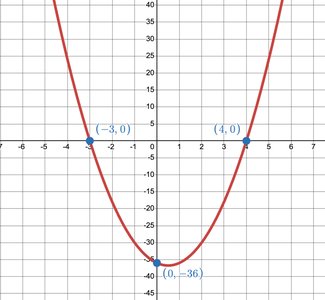
Graphical Example: Factored Form
The following graph shows a quadratic function with zeros at and , and a y-intercept at .
Quadratic Functions in Vertex Form
The vertex form of a quadratic function highlights the vertex (maximum or minimum point) of the parabola. The vertex form is:
Vertex Form: , where is the vertex of the parabola.
If a > 0, the vertex is the minimum point; if a < 0, the vertex is the maximum point.
Example: has its vertex at , meaning the maximum height of the baseball is 196 feet at seconds.
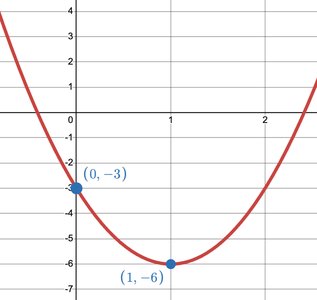
Graphical Example: Vertex Form
The following graph shows a quadratic function with a vertex at and a y-intercept at .
Applications of Quadratic Functions
Quadratic functions are widely used in modeling real-world scenarios, such as projectile motion and business applications.
Revenue, Cost, and Profit: If a company charges dollars per item and can sell items, with each item costing $6$ dollars to produce, then:
Revenue:
Cost:
Profit:
To find the price that maximizes profit, express as a quadratic function and find its vertex.
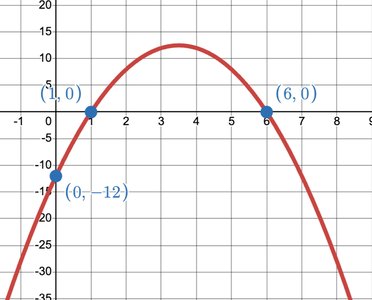
Further Graphical Examples
The following graph shows a quadratic function with zeros at and , and a y-intercept at .
Summary Table: Forms of Quadratic Functions
Form | Equation | Key Features |
|---|---|---|
Standard Form | y-intercept at ; direction by | |
Factored Form | Zeros at and | |
Vertex Form | Vertex at ; maximum/minimum value |
Additional info: The examples and graphs provided illustrate how to identify key features of quadratic functions from their equations and graphs, including zeros, vertex, and intercepts. These concepts are foundational for solving quadratic equations and modeling real-world problems in algebra.
